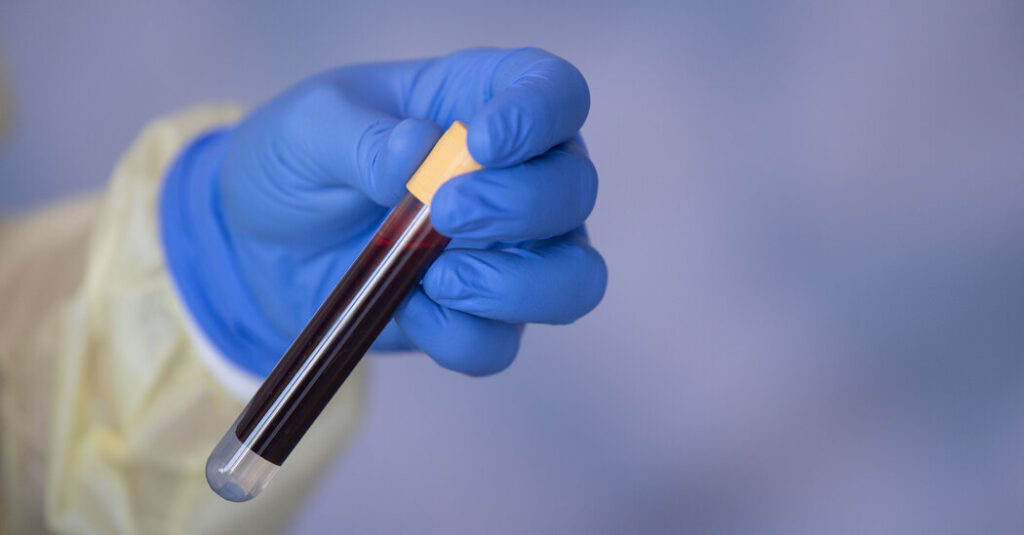
A blood test aimed at early detection of cancer failed to reduce late-stage cancers in a major clinical trial, the test’s maker, Grail, announced on Thursday.
The results cast doubt on a developing field of screening for diseases that has generated enormous hopes and investment. The goal of the blood tests is to save and extend lives by detecting cancers when they can be more easily and successfully treated.
Grail’s blood test was even briefly featured in a Super Bowl advertisement this month.
Grail’s test, known as Galleri, looks for minuscule shards of cancer DNA in the blood and for more than 50 types of cancer, according to the company.
It has been sold in the United States since 2021 and costs $949. Even though it is not yet approved by the Food and Drug Administration, the company sells it under a regulatory loophole that permits sales of certain tests without review. Very few insurers cover the test, so most people pay for it out of pocket. Grail has sold nearly half a million of the tests so far, including more than 185,000 last year.
The company lobbied heavily for the U.S. government to cover the test under Medicare. The spending package passed by Congress and signed into law by President Trump earlier this month authorized Medicare to cover cancer detection tests, and Galleri could be among those that qualify to receive the government’s approval.
Grail, which has its headquarters in Silicon Valley, announced the results of the study in a news release. The company plans to present more detailed results from the study at a cancer conference in the spring.
Cancer researchers had been closely watching the Grail study, which the company ran in partnership with the National Health Service of Britain. The study’s size and design promised to rigorously help answer the question of whether such tests were effective at catching cancer early.
The study enrolled 142,000 healthy adults ages 50 to 77 in Britain and followed them over three years. People had their blood drawn three times, each spaced about a year apart. One group of participants’ blood samples were run through the Galleri test, and those people were referred for medical care if they tested positive.
The company compared the group that underwent Galleri screening with another group that didn’t get the test.
Recipients of the Galleri test did not show a significant reduction in the cancers diagnosed at Stage 3, when the disease would have grown or spread near its original site, or Stage 4, when the cancer would have spread to other parts of the body, according to the company.
In a call with analysts on Thursday, Grail executives said they were encouraged by other findings that were not the primary goal of the study, citing a decrease in Stage 4 cancers as one promising result.
“It’s absolutely right to say we didn’t hit the primary endpoint,” Harpal Kumar, Grail’s chief scientific officer, said. “But what we did see was a very compelling clinical benefit here.”
Standard screening tests are commonly used to detect cancer of the breast, colon, cervix and prostate. But most people who die from cancer had types for which there aren’t routine tests, which is why there were such high hopes for tests like Galleri.
But diagnosing cancer sooner does not always mean people live longer. And because the tests can sometimes fail to detect cancers, there is a risk that people given the all-clear may be lulled into a false sense of security and skip their regular mammogram or colonoscopy.
The new law authorizing Medicare coverage of such cancer tests creates a path for test makers like Grail to receive coverage; Galleri is not automatically covered. Grail has also applied for F.D.A. approval for the Galleri test, which if granted could open the door for more insurance coverage. But the failed trial in Britain could sour regulators’ view of the test.
Rebecca Robbins is a Times reporter covering the pharmaceutical industry. She has been reporting on health and medicine since 2015.
The post Grail’s Cancer Detection Test Fails in Major Study appeared first on New York Times.