Seven months after my sister died, my husband asked for a divorce.
“I’ve been unhappy for years,” he said. “You’re unhappy too.”
“My sister just died,” I wanted to say. Instead I pleaded with him not to leave. I promised to change.
For the next few months I tried to be a good wife. I didn’t know what that looked like. We had been together for over 19 years. From the moment we met, what I liked most about him was that around him I didn’t have to pretend to be another person. Now I became careful and polite, a smooth-edged version of myself that I hoped he would find agreeable. I taught at a new university. I woke up every day at 3 a.m. to write a novel about 19th-century travelers to Tibet, my fingers tapping the keyboard gently so that its clicks wouldn’t wake him up in the room next door. I sent him photos of the immense stuffed ducks people carried on the Tube, or the impractical feather-trimmed sneakers men wore in winter. He was cold and distant. I didn’t complain. My complaining was what had brought us to this point. I was on probation, both at my new workplace and at home.
At the end of a year, it seemed I would continue to hold down my job. But while I was still legally married to my husband, it was clear that he no longer saw me as his wife.
Pilgrimage Into Thin Air
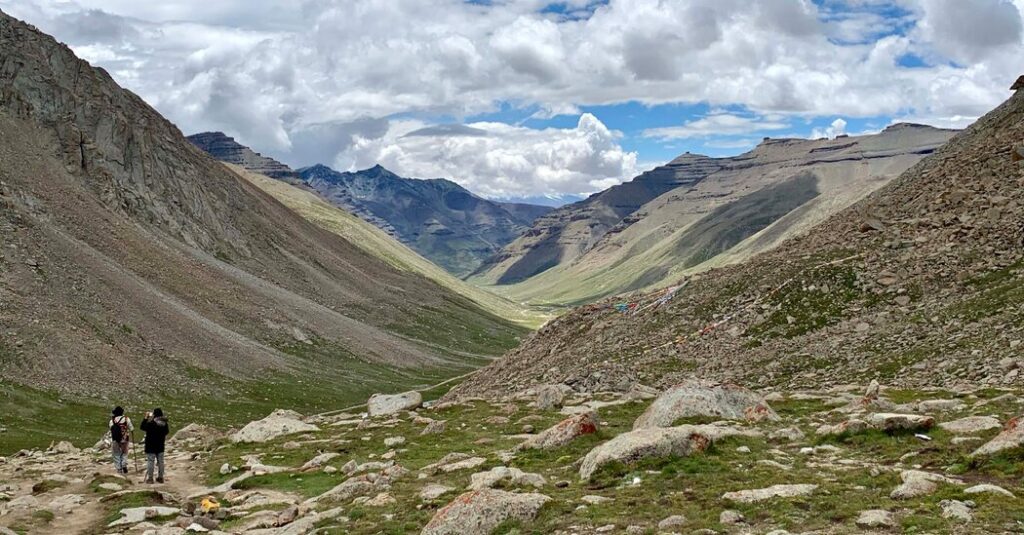
One morning in August 2023, on what would have been our 20th wedding anniversary, I stood on an incline leading up to the 18,471-foot Dolma Pass in Tibet. The pass is on the trail that loops around Mount Kailash, a sacred site for Hindus, Buddhists, Jains and those belonging to the pre-Buddhist Bon religion. The 32-mile trek takes three days on foot, or three weeks if you prostrate at every step, as many Tibetans do. The Tibetans call the circumambulation of the mountain the kora, an act they believe cleanses us of sin and brings us closer to nirvana, an end to the cycle of birth and rebirth.
I was doing the kora as part of a tour with a fixed itinerary — the only way to travel around Tibet, where China prohibits foreigners from traveling independently — but I didn’t know where the other members of my group were now. The previous night, at a guesthouse where we were resting after the first day of the trek, our Tibetan guide had advised me to hire a pony to ride to the highest point of the pass. Indians aren’t great at trekking, he said. This was yet another cliché in his brief list of stereotypes about Indians (apparently also prone to laziness and tardiness) whose veracity he seemed to hope I would confirm.
Though a pony would have made my journey easier, I refused to hire one. Decades ago in Manali, on the other side of the Tibetan Himalaya, I had relied on a pony to carry me up a steep slope to avoid the traffic jam on the highway to Leh, then had clung to the poor animal as gravity beckoned me toward the abyss.
Now, I watched ponies ferry pilgrims up the pass, my legs and lungs hurting as if I had been running a marathon. In the thin air, my breathing sounded louder than the wind. A marmot the size of a teddy bear stood on a rock, observing pilgrims trudge up the incline with oxygen cans and trekking poles. Chunks of ice skittered down the mountains around us and exploded like fireworks.
I managed to ascend five steps, then stopped again. Tibetan women, some of whom had toddlers strapped to their backs, smiled at me as they passed, lifting their hands to their chest and greeting me with tashi delek, a phrase that means hello or welcome or good luck or “may you be successful.” Tashi delek, I said, the words extracting the last of the air out of my lungs. I watched their fluid movements with envy, looking around for the young porter I had hired to carry my rucksack. He was nowhere to be found. He must be descending already, his eyes pinned to the videos he played aloud on his phone, driving everyone crazy.
The distinct, snow-coated peak of Mount Kailash had been visible for most of our trek the previous day, when we walked past a sky-burial site and an icy blue stream over which flickered the shadows of jagged ridges. But now, on the second day of the trail, the sacred mountain had vanished behind slopes and mist.
The guide came down to look for his wallet, which he had inadvertently left behind during a break. He located it easily, saw me and stopped to chat. He told me about Indian pilgrims who couldn’t breathe in the high altitude, but claimed it would be their good fortune to die next to Mount Kailash, the home of the Hindu god Shiva. I remembered that for a while my sister had almost obsessively collected figurines of Shiva’s son Ganpati, the god popularly described as the remover of obstacles. The guide gave me a white oxygen can. He showed me the altitude on his watch. Almost there, he said, encouragingly. We were already above 18,000 feet.
After the guide left, I inhaled a puff of oxygen and felt I could breathe again. I thought about the characters in my novel ascending mountains without these devices. In the 19th century they didn’t even have footwear with the grip of my expensive trekking shoes, which kept me upright despite my clumsiness. I fortified myself with another hit from the oxygen can and managed to trek up, heart flapping like an insect against my ribs.
Near the summit, on a tall boulder, pilgrims pasted photos of loved ones who had died, in the hope that their souls would find deliverance. I wished I had a photo of my sister to leave behind, within shouting distance of the home of her favorite god.
“Are you from India?” a young Chinese man asked me in English.
I nodded.
“How did you get a visa?” he asked. “The Chinese government is not issuing visas to Indians right now.”
“I have a British passport,” I said. It was an effort to speak. I couldn’t believe someone was asking me about my documents at this altitude.
“Ah, that’s how,” he said, looking satisfied. “Have a good trip.”
Learning to Say ‘Separated’
Along the summit, a narrow path led between rocks draped with hundreds of prayer flags. People sat on the rocks, eating out of plastic bags or drinking water or tea, small birds pecking at the trash heaped by their feet.
The guide was waiting by the steep steps that led down the pass. He congratulated me on my determination. This, too, was an Indian trait, he said.
A turquoise body of water, the Gauri Kund, sparkled below. Hindus believe Parvati, Shiva’s wife, created their son Ganpati here. In the early-morning darkness, before we set off, the porter had offered to scoot down on our way back and collect a bottle of the sacred water for me to take home, but I had said no. Only my sister would have appreciated such a gift.
The guide asked about my life in India and England. Perhaps it was the lack of oxygen, but I told him that it was my 20th wedding anniversary, except that my husband and I were separated. I hadn’t been able to say these words even to my family.
When my parents sent me a message that morning saying “Happy Wedding Anniversary!” I wrote back: “Thank you.”
Now the guide listened quietly as I spoke about my sister’s illness, the flights I had taken from England to India, sometimes at a day’s notice when she had a seizure or slipped into a coma and was rushed by ambulance to a hospital two hours away. Somehow she had stayed alive for four years after the doctors diagnosed her with Stage 4 cancer. In that time the tumors in her lungs had spread to her brain, erasing her memories, such that she repeated again and again, “I don’t remember, I don’t remember.” Even then, a day before her death, when she had lost the ability to speak, tears slipped down her cheeks as she held her son’s hand.
The guide spoke about suffering, his vocabulary recognizable to me from the books on Buddhist philosophy I had read, partly as research for my novel and partly in the hope that I would learn to practice detachment. I wasn’t good at it. The world was unfair, and I was angry and sad.
“Your husband must have been unhappy,” the guide said. “Maybe he felt you didn’t care for him. Maybe you spent too much money on your sister.”
I wondered if I could ever forgive myself. It was inexplicable to me that I was alive when my sister, who was younger than me, was dead.
“And your husband,” the guide continued. “He had a purpose in your life, and now that purpose has been fulfilled. This is what you have to accept.”
His words sounded plain and severe, but carried the same gentleness with which he placed a stone atop a cairn so as not to disturb its delicate form.
The guide told me I should thank my husband for spending 20 years of his life with me, then let him go.
“He is free,” the guide said. “So are you.”
Braving the Wind
We stopped at a teahouse, where I bought instant noodles for the guide and the young porter, who was waiting nearby, scrolling on his phone. The porter shared strips of dried yak meat that he had brought from home. I left him with the guide and decided to head to the guesthouse, aware they could catch up with me in seconds.
Clouds darkened the evening sky, and a furious wind tumbled down the slopes on either side of the path. A group of Tibetan monks sat by a boulder, eating leisurely as if they were at a picnic. Marmots fattened by the scraps pilgrims must have fed them came up to the path, unafraid of humans. For a while I stood with Chinese tourists who took videos of the animals. The wind rose in sound and speed.
I pulled down the hood of my jacket and walked as quickly as I could. My legs were tired, but I was breathing more easily. The landscape, steeped in danger and beauty and sacredness, made me think of the guide’s words. I wondered why it hadn’t occurred to me earlier, to be grateful for the time I did have with my husband, and my sister.
Before my journey, I had complained to a friend about white writers who spent a few weeks in Tibet, or India, then wrote best-selling books about finding themselves in these faraway, exotic lands where the natives were always humble and wise, and dispensed life-changing advice as they marched up a mountain, hauling the visitor’s luggage and rations on their stooping backs. I realized I was perilously close to casting the guide’s words as wisdom. I arrived at the guesthouse in the dark, rain dripping down my clothes.
“You made it,” someone in the group said. “Amazing.”
Close to the Gods
On the last day of the kora, I walked alone for much of the way, past rocks carved with Tibetan prayers, and signs saying “Cliff road caution falling.” Small birds flew out of what looked like burrows in the rocky inclines. There were no trees this high and I imagined these birds must make their nests in the holes. Pikas ran around my feet. I realized this was the closest I had come to feeling happy been in the six years since my sister’s cancer diagnosis. At these heights, in the proximity of my sister’s gods, it seemed I could forgive myself for my failures as a wife and a sister. In the state of anxiety in which I had spent the previous year, contorting myself so that my husband would find me lovable again, I had forgotten to acknowledge that whatever my flaws were — and my husband had pointed out many — they didn’t make me despicable, only human. Now, watching Tibetan pilgrims raise their hands to the skies, praying for everyone on earth, I felt atonement wasn’t an impossibility.
I caught up with two others in my tour group, and we walked to the hotel together. I said I was most looking forward to a shower. At the reception I learned there wouldn’t be hot water for another three or four hours, and the water in the taps was freezing cold. I paid my porter. Then, still unwashed, I went with the group to find a late lunch in town.
Deepa Anappara’s second novel, “The Last of Earth,” set in Tibet, was published in January.
Follow New York Times Travel on Instagram and sign up for our Travel Dispatch newsletter to get expert tips on traveling smarter and inspiration for your next vacation. Dreaming up a future getaway or just armchair traveling? Check out our 52 Places to Go in 2026.
The post Short of Breath, but Finding Peace, at 18,000 Feet appeared first on New York Times.