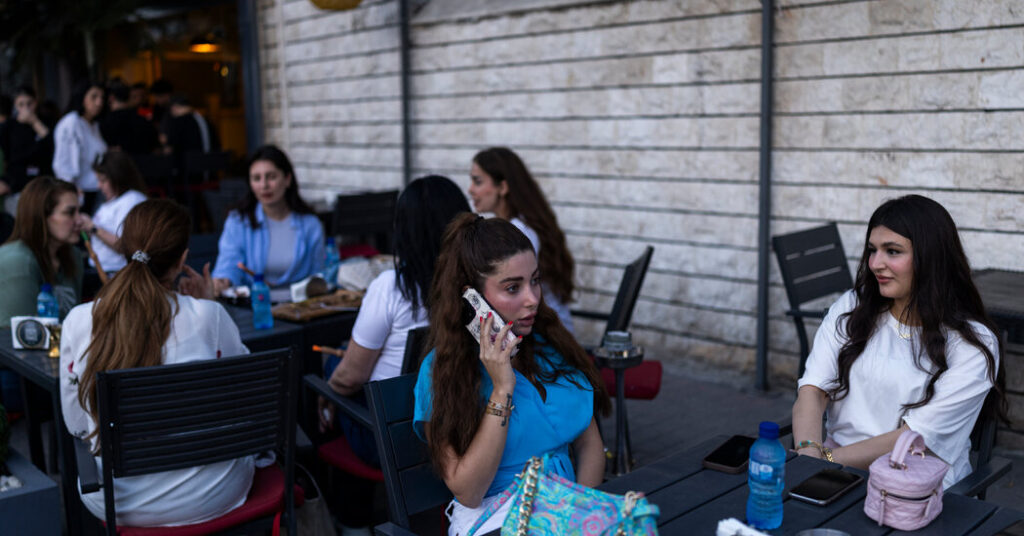
Almost as soon as an edict came out barring all female government employees in one Syrian province from wearing makeup, so too did the memes.
They mocked the genetic curse of facial hair among Syrian women, saying they would now be indistinguishable from their male colleagues.
Sultana Fawaz, a Syrian influencer, jokingly suggested that between the makeup ban and power cuts that have rendered women unable to style their hair, it was a plot by the government — led by conservative Muslims — to get women to cover their hair and faces.
“Makeup is a red line,” Ms. Fawaz said with a chuckle in a video posted on social media. “Men should come out in protest, not women.”
Joking aside, the decision by the governor of Latakia province struck fear among Syrians who are wary of the national government dominated by Islamist former rebels.
Women in particular have wondered whether the central government would eventually try to institute religious laws in a country with a diverse array of religious and ethnic minorities.
The Latakia governor, Muhammad Othman, decreed last month that female employees in state and local administrations and institutions in the province, including schools, should refrain from wearing makeup during official working hours or face “legal accountability.”
Around the same time that the order came out, a local government in a suburb of the capital, Damascus, barred men from working in women’s shops — compounding the fears among some that the country would tilt in a more conservative direction.
President Ahmed al-Sharaa has not done much to fan those fears. But there are concerns about the actions of individuals within the government, whether it’s changing school curriculums or security officers confiscating musical instruments or alcohol at the border. Mr. Othman, the Latakia governor, was appointed by the central government.
Some have also questioned the timing and prioritization of seemingly trivial matters when Syria is still in the midst of tremendous political change, economic suffering and formidable security challenges.
“Honestly, we really thought it was a joke because we’re not used to such a decision,” said Lina Ismael, 48, a media coordinator in the health department in Latakia, a province along Syria’s Mediterranean coast.
Like others interviewed, she viewed makeup as a matter of personal freedom but favored reasonable limits on heavy makeup.
Margarite Jamal, a lawyer in Latakia who spends much of her time at the courthouse, said she welcomed the decision, seeing it as an attempt to professionalize the appearance of civil sector employees.
“Frankly, in the last 10 years, professional standards have declined significantly,” she said. “Many working women now go to work dressed the same way they would to a wedding, which is completely unacceptable and gives a baffling impression of working women.”
A 41-year-old journalist who works for Syrian state television said she didn’t believe the decision when she first heard it. The woman, who asked not to be identified for fear of professional repercussions, said she herself sometimes wears makeup to work and other times will come with messy hair and an unwashed face, depending on her mood.
She rejected the governor’s edict as a matter of personal freedom and a violation of women’s rights. After widespread condemnation of the decision, the journalist said she didn’t expect it to be strictly enforced.
Weeks after the order was announced, several women interviewed said the ban was not yet being enforced. It remains unclear when or how it will be implemented and whether it will face legal challenges.
The Latakia governor declined repeated requests for an interview, but in a follow-up statement, his office sought to calm reaction to his decision. The edict “does not aim to restrict any group or infringe upon personal freedoms, which are safeguarded by the constitutional declaration and protected by law,” it said.
The governor’s statement said the decision was about regulating professional appearance and avoiding excessive use of makeup in government and public sector jobs.
There are a number of problems with the decision, said Dima Moussa, a lawyer, politician and feminist activist. For one, the law and constitution prohibit discrimination based on gender and the ban also infringes on personal freedoms, she said.
More pressing for many Syrians was the political backdrop against which the decision was made. A ban on makeup is “viewed through the lens of the background of those making these decisions,” Ms. Moussa said.
“Until now there is nothing that shows that their intent is to make the country Islamic,” she said of the government. “But there is always fear,” she added. “The good thing is that when decisions like this are made, the reaction, time and again, shows them that the Syrian people don’t accept this,” Ms. Moussa said.
Even though Syrians generally are socially conservative, no matter their religion, they still reject such restrictions, she added.
“People don’t want anyone to restrict their freedoms, tell them what to wear or not to wear, tell them how they should look, tell them if they can drink alcohol or not,” she said.
Reham Mourshed, Dayana Iwaza and Muhammad Haj Kadour contributed reporting.
Raja Abdulrahim reports on the Middle East and is based in Jerusalem.
The post A Ban on Makeup in Syria Has Some Red in the Face appeared first on New York Times.