The number of hats that Tyra Banks wore during her time on “America’s Next Top Model” could make any woman topple over on the runway.
She was one of the show’s creators, executive producers and judges. She was a celebrity host, a big-sister-style mentor to a cast of aspiring models and an overall doyenne of commercial fashion who was a brand unto herself.
But in a new three-part documentary treatment of the series, titled “Reality Check: Inside America’s Next Top Model,” Banks is treated like any other interview subject, confronted with the show’s checkered legacy of triumphs and controversies.
She was given no approval power over the documentary, no questions in advance and no compensation, two of the series’s executive producers said. Banks wasn’t able to watch the docuseries until the broader public could: on Monday, when it began streaming on Netflix.
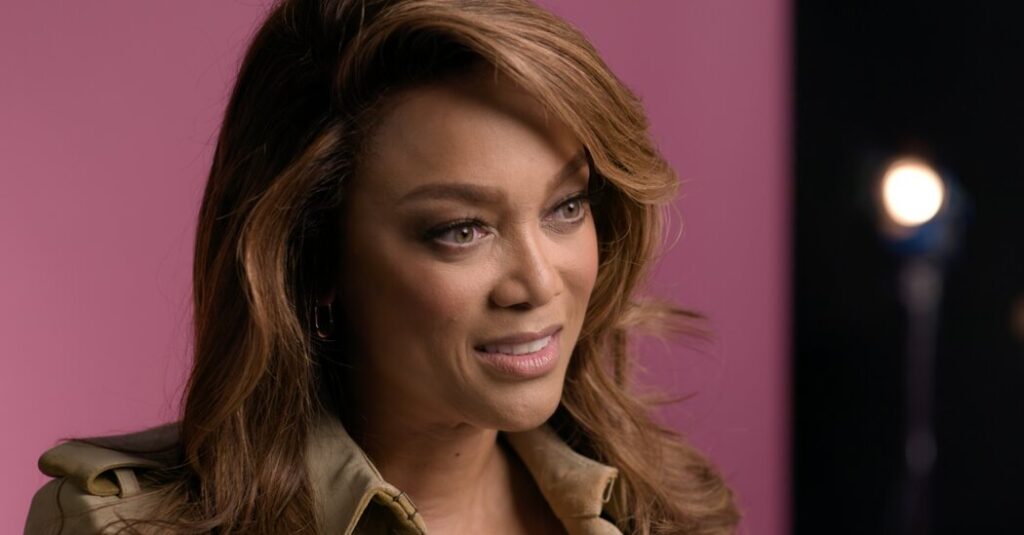
The arrangement (or lack thereof) is something of a coup in a field crowded with celebrity documentaries in which stars trade access for control, often as executive producers. The documentary is also a study of a public figure seeking to protect her own legacy. Styled in a trench coat and made up by a glam squad, Banks expresses a careful mixture of regret and justification as she is confronted with the perspectives of contestants who say the show left them feeling torn down or humiliated.
For Banks, 52, who had watched as a surge of interest in the show during the pandemic led to an internet pile-on, the decision to participate was no doubt a calculation. The mostly negative public reception that her appearance has thus far elicited, however, isn’t likely to inspire other embattled celebrities to race to the interview chair. (A personal representative declined to make her available to answer questions about the series.)
“It’s a shame that she wasn’t willing to be a little more vulnerable in this documentary,” Jay Manuel, a longtime on-camera personality and creative director on “Top Model,” said in a video interview last week. “Because what I saw was Television Tyra.’”
That’s not to say winning viewers’ sympathy was an easy task. Her commentary competes with an abundance of cringe-worthy clips and the accounts of former contestants — women who were, in effect, swallowed up by the mid-2000s reality TV machine.
There were photo shoots, for example, in which contestants were asked to pose as people who were homeless, bulimic, drug-addicted and victims of violent crime. They were asked to adopt different races or ethnicities — “Brittany, you are going to be Native American and East Indian!” — some of them in blackface or brownface.
“I was in my own little bubble, in my own little head,” Banks says in the docuseries of the race-swapping stunt. “And this was my way of showing the world that brown and Black is beautiful.”
And the former contestants describe the psychological toll of having their bodies harshly scrutinized on television. One, Dani Evans, was pressured into getting dental work to narrow the gap between her front teeth.
She objected repeatedly, then relented. The camera followed her to the dental chair, of course.
“Hindsight is 20/20 for all of us,” Banks says. “It just so happens that a lot of the things that are 20/20 for me happened in front of the world.”
Before this documentary, currently the most popular series on Netflix, Banks had said little about the recent cultural reassessment of the show. Confronted with a parade of the show’s faux pas, Banks can be frank. This was pre-2020 reality television, and it’s not as if the modeling industry was ever known for its gentle, progressive nature.
Banks’s most compelling moments are when she recalls the advent of the show, which she dreamed up as a 20-something supermodel who wanted to upend the traditional biases of an industry she had entered as a teen.
“What if I created a show where you saw what it took to become a model?” Banks says of the series, which premiered in 2003. “And for this show to represent not all white, not all skinny, but just showing all the differences and all the different types of beauties.”
Banks brought in her makeup artist, Manuel, and her runway coach, J. Alexander, with her onto the show, turning them into a famous duo (known as “the Jays”) who at the time were part of a breakthrough for mainstream depictions of gay men and women on television.
Yet, there was often an apparent clash of values: The show preached inclusivity but could also lean into intolerance — one source of onscreen conflict that fed the reality TV machine.
“Ebony’s a lesbian, and I find this offensive,” one Season 1 contestant said of another.
They allowed “plus-size” contestants but didn’t shy away from judgment: “If the body could just slim down 150 pounds, that would be good,” Janice Dickinson, one of the show’s judges, said of one aspiring model. Banks pushed back, saying, “Then she’d be 30 pounds.”
But the documentary makes the point that Banks, who has been outspoken against harsh judgment of women’s bodies, could be harsh herself.
“As much as I hate and preach about models not having to be stick-skinny, we have to face it that we are in the fashion industry,” Banks told one contestant on the show, “If you don’t fit the clothes, you don’t work.”
In recent years, the show, which ended in 2018 after 24 seasons, has become a bundle of controversies wrapped in millennial nostalgia. Naturally, the documentary filmmakers were circling.
Manuel said he had been approached at least twice a year about participating in a documentary. But he always said no, fearing it would amount to a takedown of the show or of Banks herself. (Manuel was cut from the show in 2012, along with Alexander and Nigel Barker, a longtime judge and photographer, in an effort by the network, the CW, to boost ratings.)
“I don’t believe in takedown culture,” Manuel said. “And I certainly do not believe that Tyra should be vilified.”
But after sitting down for tea with one of the documentary’s executive producers, Manuel said, he determined that the documentary seemed willing to look honestly at the flaws of “Top Model” but also to celebrate it.
Alexander, who has spent the past three years recovering from a stroke, also agreed to be interviewed, as did Barker. With Netflix already onboard, the producers approached Banks. They went back and forth with Banks’s representatives over a period of weeks, agreeing that she would sit for about an hour, the executive producers Jason Beekman and Jon Adler said. It went on for roughly four.
One of the documentary’s more emotional sections revisits the story of Shandi Sullivan, who was 21 when she was plucked from her job as a Walgreens clerk in Kansas City, Mo., to compete on the show for a modeling contract with a top agency.
Part of the season — known as Cycle 2 in “Top Model” parlance — filmed in Italy, where the contestants spent a night drinking wine with locals. Sullivan recalls in the Netflix series being blackout drunk as the film crew recorded her in bed with one of the men.
Cameras later captured her weeping with regret and inconsolable as she confessed to her boyfriend over the phone. The episode, titled “The Girl Who Cheated,” led to strangers calling her vulgar names when they recognized her on the street, Sullivan says in the documentary.
“It does bring up that whole question of when do you just put down the cameras and just be a human being to another human being,” Sullivan said last week in a video call.
Asked in the documentary about the incident, Banks replies that production was “not my territory.” One of the show’s executive producers, Ken Mok, defends the show’s handling of the situation, saying that the contestants knew the show was treated “as a documentary” and that he had “scaled back” that scene significantly.
Both Banks and Mok acknowledge that in the face of the demands for ratings, the show sometimes veered into the absurd. Contestants were outfitted in raw meat, drenched in maple syrup, lowered into a grave, and posed inside a giant bowl of Greek salad.
Banks, who now lives in Australia, seems eager to share the responsibility. In an era when “Fear Factor” and “Survivor” reigned, she says: “You guys were demanding it. The viewers wanted more and more and more.”
Perhaps unsurprisingly, many viewers did not love that answer, and some critics have questioned the sincerity of her mea culpas. (“Tyra Banks Isn’t Sorry Enough,” reads a headline in The Cut.) But it’s possible that the criticism would have been even more severe if Banks had declined the chance to say her piece.
Daniel Sivan, who directed the docuseries with Mor Loushy, argued that in any case, “in today’s culture, keeping silent is not an option.”
“People will talk trash about you online regardless of if you say anything,” he continued. “I think it was a very smart move by Tyra to come and open up and tell her side of the story.”
Julia Jacobs is an arts and culture reporter who often covers legal issues for The Times.
The post In the ‘Top Model’ Docuseries, Tyra Is No Longer In Control appeared first on New York Times.