Killing thousands of protesters last month was apparently not enough for the Islamic Republic, which followed up by arresting prominent internal critics, too. The Iranian regime wouldn’t have gone after these figures if it didn’t fear them—perhaps even as much as it fears the royalist movement that has surged around former Crown Prince Reza Pahlavi. Its sensitivity about both groups is a reminder that uniting them remains the Iranian opposition’s best move, if only activists would take it.
On January 31, the domestic oppositionists Abdollah Momeni, Mehdi Mahmoudian, and Vida Rabbani were swept up and sent to prisons in northern Iran, far from their Tehran residences. They were released on bail on February 17. Mahmoudian’s case attracted international attention because he is the Oscar-nominated screenwriter of Jafar Panahi’s 2025 film, It Was Just an Accident. All three figures were once associated with the regime’s internal movement for incremental reform; all three long ago abandoned that stance to advocate the wholesale transformation of the system instead.
Last month, the three arrested activists had joined two like-minded figures—former Deputy Interior Minister Mostafa Tajzadeh and the Nobel laureate Narges Mohammadi, both in prison—in calling for a democratic transition and free elections for a constituent assembly. In an interview with BBC Persian, Mahmoudian called on Supreme Leader Ali Khamenei to resign. Hassan Asadi Zeydabadi, a lawyer who represents Rabbani and Momeni, told me that his clients were most likely arrested because they advocated for Khamenei’s dismissal and because “the regime wants to prevent the formation of a national opposition inside the country.”
[Arash Azizi: The Islamic Republic will not last]
Iran’s regime still does have a reformist faction that functions as its loyal opposition. The reformists participate in the political system as elected representatives; they gently push some of the autocracy’s boundaries but largely defer to the authority of the supreme leader. Iran’s president, Masoud Pezeshkian, is a reformist. He owes his presidency to the active support of the Iranian Reformist Front. On February 8 or 9, that organization’s leader, Azar Mansouri, was arrested alongside several of her colleagues, including Javad Emam and Ebrahim Asgharzadeh, and detained until their release on bail on February 13 and 14. During the Women, Life, Freedom protests of 2022, regime leaders held meetings with Mansouri, ostensibly to address the people’s demands. This time, it accused her of “undermining national unity” and “coordinating with enemy propaganda.”
The Islamic Republic has the jitters. Anahita Hosseini-Lewis, an expert on Iran at Birkbeck, University of London, told me that the system is suffering from an “acute existential anxiety.” In part, that’s because the imperative to replace the Islamic Republic has become something close to a consensus across the Iranian opposition, and the regime’s operatives know it. Last month, a number of regime critics inside the country, including Mansouri and other reformists, embraced an initiative called the National Assembly for the Salvation of Iran, which planned to set forth a charter of demands for fundamental change. The initiative had hardly gotten off the ground but was likely the catalyst for the arrests, a source close to the reformists told me, speaking on condition of anonymity for fear of reprisal.
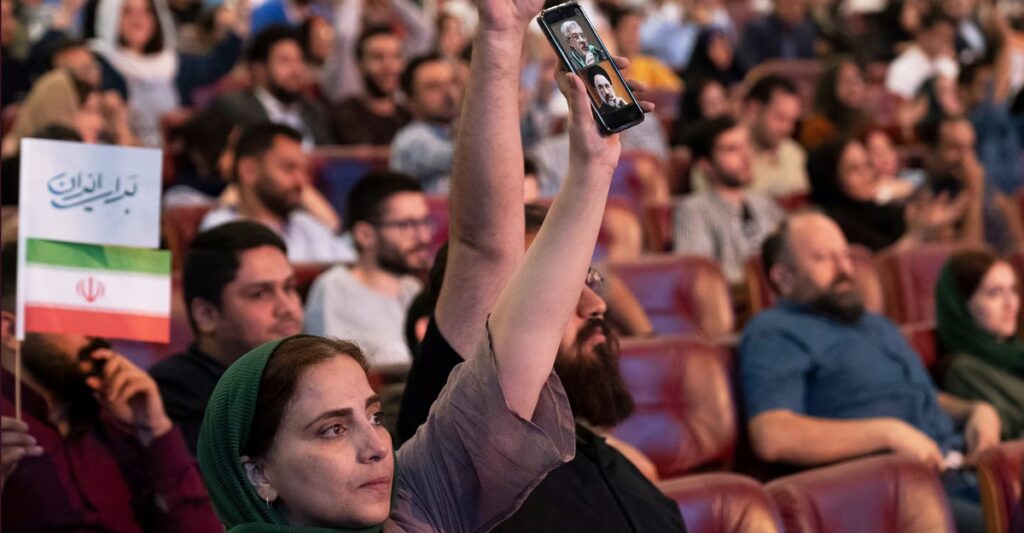
As Hosseini-Lewis pointed out, the Islamic Republic has a “long-standing strategy of preventing domestically rooted alternatives from taking shape.” Its effort to stanch domestic movements and silence their leaders has been successful enough that many Iranians now look abroad, to Pahlavi, the exiled son of the former shah of Iran, who hasn’t been to Iran since 1978. But some inside Iran worry both that the royalist movement has become brittle and non-inclusive, and that the former crown prince lacks experience inside the country.
Mohammad Karim Asayesh, an urban activist in Tehran, told me that he knows Momeni, Mahmoudian, and Rabbani, and prefers them to exiled leaders such as Pahlavi, whom he considers inept and undemocratic.
“Unlike Pahlavi, these three have a history of activism inside the country and they’ve paid a price for it,” he said. “They’ve harbored an ethical and responsible politics, have remained patriotic. And the fact that they are living in Iran means that they are more attuned to the realities of the Iranian people compared to Pahlavi, who hasn’t lived in Iran since he was 18.”
The three arrested figures are also all in their 40s, which makes them significantly younger than most Iranian political eminences and more connected to the country’s youth.
The filmmaker Jafar Panahi told me that he got to know Mahmoudian when they were in Tehran’s Evin Prison together, and that he particularly admired the sense of responsibility Mahmoudian showed toward others in captivity. The screenwriter has already spent nine years of his life behind bars and is “a rare ethical witness,” Panahi said.
But Hosseini-Lewis cautioned me that the three former reformists don’t “currently function as a viable anti-regime leadership, either individually or collectively.” An activist in Tehran, who asked that I withhold her name for safety reasons, told me of Momeni, Rabbani, and Mahmoudian, “Their courage is admirable, and they’ve taken the right positions. But the regime has created mistrust toward everybody, and their reformist pasts limit their prospects.”
Iran’s opposition spans a wide gamut—reformist, republican, and monarchist; domestic and international. Forging a broad coalition across these tendencies seems like an obvious necessity but has so far proved elusive. Amir Hossein Ganjbakhsh, a political activist based in the United States, advocates for bringing Pahlavi’s supporters together with those of Mirhossein Mousavi, the former prime minister who became the symbolic leader of the Green Movement and has languished under house arrest since 2011. Mousavi started out an ardent Islamist, became a reformist, and has called for a democratic transition since 2023.
[Nancy A. Youssef and Vivian Salama: Why the U.S. hasn’t yet struck Iran]
“These two men matter symbolically, as two ends of a spectrum, the two sides of the 1979 revolution,” Ganjbakhsh told me. “But the coalition can also include everybody in between. Without losing our historical identities, we can join up together.” Even Mansouri and her colleagues in the Iranian Reformist Front could be part of this, Ganjbakhsh suggested, given that they have shown sympathy for the protesters and have paid for it with the charges against them.
The arrests of domestic political figures coincided with sensitive diplomatic talks between Iran and the United States. Hard-liners may have worried that a deal would change the balance of factional forces inside the regime, and so sought to shore up their internal position by arresting their rivals. Mahmoud Sadeghi, a reformist former member of Parliament, went so far as to call the arrests a “pseudo-coup” in a post on X.
Surely Iran’s domestic and exiled opposition would rather participate in shaping the country’s fate than have it decided between the regime, with its many factions, and Iran’s foreign adversaries. But if the opposition is to play any role, it will have to get its act together and unite.
The post Don’t Discount Iran’s Internal Opposition appeared first on The Atlantic.