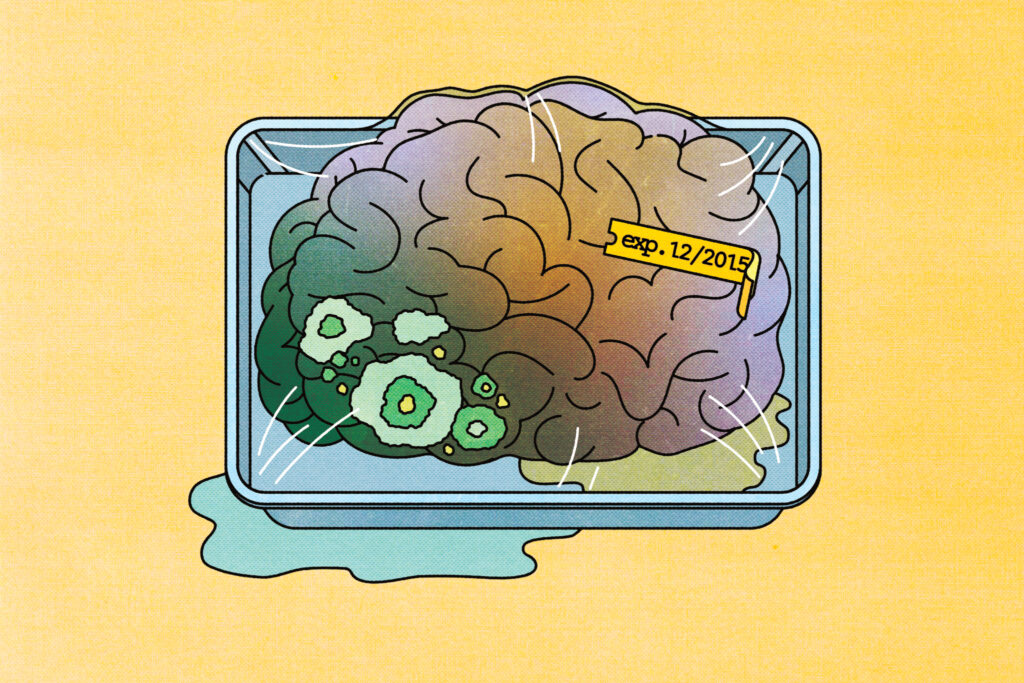
If you don’t know the term “brain rot” by now, congratulations! You probably don’t have it.
It’s slang to describe the idea that being “very online” is harming our brains. It also describes the feeling of coming up for air after spending too many hours scrolling through low-quality social media content — or to describe the content itself. Brain rot can be a noun, a verb or even an adjective, depending on how “brain-rotted” you are.
“There’s a kernel of important truth in what sounds like a silly term,” said Catherine Price, author of the “How to Break Up With Your Phone.”
But are smartphones actually rotting our brains?
We are all distracted
Price said she has heard from thousands of people since her book published who are struggling to focus. People who used to love reading find themselves unable to finish a book — she argues, because our smartphones have exacerbated our inclination to be easily distracted.
“I think that accounts for a lot of the stress and exhaustion that many people experience these days,” Price said.
Research suggests that scrolling through short videos on TikTok, Instagram or YouTube Shorts is affecting our attention, memory and mental health. A recent meta-analysis of the scientific literature found that increased use of short-form video was linked with poorer cognition and increased anxiety.
Our brains are naturally distractible — and for good reason. If you’re reading a book and hear a loud noise, you are wired to look up and investigate. Was that a car backfiring? A gunshot?
The problem with constant interruptions, whether via phone notifications or frequent switching from topic to topic as we scroll, is that it fragments our attention, making it harder to stay focused for longer.
“So then, for example, even if you’re sitting in front of a YouTube video that’s a 20-minute tutorial, you’re going to be uncomfortable,” said Nataliya Kos’myna, a research scientist at MIT. “Because it’s just longer, and it needs more of your attention.”
Long-term implications
The question of whether there are long-term implications for our brains, though, is more complicated.
“We do know that there are certain parts of the brain, certain connections between regions of the brains, that look like they are differentiated in people who are online more, who spend more time on social media, who are more attached to their phones,” said Jason Chein, a professor of psychology and neuroscience at Temple University.
But, he adds, correlation is not causation. It could be that people who are more easily distracted are drawn to use their phones more, he said.
In a 2025 studypublished in the journal Translational Psychiatry, researchers looked at longitudinal data from more than 7,000 children across the country and found that more screen use was associated with reduced cortical thickness in certain areas of the brain. The cortex, which is the outer layer that sits on top of our more primitive brain structures, allows for higher-level thinking, memory and decision-making.
“We really need it for things like inhibitory control or not being so impulsive,” said Mitch Prinstein, a senior science adviser to the American Psychological Association and professor of psychology and neuroscience at the University of North Carolina at Chapel Hill, who was not involved in the study.
The cortex is also important for controlling addictive behaviors.
“Those seem to be the areas being affected by the reduced cortical thickness,” he said, explaining that impulsivity can prompt us to seek dopamine hits from social media. In the study, more screen time was also associated with more attention-deficit/hyperactivity disorder (ADHD) symptoms.
Another important factor is that more screen time usually means nighttime use.
“The number-one reason why kids are not getting the recommended eight hours of sleep a night is that they’re using screens too much. They’re often using them in bed,” Prinstein said.
Over time, not getting enough sleep, especially in adolescence, reduces the white matter in the brain. White matter is a fatty substance that coats neurons and accelerates brain signals — and it undergoes significant growth in adolescence, he said.
“That’s a huge part of why we can engage in much more sophisticated adultlike thinking,” said Prinstein. “So an interesting study showed that across every single measure of cognitive functioning, whether it was impulsivity or reading comprehension or vocabulary, it was all lower among the highest screen users.”
But not all screen time is created equal. A recent study removed social media from kids’ devices but let them use their phones for as long as they wanted. The result? Kids spent just as long on their phones but didn’t have the same harmful effects.
“It’s what you’re doing on the screen that matters,” Prinstein said.
Your brain on AI chatbots
Kos’myna started noticing her students were using artificial-intelligence chatbots to help them complete assignments, and she was curious about how that affected student learning. She and her colleagues designed a study to find out.
Students in the study were given essay prompts. Some were able to use only their brains to answer the question, while others could use a search engine with the AI summaries turned off. A third group used an AI chatbot as much as they wanted. All students’ brain activity was recorded, and they were asked questions afterward about what they wrote.
The sample size was small — 54 students — but the results were striking.
The students who used the chatbot didn’t retain the information — most couldn’t quote from their own essays, even immediately after finishing — and their brains weren’t as active during the experiment.
“What we measured is called functional brain connectivity,” Kos’myna said. “It doesn’t measure laziness or IQ or anything of the sort, but it actually measures, in layperson terms, which regions of the brain talk to each other.”
How to make screens work for you
The good news is there are simple ways to mitigate the impact of screens and social media use on our brains. Here are some tips from the experts.
No screens in the bedroom, for anyone. Sleep is especially important for children and adolescents whose brains are still developing, but it’s essential for everyone’s physical and mental health. Devices should be charged overnight in a room far from your nightstand, Prinstein advised, adding: “Go buy an old-fashioned alarm clock.”
Make conscious decisions when using chatbots. There is always a cost to outsourcing a task. “Our brains do love shortcuts,” Kos’myna said. But if you don’t use a skill, you will lose it. There are also environmental costs and mental health concerns, as well as data privacy issues.
Moderation is your friend. “Are we choosing how much time we spend on our screens, or are the platforms influencing that choice?” Prinstein asked. Watching TikToks for 10 minutes might be relatively harmless, but if you frequently find yourself falling down a rabbit hole, it might be time to reassess your relationship with a particular app or device. The experts recommend deleting problem apps or using app blockers.
Embrace friction. Many technologies hold the promise of ease in our social interactions, work and studies. But too much ease is bad for our brains. “We need a little friction, we need a little struggle, we need a little challenge. That’s part of learning,” Prinstein said. Too much ease takes away the struggle that led humans to have such advanced abilities in the first place.
The post Is ‘brain rot’ real? How too much time online can affect your mind. appeared first on Washington Post.