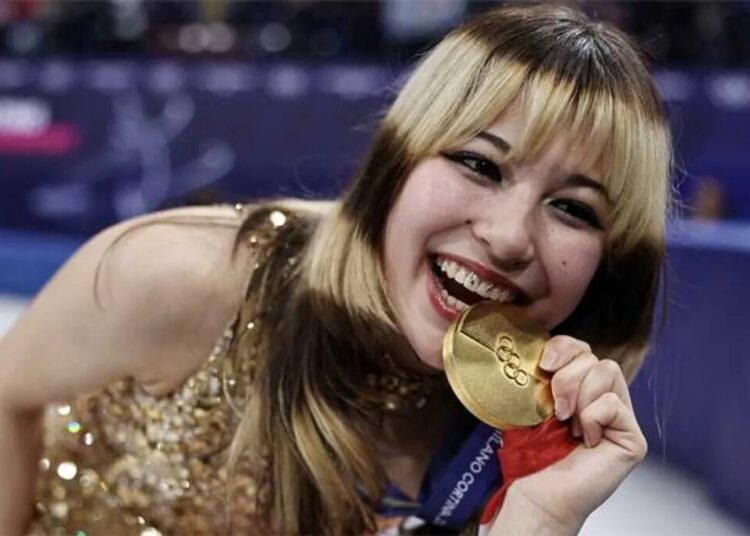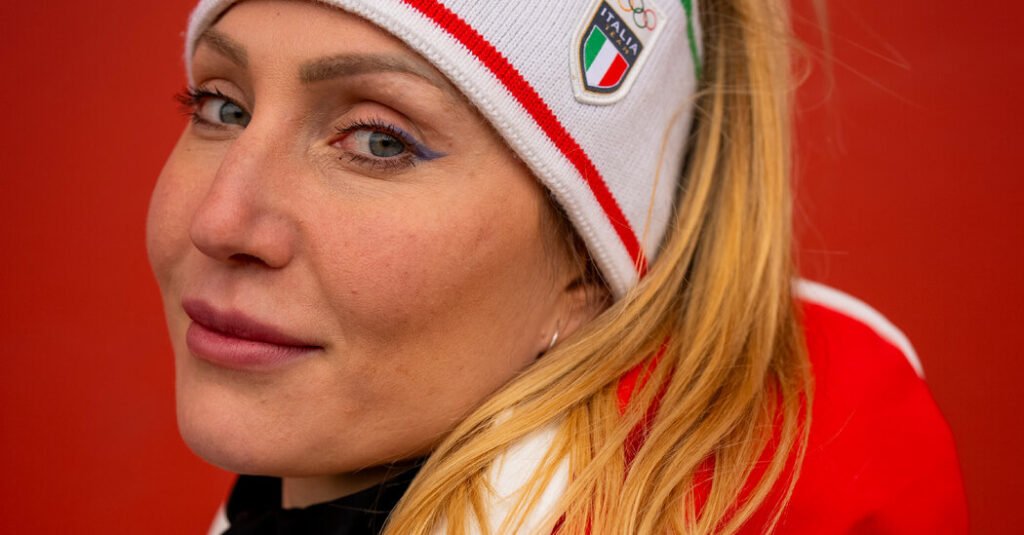
The Italian speedskater Francesca Lollobrigida had just won a gold medal and set an Olympic record — on her 35th birthday, no less — but her toddler son Tommaso stole the limelight.
Ms. Lollobrigida, holding her 2-year-old son in her arms with her gold medal slung around his neck, answered questions from reporters while Tommaso, bleating “Mamma,” grabbed her nose, batted a broadcaster’s microphone, and ripped the Team Italy headband off her head. “Wait one second, love,” Ms. Lollobrigida said, never breaking her composure.
The reaction to Ms. Lollobrigida’s breakout moment revealed the complicated landscape for Italian women who want to balance their professional and family lives.
While medal-winning Italian men who celebrated with their children attracted little attention, Ms. Lollobrigida’s multitasking went viral. Several Italian newspapers ran front page photos of her holding Tommaso, under headlines playing on the word “Mamma.” Giorgia Meloni, Italy’s first female prime minister and also a mother, joined a largely supportive chorus by praising Ms. Lollobrigida’s “Italian pride, talent, and determination.”
Amid the support, there was still plenty of criticism. Scoffing at Tommaso’s naughty behavior that threw shade at Ms. Lollobrigida’s parenting skills. Jibes at her husband for not taking control and removing his son from the scene. Even the positive reaction expressed an implicit surprise at a female champion who was also a successful parent.
“In Italy we still have the meaning that the man needs to work and the woman needs to stay home, you know?” Ms. Lollobrigida said in an interview with The New York Times.
Ms. Lollobrigida’s multitasking with her child might have felt familiar to working mothers anywhere. The reaction to it was one of several moments in the Games that showed the challenges still faced in particular by Italy’s sportswomen, who have achieved growing success and publicity at these Olympics while never shaking the chauvinism of their society.
After the Italian skier Federica Brignone won the first of two gold medals in Cortina earlier this month, her father, Daniele Brignone, told a reporter he hoped she would quit skiing and “stay home and give me two beautiful grandchildren.” A piece in Il Sole 24 Ore, Italy’s main business newspaper, described the women of Italy’s Olympic delegation — many of them in their mid 30s — as “irresistible girls” who won while “the biological clock goes faster than they do.”
Unlike Ms. Lollobrigida, most Italian female athletes retire before having children, said Francesca Vitali, an assistant professor in sports sciences at the University of Verona. “The perception is, if you are an athlete, probably you are not so good of a mother,” Ms. Vitali said.
In Italy, a lower proportion of women work than in most other European countries and earn nearly 40 percent less on average than men. Meanwhile, the birthrate has fallen to one of the lowest in Europe — in part, experts say, because of the lack of support for working mothers.
While Italy has traditionally been a family-focused culture, some of the backlash against Ms. Lollobrigida’s son during her gold medal interviews may reflect a declining tolerance for children in public places, said Letizia Mencarini, a demographer at Bocconi University in Milan. As births have declined, “we are not used to seeing children anymore,” Ms. Mencarini said.
Ms. Lollobrigida said in the interview with the Times that she hoped to challenge some of these trends. “I want to show that it’s possible” to combine professional achievement with motherhood, she said this week following practice in Milan, four days after she had won her second gold medal.
Ms. Lollobrigida came to sport early. The eldest of two daughters, she grew up outside Rome with their father, Maurizio, a onetime rollerskating champion and swim coach, and mother, Sondra Bergamini, a physical education teacher. By the time she was 14 months old, Ms. Lollobrigida was on roller skates. By the time she was 3, she was on inline skates. As a teenager, she won national, and then international, championships.
“I’ve known many boys and girls who were even better, maybe, than Francesca, but didn’t have the patience and the perseverance to keep at it,” said her father, Mr. Lollobrigida, 64. She sacrificed school trips and parties to train, often driving hours on a Friday night to get to an ice rink in the north of Italy. When classmates teased her about her legs being too big and powerful for a girl, she persisted.
During the 2006 Winter Olympics in Turin, Ms. Lollobrigida began to harbor her own Olympic ambitions. She reached out to Maurizio Marchetto, Italy’s national speed skating coach, and asked if he would help her transition from wheels to blades. She often practiced with men, but highlighted her femininity with pink stripes on her skates or manicures in bright colors. (She won her first two gold medals in Milan sporting bold green nails.)
At the Winter Games in Sochi in 2014, she placed 23rd in the 3,000 meters. Eight years later at the Beijing Games, she finally won Olympics bronze and silver medals.
After Beijing, she told her coach that she and her husband, Matteo Angeletti — who she met on the inline skating circuit — wanted to start a family. She figured that if she gave birth within a year, she could take leave and retrain in time to compete in the next Winter Olympics in her home country. “She was good at choosing her timing,” said Mr. Marchetto, her coach.
As soon as she told her parents she was pregnant, her father said, he scoured the internet for studies on women who had returned to elite sports after childbirth. Ms. Lollobrigida modified her workout during her pregnancy.
When Tommaso was 4 months old, Ms. Lollobrigida returned to full-time training. She wanted to continue to breastfeed, so Italy’s ice sports federation paid for her mother and sister to join her to care for the baby while she was away from her home outside Rome. Because Italy does not have a permanent indoor skating oval, the athletes travel as much as 250 days a year to train and compete in other countries.
“We sports people have to be an example,” said Andrea Gios, president of the federation. He said he hoped the success of athletes like Ms. Lollobrigida would “spread in our country a different culture” of support for working parents.
Once he began walking, Tommaso was enrolled in nursery school near Rome and Mr. Angeletti, 38, an electrical engineer, now swaps day care drop off and pickup duties with his mother-in-law.
Mr. Angeletti is not fazed. “I knew what I was getting myself into,” he said during an online interview with Tommaso playing with a toy helicopter in the background.
The couple had Tommaso on skates before his first birthday. Lately, though, “he says ‘no’ because he associates the skates with when I’m away,” Ms. Lollobrigida said.
After the Winter Games are over, Ms. Lollobrigida said she is done with Olympic competition. She and Mr. Angeletti want to try for a second baby. But she plans to stay involved in the sport in some capacity.
Mothers, she said, “need some space for themselves.” Working can help them recharge, she said, so they can “give 100 percent to being a mom.”
Josephine de La Bruyère contributed reporting.
Motoko Rich is the Times bureau chief in Rome, where she covers Italy, the Vatican and Greece.
The post A Toddler’s Gold Medal Moment Underscores Struggle for Italian Mothers appeared first on New York Times.