What in the world do comedy audiences want in 2026?
Clean jokes? Sexy clowns? Josh Johnson? As the dominance of the Netflix special gives way to the ascendance of YouTube, it’s become harder to sum up who is hitting it big in standup right now. In a joke from his latest special, Raanan Hershberg boils it down to two groups: manosphere types poking fun at the woke, and crowd-work comics asking audiences about their lives. “Half the comedians work for the Census Bureau,” he said, with barely hidden contempt.
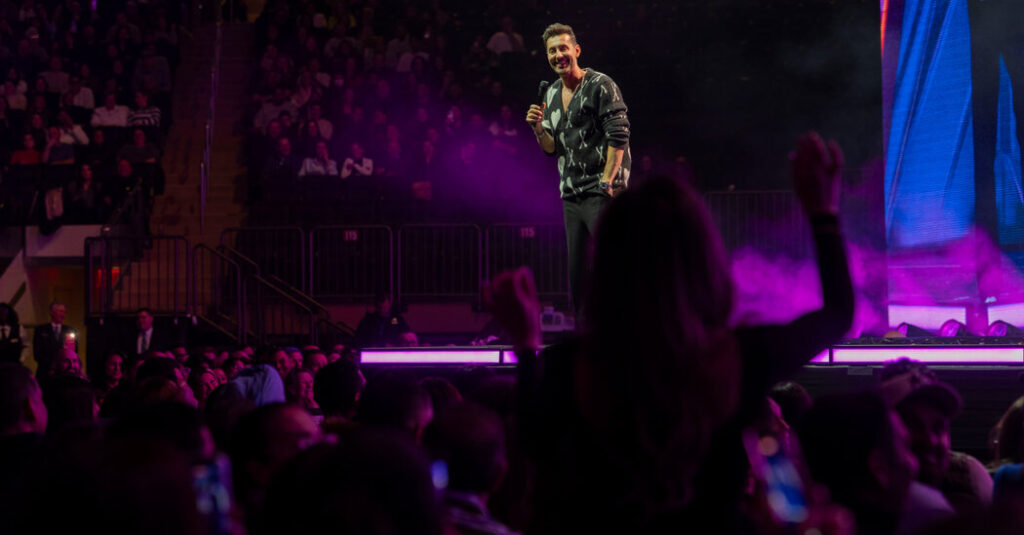
No comic in the census camp is rising faster than Max Amini, the most popular standup you probably haven’t heard of. Following the career route of Matt Rife, he has quickly built a huge audience on social media by relentlessly posting crowd-work videos. His 2025 hour, “Randomly Selected,” received 17 million views, making it the most popular new special on YouTube. In the ultimate symbol of success, Amini sold out Madison Square Garden, the first Iranian American comic to do so.
His breakthrough is oddly timed, he pointed out at the Garden on Sunday, because as he was making history, Iran had become the focus of major protests and violent crackdowns by the government. The prospect of President Trump starting a war with Iran appears more likely every day.
In recent weeks, Amini’s Instagram feed has ping-ponged between cheerful joking and sober political statements, including videos of him onstage encouraging the president to act. Right before the Madison Square Garden show, he gave an interview criticizing the Iranian government and declaring: “We need to go into that country and rescue the people kidnapped by a terrorist regime.”
If Joe Rogan could help sway an American election, should we be surprised that a crowd-work comedian is calling for regime change?
At the rambling, raucous, often downright bizarre two-hour show, Amini entered with rock-star swagger, fireballs shooting up behind him. His outfit, a plunging V-neck sweater with hearts on it, was more suited for a coffeehouse folk singer. “Where my Arabs at?” he roared. “Thank you for identifying yourself. White people, relax.”
Then he started polling members of the audience about what countries they were from. India! Egypt! Iraq! Norway! Brazil! Amini had words of love for each nation before some gentle roasting. “Lebanon has the most beautiful Arabs,” he said to a woman from there, before finding someone from Jordan and adding, mischievously: “Jordan has the ugliest ones.”
Arenas like the Garden aren’t built for crowd work. In the upper balcony, you can’t hear, let alone see, half the conversation. But this didn’t stop Amini, who made small talk with ticket-buyers for 20 straight minutes. He moved on to a few solid, prepared stories with jokes about growing up in Tucson, Ariz., and experiencing the culture clash of his teenage years in Iran. But his banal punchlines would fit into small talk at a family picnic. “My mom raised four children,” he said. “Me, my sisters and my dad.”
The Max Amini phenomenon reflects a transitional moment in an increasingly globalized comedy scene, upending two common beliefs. The first is that fans just want great jokes. Some do, but what you see from Amini is an artist less interested in putting together clever punchlines than in creating a sense of event, a warm vibe, a show that becomes a community. On Sunday when Dane Cook, an artistic antecedent as the first social media standup star, introduced Amini, he didn’t trumpet the younger comic’s funniness, but his ability to connect and unify.
Amini quietly listens to people talk for long stretches. His patience leads to dead spaces, but also a sense that things could be going off the rails. At one point, a drunk audience member hijacked the show. At another, a woman told a long story about seeing a medium that almost no one in the arena could hear. Amini got his biggest laughs mocking the audience members, calling back to them, weaving them into a story. What becomes clear is they are not just seeing the show. They are the show.
The second belief Amini challenges is that comedy doesn’t travel. Part of his success can be attributed to a relentless touring schedule (150 shows in 19 countries last year) that includes markets where standup is a younger art form. Social media allows comics easy access to a global market in a way that has shifted incentives to work that is broader and less culturally specific.
Just judging from the crowd at the Garden, his audience comes from nearly every continent, and Amini made sure that his material was accessible to them all. His subjects were universal and bland — dating, family, music — and he never went deep or specific enough to confuse anyone. His examination of Iranian culture often applied to other immigrant experiences.
The paradox was that he spent two hours talking about myriad cultures but made them all sound the same, or at least, differentiated by only the most well-worn, often retrograde stereotype.
His story about riding in a rickshaw in India hinged on the fact that citizens there work for Apple customer service. Amini favors dopey jokes about gay vs. straight guys and the kind of mild leering that could be found on “The Tonight Show” of the 1970s.
Maybe it’s more accurate to say that comedy can travel, but at a cost. When it’s aiming for laughs everywhere, it risks seeming like it’s from nowhere.
Amini’s only really challenging material came at the end of the show when he stopped joking and told the crowd that thousands of protesters had been killed in Iran and that what was happening there was “the biggest revolution in our time.” Then he showed a series of short videos of scenes of violence, protesters getting run over and attacked, as a narrator intoned: “Freedom is not a punchline.”
It’s an incongruous way to close a comedy show, especially because it came right after Amini brought audience members onstage and asked them, for reasons I still don’t understand, to compete in a push-up contest. Like a social media scroll, solemn tragedy and silly nonsense sat side by side.
Both also merged in the opening act, the most catastrophic bomb I have ever seen in an arena show. Wearing a pink suit and a goatee, Rob Schneider ran into trouble early with gibes about crime in New York and the current mayor that might have killed on “Gutfeld!” but just received a few chuckles. Then a long joke about the pool boy for Savannah Guthrie’s mother earned groans.
The look on Schneider’s face gave the distinct impression that he had misjudged this crowd. Comedy in 2026 is tough to figure out. “You don’t have to like all the jokes,” he said sourly, before a punchline about anti-ICE protesters in Minnesota silenced a room of 20,000 people. “Alright, whatever,” he said. “I’m not being paid to be here.”
Jason Zinoman is a critic at large for the Culture section of The Times and writes a column about comedy.
The post The Most Popular Comedian You’ve Probably Never Heard Of appeared first on New York Times.