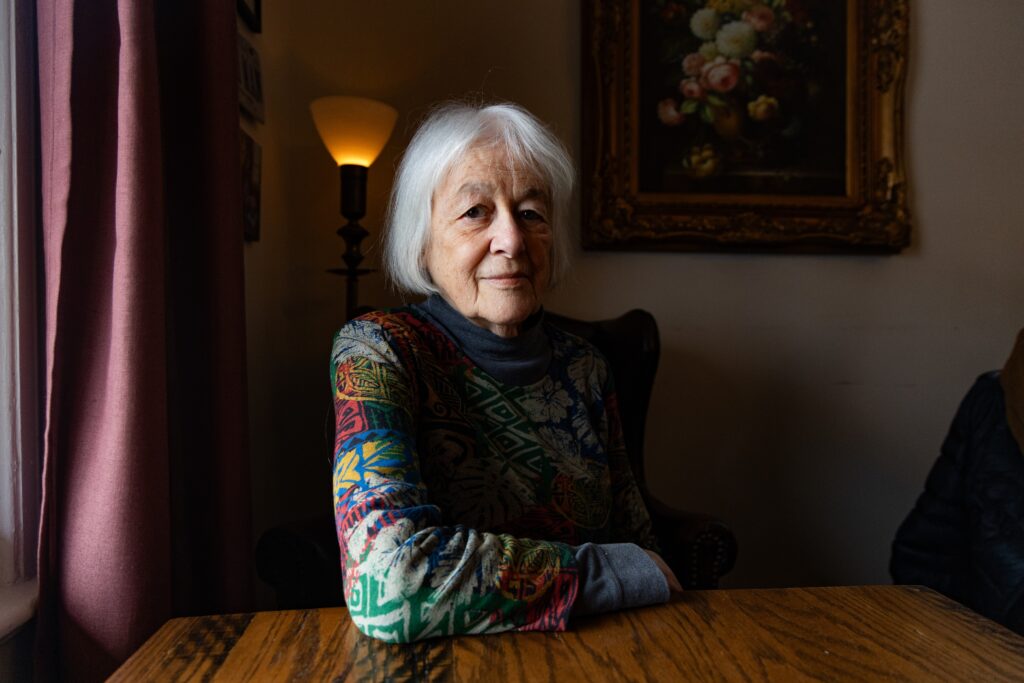
WASHINGTON, Virginia — A group of women met for wine and nibbles at Ann Tate’s house here not long ago. The mood: festive. The conversation: ghoulish.
Pat Curry, 89, explained that she wanted to donate her body to science — but those pesky requirements! “They don’t want you if you have a contagious disease,” she told her friends. “They don’t want you if you’re all smashed up. You have to be just right.” Also the proper temperature: “I have to call the fire department to see if they can get me under refrigeration within four hours.”
“Speaking of refrigeration,” said Tate, 80, “it is hard to have a green burial if you die in the summer,” when unpreserved bodies decompose quickly. Luckily, the hostess added, her most recent friend to have a green burial died in winter, so “we stuck [her friend] outside. I was scared the birds would come, but that didn’t happen.”
Daphne Hutchinson, 80, made a case for spending eternity on one’s own land: You get to supervise the digging of your own grave. Hutchinson recounted how a terminally ill friend led her son-in-law and his backhoe to the middle of her garden and said, “It needs to be done here and it needs to be done now so that it’s ready for me.” She’s now “planted” in her garden.
But Curry had a question: “What does that do to the resale value of the house if you know you’ve got somebody over there moldering under the ground?”
Another slice of cake, anyone?
Once a month, Curry, Tate, Hutchinson and four other women, all ranging in age from 78 to 89, get together to share a midday potluck and talk about their demise. They discuss their care needs, their living options, their end-of-life wishes. They’ve signed do-not-resuscitate orders together and drafted their own obituaries.
It may sound macabre, and terribly depressing. But the women, all but two of whom have been widowed, say it has been just the opposite for them: a life-affirming exercise that has given new meaning to their final chapters. It seems that by demystifying death, by refusing to deny that their lives are near the end, they have freed themselves from some of the fear of dying. Instead, they are able to focus on “how we enjoy these last few trips around the sun,” as one of them put it. And it’s no surprise that those final years are more enjoyable if filled with companionship — in this case, a group of peers with 600 years of combined life experience.
“That is what is so magic about this: It gives you a safe, comfortable, un-frightening way to talk about death,” said Hutchinson, who survived a major heart attack some years back. “Talk about death when you are feeling good. Talk about death when you can still do something to change the path that you’re on.”
They call themselves the “RONettes” because they came together through a local program called Ready or Not, which helps seniors draft advance directives and put their affairs in order. But they have continued meeting long after the program ended, forming an all-purpose sisterhood and support group that talks about their struggles with illness, with husbands and with children. One of the original eight had to leave the group because her Alzheimer’s disease worsened, but RONettes still pay her visits.
Another member of the group, Ellie Clark, 79, will leave in the spring because she’s moving to a continuing care community near her son — a decision she reached in emotional discussions with the group. “We were talking about how we want to spend the rest of our lives, and I would have loved to have lived here the rest of my life,” she told me. “But I had a concussion, and it left me with some mild cognitive impairment, and it’s not getting any better.”
Attrition is inevitable in a group of octogenarians, but I was struck by how devoted the RONettes are to one another. They were neighbors and acquaintances when they formed a Ready or Not cohort three years ago. Now close friends, they routinely talk about their deepest fears and greatest vulnerabilities.
“We really kind of have to depend on each other,” Tate said.
“We feel comfortable asking each other for help,” Hutchinson added. “Like you would with any friend, except more because we have this little network.”
Studies find that planning for the end of life can have many psychological benefits. In a narrow sense, it maximizes your sense of autonomy late in life. “Research within the hospice field and within palliative care has documented that if people are more prepared for the end of their life, then it can cause less psychological distress for them and less psychological stress for the people that survive them,” said Brian Carpenter, a psychology professor at Washington University in St. Louis who studies aging.
But it also improves well-being on a broad level. When you talk about your mortality, it inevitably leads you to think about other existential questions: What has my life been about? What is my legacy? “It’s really taking a careful look at your life, trying to make sense of the decisions that you’ve made,” Carpenter told me, “so that you can die with a sense of coherence about what your life has been all about. And that’s incredibly psychologically satisfying for people. … That helps us understand ourselves and come to some sort of peace with our lives.”
This is something we can benefit from at any age. Carpenter has his college students write their own obituaries to put them in that frame of mind. I’m a generation younger than the RONettes, but I envy the peace they’ve made with death — because they are getting more pleasure out of life. “You get a whole different perspective,” Tate told me. “I’ve got to make the best of the day because I might not be here next week. … When people say, ‘I’m going to do it in five years or 10 years,’ I’m thinking, that isn’t in my vocabulary anymore.”
There are other efforts to get people to talk openly about death. The London-based nonprofit Death Cafe has helped initiate tens of thousands of meetups to “drink tea, eat cake and discuss death” in cities around the world. But the Ready or Not program here in Virginia’s Rappahannock County is more intensive. A local nonprofit that helps seniors age in place, Rapp at Home, borrowed the concept from a similar group, Queen Anne’s at Home, on Maryland’s Eastern Shore, and it is now introducing the program to neighboring Virginia counties.
The formal program involves half a dozen meetings in which participants, some still in their 60s, might visit nursing homes; hear from an emergency medical technician; or use a workbook to develop a “Senior Navigation Action Plan” covering legal, medical and financial decisions, home safety and decluttering, and their funeral arrangements. Participants also fill out their “Five Wishes,” an advance directive that deals with medical and other decisions. Questions range from the philosophical (“How do I/we define ‘home’?” and “What does ‘thriving’ look like to me/us?”) to the minutiae of mortality (“Would you like a casket? … Would you prefer to be wrapped on a board?”). A trained facilitator leads the sessions.
But people who have gone through the program tell me that some of the most powerful stuff happens outside the meetings, in the personal reflections that come about from writing your obituary and your “legacy letter” to your children, and in the hard discussions with spouses and children about end-of-life medical decisions. Several Ready or Not cohorts have continued occasional meetings outside the formal program, but none as much as the RONettes.
Earlier in their lives, they were a social worker, an architect, a nurse, a journalist and a couple of artists. They moved to Rappahannock County at various stages of their lives and careers, but now they are navigating the common challenge of being old in a place without hospitals, without mass transit, without Ubers, and without easy access to supermarkets and pharmacies.
Joining them for two of their monthly meetings, I saw what you’d expect to find when seven octogenarians gather. One of them forgot about one meeting and had to be chased down by phone. Those who couldn’t drive carpooled with those who still could. One woman parked her walker in the vestibule. “I just turned up my hearing aids,” reported another.
I also found a lot of honesty.
Clark admitted that she was struggling with downsizing her home before selling it. “It’s a lot to decide what you can’t live without,” she said.
“It’s something I really dread,” Tate said.
“Don’t wait too long,” Clark advised. “Do it while you’re still compos mentis.”
Curry confessed that she was worried about “all the stuff I have to do” before she dies. Top of the list: Repatriating South American artifacts that she acquired long ago doing excavation work for her dissertation. “I’ve got to get my notes together,” she said of her research. “I’m forgetting so much.”
“Can we help in any way?” Tate asked.
“I’ll pack them up for you,” offered Yoko Barsky, who at 78 is the baby of the group.
Even with my digital recorder running, they were frank. Clark reported that her prescription insurance company dropped her. Curry shared that when she filled out a form in a doctor’s office, and one of the questions asked her to list hobbies, “I didn’t have anything to put there.” Hutchinson spoke about the difficulty of deciding which of her children will make her medical decisions, explaining that it’s best not to pick “the one that loves you the most, because they don’t want to let you go.”
Susan Hornbostel, 84, said the openness reminds her of the consciousness-raising groups of the women’s movement. “I had a hard time being totally honest in that group, but here I find it easier. Maybe it’s age,” she said. “You can ask any question you want to, or bring up any subject, which you can’t usually do in polite society. … My husband will not talk about any of this with me because he believes he’s never going to die.”
At one point, Hutchinson checked to see if they had completed their obituaries. She had challenged them to dig deep into their lives: “How did you make a difference? How did you influence others? What were you known for? What was the credo you lived by? What were your priorities in life?”
And she had shared with them a first draft of her own obituary: “Daphne Ingle Hutchinson died DATE at her home in Washington, Virginia. Napping in the sunshine, she slipped away peacefully, encircled by family, her beloved dogs and that darn cat.”
They frequently returned to the topic of disposing of their earthly remains, and the seemingly inexhaustible permutations of composting, burial and donation — but not, for most of them, cremation. “It does horrible damage to the environment,” reasoned Clark, who aspires to a green burial after they first “take chunks out” as organ donations. Besides, she added, her husband died a decade ago, “and I still have not buried his ashes.”
Hutchinson could relate to that. “I have three ash sets in my bedroom,” she reported.
They also kept refining their thoughts about what they want when the end is near. Clark said she might like “a trial of being on a respirator, and then if it doesn’t help, you give them permission to unplug you.” Tate said she wants all machines cut off if she can’t “have a cohesive conversation with others.” Curry read a provision she put in her directive requesting “aid in dying” if she can no longer recognize friends or family, or to be moved “to a jurisdiction where my wish can be honored.”
This met with general approval. “Send it to us,” Hutchinson told Curry. “We’ll all use it.”
I didn’t hear any mention of God, or heaven or hell. Hutchinson said some in the group “believe really strongly, but most of us don’t.”
Instead, they have found solace in the worldly act of sharing their fears with other humans. “I think I’m blessed that we have been here,” Clark told me. “I think dying has kind of been demystified for me.”
Curry described a similar calm about her final moments. “I don’t know how it will be in the actual experience,” she said. “But right now it’s not scary.”
Hutchinson said that after her heart attack she became obsessed with death and suffered nightmares about it. But in her long talks with the RONettes, she came to understand that what she actually feared was dying in an intensive care unit, intubated and alone. “It wasn’t the fear of death, it was fear of the process of dying,” she said. Now that she’s asserted some measure of control over her end, the nightmares have stopped. “I don’t feel afraid anymore.”
The post One path to a happier life: Thinking more about death appeared first on Washington Post.