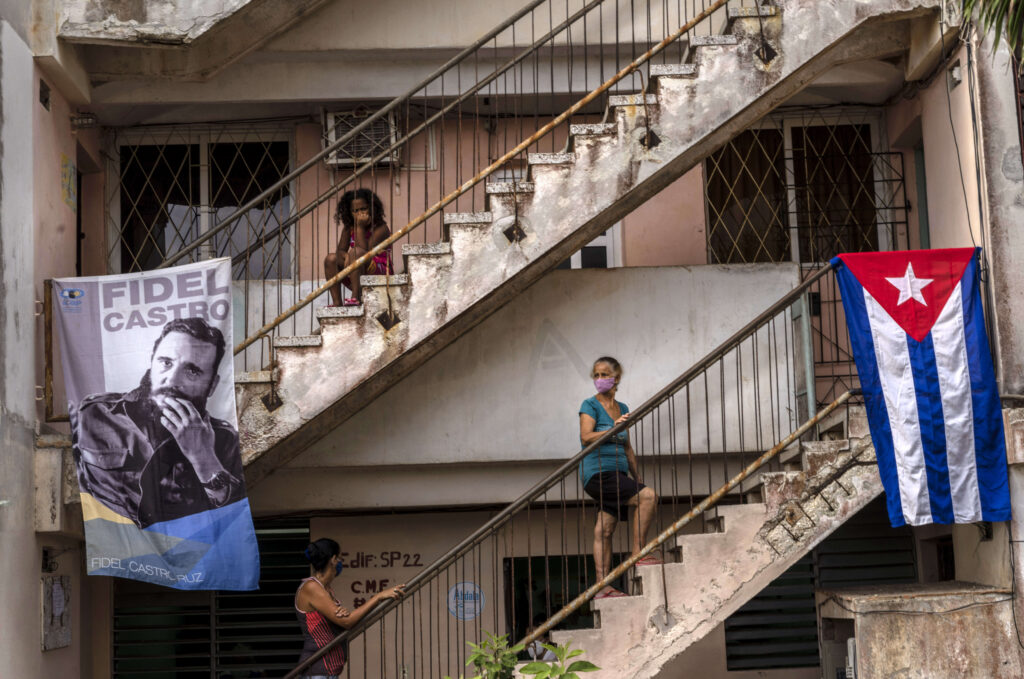
The Museum of Socialism, a.k.a. Cuba, is plummeting in a tightening gyre. The 67-year-old Communist regime, which has existed during 14 U.S. presidencies (counting Donald Trump twice), might not survive into a 15th.
Its iron fist grips an island prison that has fewer than 11 million — perhaps under 9 million — inmates. In this decade, more than a million have escaped; the regime considers this partly a safety valve, exporting dissidents. Most have gone into America’s Cuban diaspora. “Cuban society is a rudderless, drifting hulk,” writes Juan Antonio Blanco, president of a Madrid-based think tank, in the Journal of Democracy. “Amid the institutional anomie, ordinary citizens endure a daily hell of ever-increasing hardships.”
Fidel Castro, who perhaps was a billionaire when he died in 2016, was proudly anti-bourgeois, telling Cubans: “We are not a consumer society.” He got that right. Cuba, a threadbare geopolitical irrelevancy, was once famous for cigars and sugar. It has had to import tobacco from Spain and sugar from Brazil.
The Financial Times reports that drivers wait hours to fill their gas tanks. Garbage accumulates in streets because refuse trucks lack fuel. Airlines avoid Havana because fuel is unavailable. Abandoned hotels, built for tourism that never materialized, line Havana’s waterfront. Soviet-era oil-fired electricity generators fail from lack of maintenance. People trek from the provinces to Havana to buy expensive candles that burn for about an hour.
Patients who need operations are told to bring to the hospital their own sheets, gauze, bandages, even scalpels. Writing in Foreign Affairs, Michael J. Bustamante, chair in Cuban and Cuban-American Studies at the University of Miami, says “an outbreak of dengue and other mosquito-borne viruses has reached epidemic proportions.”
In the 1930s, apologists for Joseph Stalin’s use of terror and engineered famine to produce socialism, complacently said, “You can’t make an omelet without breaking eggs.” George Orwell’s acid reply: “Where’s the omelet?” Mendicant Marxism, dependent for decades on Soviet subsidies, then on Venezuelan oil from the Hugo Chávez and Nicolás Maduro regimes, is discredited everywhere outside Western universities’ humanities departments.
When Castro came to Manhattan in 1960, novelist Norman Mailer swooned: “One felt life in one’s cold, over-argued blood.” Director Oliver Stone, emblem of Hollywood progressivism, advised of Castro in 2003: “We should look to him as one of the Earth’s wisest people.” Castro may have been the last charismatic totalitarian to enchant the Western left.
In the 1960s, Jean-Paul Sartre, France’s celebrity existentialist (existentialists believed that life is absurd, so they should be, too), said Castro exemplified “direct democracy.” Cuba’s democracy has indeed been unmediated by elections. Castro promised elections at his trial in 1953, and in his manifesto from the mountains in 1957, two years before he got to Havana.
Cuba has had only two presidents since Castro, then 81, retired in 2008: his brother Raúl (who is 94 and still influential) and, since 2018, Miguel Díaz-Canel. Blanco argues that since Castro’s death, Cuba has transitioned from a Communist state to a mafia state. The distinction is without much difference.
Under communism, the dominant class was the bureaucracy. Now the country’s main sources of wealth have been privatized to serve essentially the same oligarchic interests. Today, as before, writes Blanco, “nothing works except the system of repression.”
According to the Cuban Observatory of Human Rights, 89 percent of Cubans consider themselves living in “extreme poverty.” Seventy-two percent consider power outages Cuba’s primary problem; 71 percent say food shortages. Only 15 percent have constant access to running water. Seventy percent do not regularly eat three meals a day.
On Jan. 29, President Trump declared Cuba “an unusual and extraordinary threat.” This absurd finding enables a U.S.-enforced oil embargo that might tip Cuba into, at best, social entropy. Then what?
Cuba’s internal-security apparatus has reduced society to a dust of individuals. There is no latent capacity for organic democratic expression, as Solidarity became in Poland in the 1980s, when, suddenly, a third of the nation joined it. If Cuba soon completes its collapse into the status of a failed state, flotillas of the desperate might sail 90 miles north.
Eleven months before he was murdered by a Castro admirer, President John F. Kennedy, author of the feckless 1961 Bay of Pigs attempt to overthrow Castro’s regime, spoke in Miami to survivors of this fiasco. They gave him a Cuban flag. He vowed: “I can assure you that this flag will be returned to this brigade in a free Havana.” Planting that flag there will be easier than planting the institutional structures of freedom.
The post After Cuba completes its failed-state collapse, then what? appeared first on Washington Post.