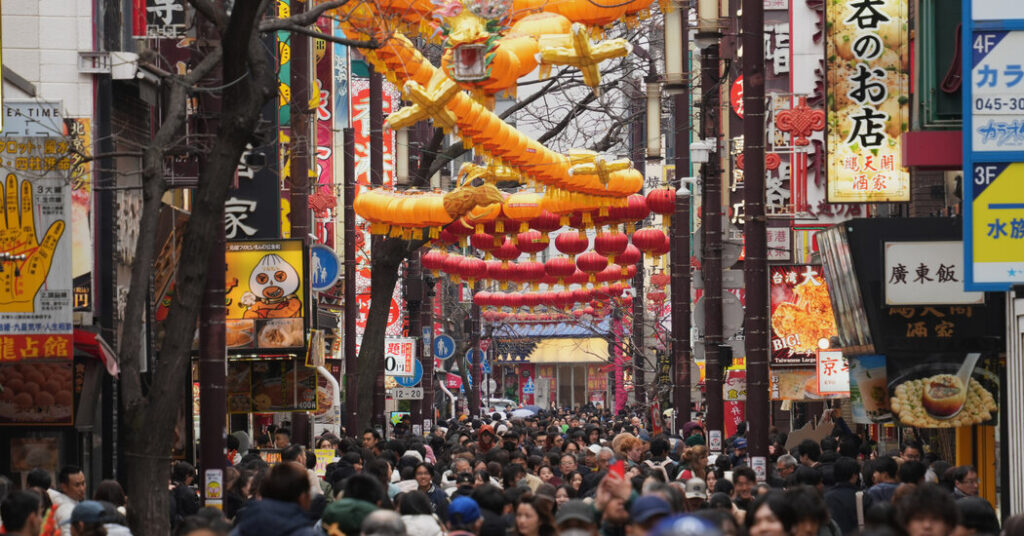
Japan’s shopping districts, restaurants, temples and ski resorts would normally be teeming with Chinese tourists right now as they celebrate the Lunar New Year holiday.
Instead, in cities like Tokyo, Osaka and Kyoto, business owners say visitors from China have been scarcer this year.
The Chinese government, drawing on falsehoods and exaggerations, is aggressively discouraging its citizens from visiting Japan as part of a campaign to punish Tokyo for its support for Taiwan, a self-governing democracy that Beijing considers part of its territory.
In recent government statements and state media commentaries, Beijing has portrayed Japan as a land where people live under the constant threat of earthquakes, crime, traffic accidents and attacks by bears — and where Chinese travelers, in particular, are targeted.
“Chinese citizens face serious security threats in Japan,” China’s foreign ministry said ahead of this week’s Lunar New Year holiday, China’s peak travel season.
Beijing’s strategy of undermining Japan’s image in China as one of the world’s safest travel destinations may be working. The number of Chinese travelers to Japan has sharply declined in recent months, falling 61 percent in January from a year earlier (though the data is somewhat skewed by the timing of the Lunar New Year, which began in January last year and in February this year). Arrivals had fallen 45 percent in December.
Here’s a look at Beijing’s claims.
Earthquakes
China has repeatedly pointed to the frequency of earthquakes in Japan to deter travel there. In December, after a powerful earthquake in northern Japan, the Chinese foreign ministry said people should avoid the country because of the risk of a tsunami or a so-called mega quake.
Yes, Japan sits along the Pacific “Ring of Fire,” a chain of seismologically active faults encircling the Pacific Ocean, making it one of the world’s most earthquake-prone countries. But Japan is also a global leader in dealing with earthquakes, with early warning systems and strict construction standards.
By seizing on earthquakes, analysts said, the Chinese government is attempting to signal that its central concern is safety — not politics. In these warnings, the government rarely mentions its fierce opposition to Prime Minister Sanae Takaichi’s stance that Japan could help defend Taiwan in the event of a Chinese invasion.
“A safety narrative feels more neutral and reversible, giving the Chinese government room to signal displeasure while keeping diplomatic flexibility,” said Xiao Qiang, a specialist in Chinese propaganda at the University of California, Berkeley.
Targeting of Chinese Citizens
China has argued that its citizens risk being targeted in Japan, tapping into a longstanding nationalist narrative rooted in the two countries’ bitter World War II history and Japan’s record of wartime atrocities.
China has highlighted attacks on its citizens, including an incident reported by Japanese media this week in which a man attacked a Hong Kong resident on the head with a beer bottle in the northern city of Sapporo. China has also said, without providing specifics, that there have been cases of “unprovoked verbal abuse and physical assault” against its citizens in Japan.
There is no evidence of a surge in crime or discrimination against Chinese citizens in Japan. In fact, the number of murders, robberies and arsons involving Chinese victims has declined over the past several years, according to official Japanese statistics.
China’s attempts to heighten a sense of prejudice might resonate domestically because of the emotions people still feel about World War II, said Kurt Tong, a managing partner at the Asia Group and former American diplomat.
“These emotional, interpersonal arguments could have more resonance with the Chinese public,” he said. “It plays into the nationalist idea that they’re being disrespected as a people.”
Crime, Accidents and Bears
Japan has one of the lowest crime rates in the world. But you wouldn’t know that by reading Chinese media reports.
Beijing has seized on random incidents of violence in Japan as evidence of a broader safety problem, pointing, for example, to the stabbing of three teenagers this month in Osaka.
“The security environment in some areas of Japan has been unstable, and similar vicious cases have been occurring frequently,” the Chinese consulate in Osaka said in a statement that warned citizens against traveling to Japan.
China has also suggested that Japan has a road safety problem, even though traffic fatalities are relatively low in the country.
Last month, the Chinese authorities highlighted an incident in which a car rammed into pedestrians along a street in Tokyo’s popular Shinjuku neighborhood. Beijing said that two Chinese nationals were seriously injured.
The Chinese embassy in Japan even issued a warning about a record surge in bear attacks in the country.
Experts said that Beijing would have to work hard to convince the public to forgo trips to Japan, given the love in the mainland for Japanese food, culture and products.
“They’re reaching for the stuff they think might get people’s attention,” Mr. Tong said. “But Japan is such an attractive place to visit. In the long term, they might not be able to keep people away.”
Kiuko Notoya and Hisako Ueno contributed reporting from Tokyo and Chris Buckley from Taipei.
Javier C. Hernández is the Tokyo bureau chief for The Times, leading coverage of Japan and the region. He has reported from Asia for much of the past decade, previously serving as China correspondent in Beijing.
The post How China Is Stoking Fear About Travel to Japan appeared first on New York Times.