Cuba is confronting the United States’ first effective blockade since the Cuban Missile Crisis and running out of fuel fast, pushing the nation toward a humanitarian crisis and its government to the edge of collapse, according to a New York Times analysis of shipping data and satellite images.
Cuban tankers have hardly left the island’s shores for months. Oil-rich allies have halted shipments or declined to come to the rescue. The U.S. military has seized ships that have supported Cuba. And in recent days, vessels roaming the Caribbean Sea in search of fuel for Cuba have come up empty or been intercepted by the U.S. authorities.
Last week, a tanker linked to Cuba burned fuel for five days to get to the port in Curaçao but then left without cargo, according to ship-tracking data. Three days later, the U.S. Coast Guard intercepted a tanker full of Colombian fuel oil en route to Cuba that had gotten within 70 miles of the island, the data showed.
While President Trump has pledged to halt any oil headed to Cuba, the Trump administration has stopped short of calling its policy a blockade.
But it is functioning as one.
Mr. Trump signed an executive order last month threatening to impose tariffs on countries that provide oil to Cuba. That has succeeded at scaring other nations, like Mexico, into sitting on the sidelines despite their desire to help Cuba.
At the same time, the largest U.S. military presence in the Caribbean in decades is policing the waters around the island, fresh off its work blocking oil shipments to and from Venezuela ahead of the U.S. capture of the country’s leader, Nicolás Maduro, last month.
And, according to a U.S. official who spoke on the condition of anonymity to discuss operational matters, the Coast Guard’s interception of the tanker headed to Cuba last week was part of a blockade that the Trump administration has not yet announced.
“Among us longtime Cuba watchers, we’ve always resisted people using the word blockade,” said Fulton Armstrong, the former lead Latin America analyst for the Central Intelligence Agency, who has been studying Cuba since 1984. “But it is indeed a blockade.”
The White House declined to comment. A Cuban government spokeswoman did not respond to a request for comment.
The United Nations has criticized the U.S. policy as a violation of international law that has exacerbated the suffering of Cuba’s nearly 11 million residents. It also appears to have the island’s Communist government teetering on edge.
“Since the Cuban Missile Crisis, this is the biggest step,” Mr. Armstrong said, referring to the 13-day confrontation in 1962 when the U.S. Navy encircled Cuba. “And the Cubans will have to make a decision of whether to surrender.”
President Miguel Díaz-Canel of Cuba has said he was open to negotiating with Washington, while promising to find ways around the blockade. “We are making every effort so that the country can once again have fuel,” he told reporters this month. “We have to do very hard, very creative and very intelligent work to overcome all these obstacles.”
To understand whether fuel was still flowing to the island, The Times conducted interviews and analyzed satellite images, port records and data broadcast from a series of ships connected to Cuba.
The analysis showed that oil-tanker traffic to and from the island has nearly stopped. Yet it also showed that several ships did appear to venture out in search of fuel. All were stymied by Mr. Trump’s policies.
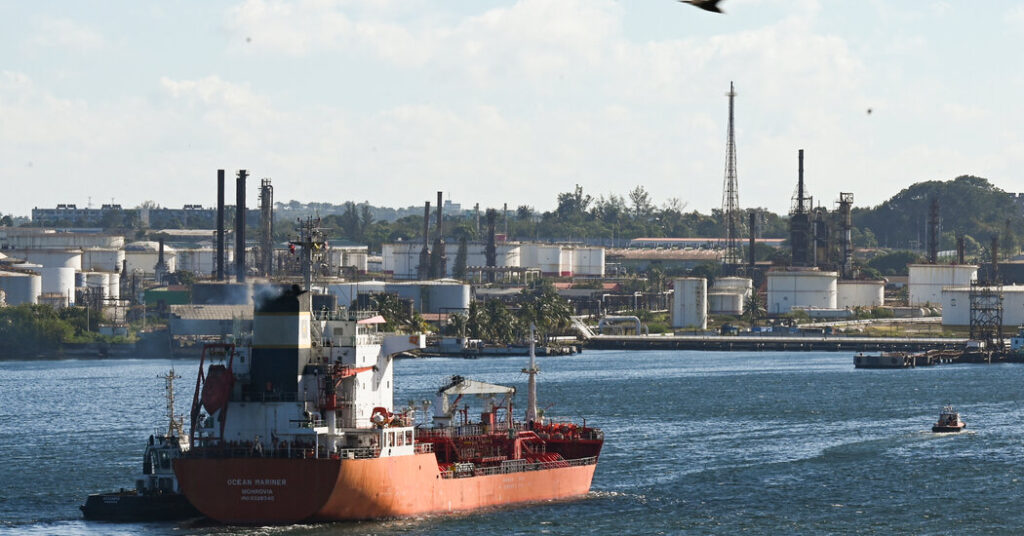
The Ocean Mariner
On Jan. 29, Mr. Trump declared a national emergency, claiming that Cuba is a hotbed for spies and terrorists and threatening tariffs against any nation that provides petroleum products to the island.
On the same day, a tanker called the Ocean Mariner docked at a port in Barranquilla, Colombia, according to data broadcast by the boat and satellite imagery. It loaded 84,579 barrels of fuel oil, according to Kpler, a shipping data firm.
The Ocean Mariner has been a regular carrier of oil to Cuba, even delivering the island’s last shipment, from Mexico, on Jan. 9. But when it left Colombia, it broadcast its destination as the Dominican Republic.
Twelve days later, on Feb. 10, it changed course toward Cuba.
On Feb. 11, just 65 miles from Cuba, the Ocean Mariner abruptly made a U-turn, according to ship-tracking data. It appeared to have realized it was being pursued.
The next day, a U.S. Coast Guard vessel pulled up alongside the tanker, according to the data. The Coast Guard crew asked the Ocean Mariner where it was headed, and the tanker reported it was destined for the Dominican Republic, despite the fact that it was way off course, according to a U.S. official who was briefed on the episode.
The Coast Guard then sailed alongside the Ocean Mariner for nearly two days, escorting it into Dominican waters, the data show. The ship remained there, full of fuel, for several days.
On Thursday, a Coast Guard vessel again began escorting the Ocean Mariner — this time north toward the Bahamas, which the Ocean Mariner broadcast as its destination.
When U.S. vessels were seizing Venezuelan oil tankers late last year, those ships also brought their oil to the Bahamas.
Growing Isolation
In Cuba, people are struggling with frequent blackouts, shortages of gasoline and cooking gas and dwindling supplies of diesel that power the nation’s water pumps. Trash is piling up, food prices are soaring, schools are canceling classes and hospitals are suspending surgeries.
The U.S. embargo on Cuba has complicated life on the island for more than six decades, but by all accounts, this is one of its darkest moments.
Jorge Piñón, a former oil executive who runs a team at the University of Texas at Austin tracking Cuba’s oil, said the team estimates that the country’s fuel reserves could be depleted by mid-March, triggering social unrest that could threaten the government. Nearly all of Cuba’s energy runs on oil and oil products.
And Cuba appears to have few lifelines left.
Its once dominant supplier, Venezuela, is now effectively controlled by the United States. Russia recently promised to send oil but its ships are nowhere to be seen. And other oil-exporting countries friendly to Cuba are staying away, Mr. Piñón said, including Brazil, Angola and Algeria. “All of these countries have their own problems,” he said. “Why antagonize the White House?”
After Washington took control of Venezuela’s oil, Mexico was left as Cuba’s primary provider. But after Mr. Trump threatened tariffs, it halted its shipments. Mexico is economically dependent on the United States and locked in negotiations with Washington over an expiring trade deal.
President Claudia Sheinbaum of Mexico has tried to walk a fine line, sending humanitarian aid packages to Cuba, offering to mediate talks and saying: “You cannot suffocate a people like this.”
The Gas Exelero
The Times analysis suggests that in the absence of its typical suppliers, Cuba has begun looking to some of its smaller neighbors in the Caribbean.
On Feb. 9, a tanker called the Gas Exelero set sail from Cuba to Curaçao. The five-day journey consumed a significant amount of fuel for a nation short on it, and yet it all appeared to be for naught.
The vessel docked at a port in Curaçao for nine hours before departing again. According to the ship’s data on its depth in the water — a measure of how much product is on board — it appeared to depart empty. Ship data also showed that the ship docked on the side that would allow it to refuel for a return journey but not load supplies.
Curaçao officials did not respond to requests for comment.
The Gas Exelero then sailed to Jamaica, where it has sat at anchorage near the port of Kingston since Feb. 17.
The ship is at least the fourth vessel with links to Cuba that has anchored near the Kingston port since October. Exactly why the ships have stopped there is unclear. Ship data and satellite images show the boats have not docked at the port, which abuts Jamaica’s only oil refinery, nor have they taken on any weight.
Kamina Johnson Smith, Jamaica’s foreign minister, told reporters last week that Cuba had not requested to buy fuel from Jamaica and that Jamaica had not sold fuel to Cuba in at least a decade. Trade data shows that as recently as 2023, Jamaica’s largest export to Cuba was refined petroleum.
Some of the ships have anchored near Jamaica several times a year. Shipping analysts said the vessels may be changing crews because of the complicated logistics of doing business in Cuba.
Crew members also appeared to be visiting Jamaica. A Facebook account that appeared to belong to a Filipino man who works on one of the vessels posted a photo in 2024 of 15 people in what looked like a crew dining area, about to eat a meal of lechon, or suckling pig, a celebratory dish in both Cuba and the Philippines.
Every one of them wore matching Jamaica shirts.
Eric Schmitt contributed reporting from Washington, and Emiliano Rodríguez Mega from Mexico City.
Note: The International Maritime Organization issues an IMO number, a permanent identification number, that remains associated with a vessel throughout its lifetime unlike a ship’s name, which can change frequently. The ships in this article are Gas Exelero (9392042) and Ocean Mariner (9328340).
Jack Nicas is The Times’s Mexico City bureau chief, leading coverage of Mexico, Central America and the Caribbean.
The post A New U.S. Blockade Is Strangling Cuba appeared first on New York Times.