President Trump’s desire for significantly lower borrowing costs has run into a perpetual problem since he returned to the White House. The economy is simply not calling for that kind of support from the Federal Reserve.
But a new rationale for relief has begun to gain traction that seeks to overcome this hitch. It centers on artificial intelligence and the possibility of a productivity boom that will unleash higher economic growth without stoking inflation. That, in turn, could give the Fed space to cut interest rates, the argument goes.
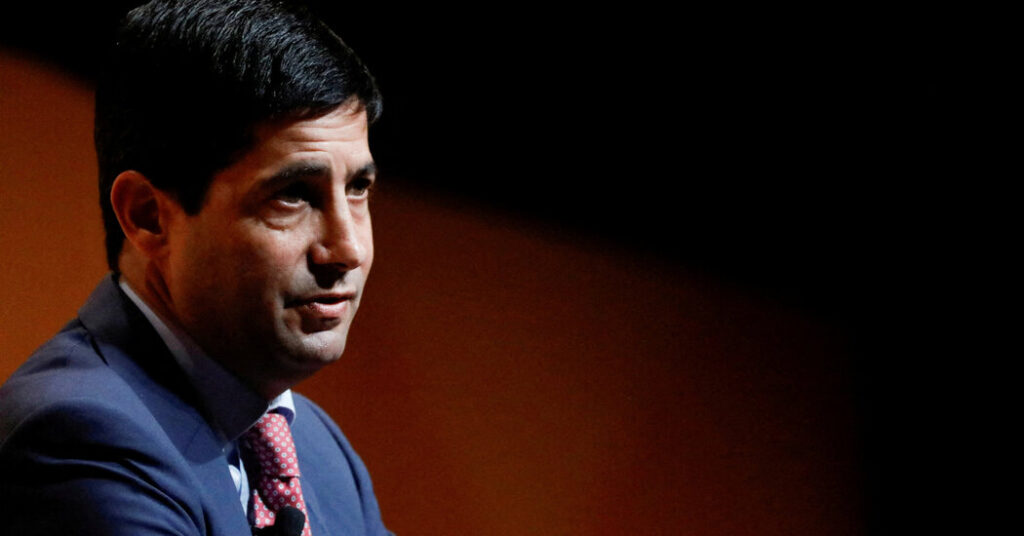
One of the biggest proponents of this view is Kevin M. Warsh, whom Mr. Trump wants to replace Jerome H. Powell as Fed chair. Before being tapped for the job, Mr. Warsh characterized the A.I. boom as “the most productivity-enhancing wave of our lifetimes — past, present and future.”
He surmised that the technology would be “structurally disinflationary,” like the internet, although conceded that the full economic impact would take time to materialize. “My sense is that the anecdotes will be there before the data,” Mr. Warsh said, forcing central bankers to “make a bet” on leaning into a potential productivity surge.
Mr. Warsh might be ready to make that wager if he is confirmed by the Senate, but his soon-to-be colleagues at the Fed appear far less convinced, especially given their growing skepticism about the need to cut rates further after another year of inflation above their 2 percent target.
“I expect that the A.I. boom is unlikely to be a reason for lowering policy rates,” Michael S. Barr, a Fed governor, said just this week. Mr. Barr’s comments are so far the most direct on the issue, but other policymakers appear aligned.
“I don’t think we are anywhere close yet to having evidence that A.I. has increased potential output that significantly,” said Athanasios Orphanides, formerly a governor at the Central Bank of Cyprus and a senior adviser at the Fed who is now at M.I.T. Sloan School of Management. “That’s why it’s tricky to use this argument to say this clearly justifies lower rates today.”
1990s Redux?
Mr. Warsh’s argument relies on a simple premise. Ordinarily, the economy can grow only so quickly without triggering inflation. If factories are operating at full capacity, workers are all employed and companies are doing as much business as they can handle, then any increase in spending will result just in higher prices, not greater output.
But if something — a technological breakthrough, an innovative management approach — allows businesses to produce more with the same number of workers, then output can rise without inflation picking up.
That is what Mr. Warsh and others argue is happening now. And they say there is a historical precedent: the personal computing revolution of the 1990s.
In the latter part of that decade, economic growth accelerated, the unemployment rate fell to historic lows, and the stock market boomed. Many economists, including some at the Fed, argued that the central bank should begin raising rates to cool off the economy and prevent a pickup in inflation.
Alan Greenspan, then the Fed chair, disagreed, arguing that the United States was in the early stages of a technology-driven increase in productivity growth. He resisted the call to raise rates, arguing in a 1997 Fed meeting that the economy was in “a very unusual era.”
“The pickup in productivity helps to explain why inflation remains so well contained at this stage in the expansion, despite the increasingly tight labor markets and other developments that, on the basis of our historical models, would have produced significant inflation,” Mr. Greenspan said at the time, according to meeting transcripts.
But critics point to differences between the two periods. For one, other factors were helping to keep a lid on inflation during Mr. Greenspan’s tenure, including rapid globalization and rising immigration. Today, the opposite is true, with Mr. Trump’s tariffs fracturing trade relations and his immigration crackdown shrinking the work force.
“It’s so different that it creates sufficient uncertainty that you would not want to cut rates pre-emptively,” said Matthew Luzzetti, chief economist at Deutsche Bank.
In fact, under Mr. Greenspan, the Fed was debating whether to raise rates, not whether to cut them. And while policymakers held off on making any moves for a while, they eventually did raise rates once inflation began to pick up.
“Greenspan never cut rates because of productivity,” said Aditya Bhave, an economist at Bank of America. “He resisted the committee’s call to hike rates because of productivity, and he turned out to be right for a bit, and ultimately they wound up hiking anyway.”
Measuring the Boom
Many economists also argue that it is far from clear that the United States is in the midst of an A.I.-driven productivity boom — or a productivity boom at all.
According to the latest data from the Bureau of Labor Statistics, labor productivity was up 1.9 percent in the third quarter from a year earlier, a respectable but hardly spectacular growth rate. That number will almost certainly be revised higher in subsequent updates to account for job growth that was slower in 2025 than initially reported — if fewer workers produced the same amount of economic output, then by definition their productivity was higher.
But that anticipated revision only highlights the challenge: Productivity is notoriously hard to measure in real time. Even more than with employment, inflation and other statistics, productivity figures often change drastically as more complete data becomes available.
Even when the numbers don’t change, they can be hard to interpret. Early in the pandemic, for example, productivity soared, but not because workers suddenly became better at their jobs. Low-productivity sectors like hospitality largely shut down, making overall productivity, on average, appear artificially high.
“It is important to keep in mind that it’s a noisy series,” said Martha Gimbel, executive director of the Budget Lab at Yale University. “You should never hang your hat on one or two quarters of economic data, but that is particularly risky with productivity.”
Even if the recent pickup in productivity is real, it isn’t clear that it’s driven by artificial intelligence, or that the gains will last. Some individual companies have begun reporting that they are seeing the benefits of artificial intelligence, but the evidence linking those gains to overall productivity growth is thin.
That isn’t necessarily surprising. Research into past technological revolutions has found that they often follow a J-shaped pattern, where productivity growth initially slows as companies figure out how best to take advantage of the new technology, before it later accelerates.
“That doesn’t mean it will never happen,” Ms. Gimbel said. “It just means that change is not immediate, and just because something is happening at an individual firm or for a very specific group of workers does not mean that it’s an economywide phenomenon.”
Still, some prominent economists are less skeptical of A.I.’s impact. In a recent article in The Financial Times, Erik Brynjolfsson, a Stanford economist who has studied A.I., argued that the recent pickup in productivity, combined with evidence from specific industries and companies, suggests that the economy is “now transitioning out of this investment phase into a harvest phase” where productivity gains will be more substantial.
Convincing the Committee
Fed officials have stopped short of making definitive arguments about A.I. and its impact on productivity in light of these uncertainties. They have, however, started to debate the topic more vigorously.
Officials discussed productivity gains at January’s meeting, according to minutes released on Wednesday. Several policymakers at that gathering endorsed the idea that higher productivity growth, stemming from technological advances or changes in regulation, could put downward pressure on inflation. They also thought it would help to bolster economic growth overall.
In a speech this month, Lisa D. Cook. a Fed governor, acknowledged those benefits, but also stressed the costs, including the possibility that “job destruction may precede job creation.”
Such a confluence of factors has made determining the right policy settings much harder. If an A.I.-led productivity surge is poised to result in significant job losses, should the Fed respond by lowering rates? If, instead, it will take time for productivity gains to accrue, but companies are already pouring money into new investments, driving up financial asset prices and buoying consumer demand, would that call for higher rates in the near term?
Policymakers are also grappling with the implications for the “neutral” rate, which reflects a policy setting that neither speeds up growth nor slows it down. Officials have raised their estimates to around 3 percent since the pandemic to reflect disruptions in global trade and rising government debt levels. Productivity-fueled growth may soon be added to that list.
Philip N. Jefferson, the Fed vice chair, said in a speech this month that “all other things being equal, persistent increases in productivity growth are likely to result in an increase in the neutral rate, at least temporarily.”
Both Neel T. Kashkari, who as president of the Federal Reserve Bank of Minneapolis will vote on rates this year, and Mary C. Daly of the San Francisco Fed echoed that point this week. Mr. Barr also made the case on Tuesday, when he fleshed out his skepticism about higher productivity’s paving a path to rate cuts.
“Demand for capital would rise because of the strong business investment required to take advantage of the technology, putting upward pressures on interest rates,” Mr. Barr said. “And household savings could fall due to expectations of stronger real wage growth and thus higher lifetime earnings, also putting upward pressure on interest rates.”
These comments indicate Mr. Warsh is likely to face an uphill battle in convincing others at the Fed, if he is confirmed as chair. His job was already set to be difficult in light of concerns about his independence from Mr. Trump, who insisted that he would pick only someone who supported lower rates.
“As a general rule, if it takes a really long time to litigate your argument, then the argument is not as convincing,” said Vincent Reinhart, a former Fed economist now at BNY Investments. “That’s going to be the problem.”
Colby Smith covers the Federal Reserve and the U.S. economy for The Times.
The post Can an A.I. Productivity Boom Clear a Path for More Rate Cuts? Trump’s Fed Pick Thinks So. appeared first on New York Times.