Venezuelan lawmakers on Thursday passed a wide-ranging amnesty bill that could free hundreds of political prisoners, in perhaps the strongest indication yet that the interim government, under pressure from the United States, is moving to ease some of the regime’s most repressive tactics.
But some experts and activists for political prisoners say the amnesty measure, while long overdue, leaves out many people held by the state and relies on a compromised judiciary system to carry it out. Even some supporters of the law have called it imperfect.
The law applies to the years in power of the ruling government, starting in 1999, the first year in office of former President Hugo Chávez, a self-described socialist and charismatic strongman leader who put in place the current regime before his death in 2013.
The amnesty law, however, extends only to prisoners who were detained in a limited number of protests. Critics of the proposal also note that prisoners facing some of the most serious charges, such as those accused of violent, armed actions, would not be eligible. According to rights groups, these kind of allegations were often arbitrarily applied and often based on fabricated evidence.
The bill’s passage comes as the United States is pressuring Delcy Rodríguez, Venezuela’s interim president, to steer the country’s economy toward American interests and pursue democratic changes after a quarter-century of increasingly authoritarian rule.
Over that period, thousands of Venezuelans and foreigners have been detained, many on drummed-up charges, according to rights groups, and usually for opposing the government. The measure will now go before Ms. Rodríguez, who is expected to give it final approval.
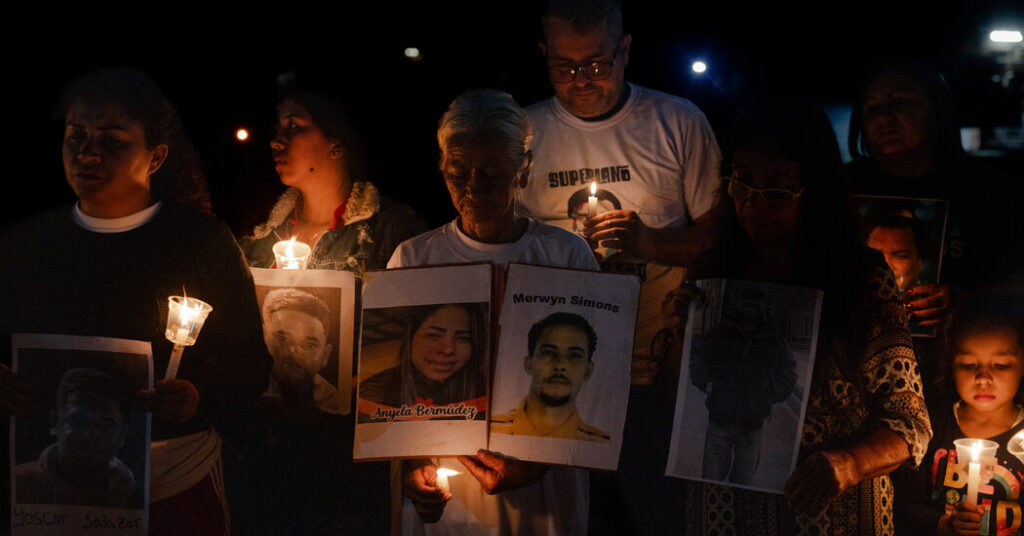
Rights groups estimate that 600 to 900 political prisoners remain incarcerated in the country as of this week, including opposition politicians, journalists and others. The groups have documented torture and abuse in Venezuela’s prisons, and dozens of political prisoners have died in captivity or been disappeared.
In addition to concerns about exclusions baked into the amnesty legislation, there is also widespread fear that the government would not fully abide by the new law. The government remains largely unchanged after President Nicolás Maduro was captured by the United States on Jan. 3 and jailed in New York.
Ms. Rodríguez must now navigate growing scrutiny at home and from Washington. In a social media post last week, President Trump called relations with Venezuela “extraordinary,” and Ms. Rodríguez said on NBC that she had been invited to the White House.
Last week, students organized modest marches and rallies across Venezuela, demanding blanket amnesty for all political prisoners and denouncing the measure as falling short. And on Thursday, United Nations human rights experts called for the unconditional release of all arbitrarily detained people, in a statement. U.S. and Venezuela officials did not immediately respond to requests for comment.
Who could be freed under the new law?
The new law would free prisoners and expunge their criminal records. It would apply to many of the hundreds of people incarcerated for reasons linked to their opposition to the government.
But the amnesty offered is narrow in scope.
The measure applies only to those who were detained in connection with about a dozen specific “politically motivated violent events” dating back to 1999. These events were mostly large protests that in some cases spanned months and included a failed coup against Mr. Chávez in 2002.
Trump Administration: Live Updates
Updated
- HUD revives a proposal to eject undocumented immigrants from public housing.
- Trump calls himself a ‘schmuck’ for donating his presidential salary.
- Trump’s Board of Peace promises billions for Gaza, with few details.
These restrictions will most likely mean that not all political prisoners would be released, said Nicmer Evans, a political scientist and government critic recently held in El Helicoide.
Mr. Evans, who called the law “unjust,” said it could exclude those jailed for criticizing the government outside of the periods specified in the law. “Practically all of us journalists who have been detained for our opinions outside of these established time frames are excluded,” he said.
Activists are also wary that, under the law, those released must go before the judicial authorities, who will “verify the grounds for amnesty” before granting a pardon, raising concerns that the highly politicized courts may have too much discretion over the process.
The activists have called for an independent commission that includes international human rights organizations to supervise carrying out the law.
Why is this happening now?
Ms. Rodríguez has to balance the demands of the Trump administration and an entrenched political system known as Chavismo, after its founder, Mr. Chávez.
That system has been sustained through repression and elections marred by fraud, according to Venezuela experts. Ms. Rodríguez and her brother, Jorge Rodríguez, are believed to be some of the chief architects and beneficiaries of that system.
Still, since the capture of Mr. Maduro, Ms. Rodríguez has embraced the amnesty law and pledged to close El Helicoide, the prison that Mr. Trump appeared to be referring to when he said that Venezuela had vowed to close a “torture chamber.” More than 400 political prisoners have been released since Mr. Maduro’s ouster.
Mr. Rodríguez, the president of the National Assembly, recently apologized to Venezuelans for any crimes committed by the state since Mr. Chávez came to power. “We ask for forgiveness, and we, too, must forgive,” he said, holding up a photograph of Mr. Chávez clutching a crucifix.
Is Venezuela becoming less repressive?
Since the capture of Mr. Maduro, there have been emerging signs that repression in the country might be easing. And some Venezuelans say the amnesty law is a key part of that process.
“The amnesty is a first step in the right direction,” Michael Penfold, a professor in Caracas of political economy and governance, said on social media Feb. 7.
Mr. Penfold, who has been critical of the government, recently joined the interim government’s new Program for Coexistence and Peace, a national plan that seeks to restore political dialogue.
But many in Venezuela say the amnesty law does not go far enough.
Delsa Solórzano, a lawyer and former legislator who went into hiding after the country’s fraud-marred presidential election in 2024, said in an interview last week that the bill did not include the repeal of certain laws that have “served as real instruments of political persecution,” referencing, among others, an “anti-hate” measure, which has been used to silence critics.
The law allows those outside the country, many political exiles, to seek amnesty through their lawyers. But it excludes anyone who has promoted armed action from abroad, a caveat which is widely seen as aimed at María Corina Machado, the exiled opposition leader who has backed U.S. military intervention.
Renzo Huamanchumo Castillo, a Peruvian American who was held as a political prisoner in another Venezuelan prison, Rodeo I, said this week that he was worried the government would find “excuses” to keep people detained and to continue its past practices.
Yet, he said, he found reason to hope, pointing to recent protests outside prisons.
“It’s the perfect moment for people to come out and fight for their freedom,” he said. “They’re not alone anymore.”
Max Bearak is a reporter for The Times based in Bogotá, Colombia.
The post Venezuela Passes Amnesty Bill Denounced by Some as ‘Unjust’ appeared first on New York Times.