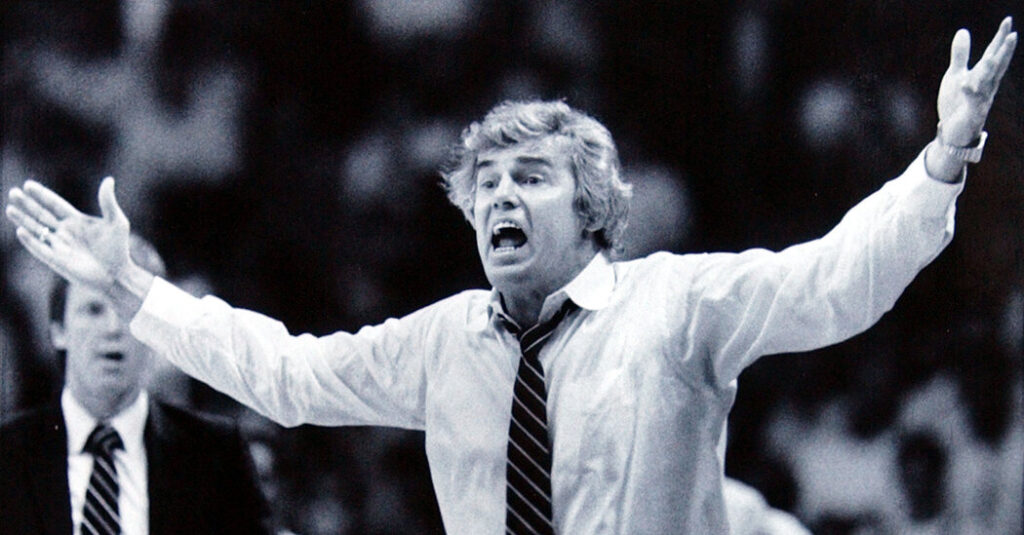
Doug Moe, an irreverent, freewheeling N.B.A. head coach who prided himself on rarely calling preplanned plays across 15 years on the bench, and whose promising playing career was curtailed by a connection to a college point-shaving scandal, died on Tuesday in San Antonio. He was 87.
Larry Brown, the Hall of Fame coach and a close friend and former college teammate of Moe’s at the University of North Carolina, said the cause was cancer.
A sports journalist’s dream, Moe was as colorful as he was unpredictable. He called players without great technical ability, but with intangible qualities of passion or instinct, “stiffs” — a term of endearment, he said, because “a stiff has no talent, but he can help you win.” Below that in his lexicon were “no-hopers,” players with neither talent nor intangibles.
Moe’s wardrobe, loud and rumpled, matched his full head of shaggy hair. He was once fined by the N.B.A. front office for throwing water on a referee. Dismayed by his players’ lack of effort in one game, he ordered them to stop playing defense after a certain point so that the opposition could set a team scoring record.
After coaching the San Antonio Spurs for several years in the late 1970s, he was hired by the Denver Nuggets in 1980. He was fired by the Nuggets in 1990 during a front-office shake-up by the team’s new owners, who thought he was a bit too animated and profane on the bench. This came despite him making the playoffs in nine of 10 seasons with the team and being named N.B.A. coach of the year in 1987-88.
Moe showed up for a news conference after the announcement wearing a Hawaiian shirt, uncorked a bottle of champagne and toasted the following season — when, under his contract, he would be paid for not working.
Moe would most likely have played in the N.B.A. had an N.C.A.A. investigation in 1961 not disclosed that while playing for North Carolina he had accepted $75 from a sports gambler in a meeting arranged by Lou Brown, a Carolina reserve player. Brown was indicted on a charge of trying to bribe teammates into “shaving points,” or intentionally underperforming.
No evidence was found that Moe had further participated in the scheme or adjusted his play, but he was barred from the N.B.A. along with other players of that era who had brushes with gamblers. He played professionally in Italy instead, until the American Basketball Association was formed in 1967.
That year Moe, who by then was 29, told the New Orleans Buccaneers, an A.B.A. team, that he would sign with them only if Larry Brown, with whom he shared Brooklyn and Carolina roots, could join him. The two played one season in New Orleans. The following season, they were traded in tandem to the Oakland Oaks, where they won the league title.
Moe, a three-time A.B.A. All-Star, played five seasons in the innovative league, which operated on the brink of bankruptcy, before a bad knee forced his retirement. He broke into pro coaching as an assistant with the A.B.A.’s Carolina Cougars before joining the Nuggets staff after Brown became the head coach there in 1974.
The roots of Moe’s coaching principles were explored in Terry Pluto’s 1990 book “Loose Balls,” an oral history of the A.B.A. In New Orleans, Moe, a 6-foot-5 forward, would leave a team huddle after the coach had diagramed a play and tell Brown: “Forget all that crap. Just get the ball to me and I’ll take it to the hole.”
The moral: Offense was all about instinct, not to be overthought.
Given his hyper-energetic style of offense, it was no coincidence when, on Dec. 13, 1983, Moe’s Nuggets lost a triple-overtime game to the Detroit Pistons, 186-184, that was the highest scoring game in N.B.A. history.
Another episode of turning players loose on offense occurred on the final day of the 1977-78 season, when Moe was coaching the Spurs and George Gervin, known as the Ice Man, was locked in a tight race with Denver’s David Thompson for the individual scoring title.
After Thompson edged ahead by scoring 73 points against Detroit in an afternoon game, Moe told his players to “get out of Ice’s way.” Gervin notched 63 against New Orleans that night to claim the title.
In a 1988 Sports Illustrated article on Moe’s high-octane Nuggets, Bill Hanzlik, a forward, said that the Nuggets essentially had one set play — for inbounding the ball. Moe described the offense as “basically doing whatever the hell you want.”
But Brown said in a telephone interview that Moe’s roll-out-the-ball reputation was only part of the story. Moe, he insisted, should also be remembered as a disciple of Dean Smith, who was an assistant coach during Moe’s time at North Carolina before succeeding Frank McGuire as head coach in 1961.
“Coach Smith, he had his set plays, but he also had what he called a passing game,” Brown said. “Passing, cutting, making sure everyone’s involved. Doug just took out the set plays and went with the passing game. He coached to his talent.”
Moe had great players to coach — Alex English in Denver, Gervin in San Antonio. He just never had the greatest. In the 1979 playoffs, his Spurs lost the seventh game of the Eastern Conference finals to the Washington Bullets, led by Elvin Hayes and Wes Unseld. In the 1985 Western Conference finals, his Nuggets were defeated by the Los Angeles Lakers of Magic Johnson and Kareem Abdul-Jabbar.
That was as close as Moe got to an N.B.A. title.
Douglas Edwin Moe was born in Brooklyn on Sept. 21, 1938, one of three children of Gunar and Dolores (St. Clair) Moe. The family lived in the Flatbush section, and his father worked in sales.
Moe was a star at Erasmus Hall High School in Flatbush and a two-time All-American at North Carolina, where he played from 1958-61 and, as a senior, averaged 20.4 points and 14 rebounds.
He married Jane Twisdale, a teacher, in 1961. He is survived by his wife; two sons, David and Doug Jr.; six grandchildren; and one great-grandchild. A third son, Barry, died three weeks after birth.
Though he retired to San Antonio, Moe remained one of Denver’s most popular sports figures. For winning 432 regular-season games with the Nuggets — his overall N.B.A. coaching record was 628-529 — the team in 2002 raised a banner with that number on it to the roof of the Pepsi Center (now the Ball Arena).
Watching his former team in 2013, on a night when Carmelo Anthony, a former Nugget, returned to Denver with the New York Knicks, the 74-year-old Moe delighted in how the Nuggets were dismantling the visitors with overwhelming pace.
Moe had worked with Anthony when he joined Coach George Karl’s Nuggets staff in 2003, a decade after his previous coaching job, with the Philadelphia 76ers, had lasted less than one season.
“Don’t you love watching them play?” Moe said to a reporter from The New York Times, referring to the Nuggets. “They play together, hit the boards, run on everything. They’re so much more fun than these teams that come down, hold the ball, one pass and then a shot.”
The post Doug Moe, 87, N.B.A. Coach as Freewheeling as His Style of Play, Dies appeared first on New York Times.