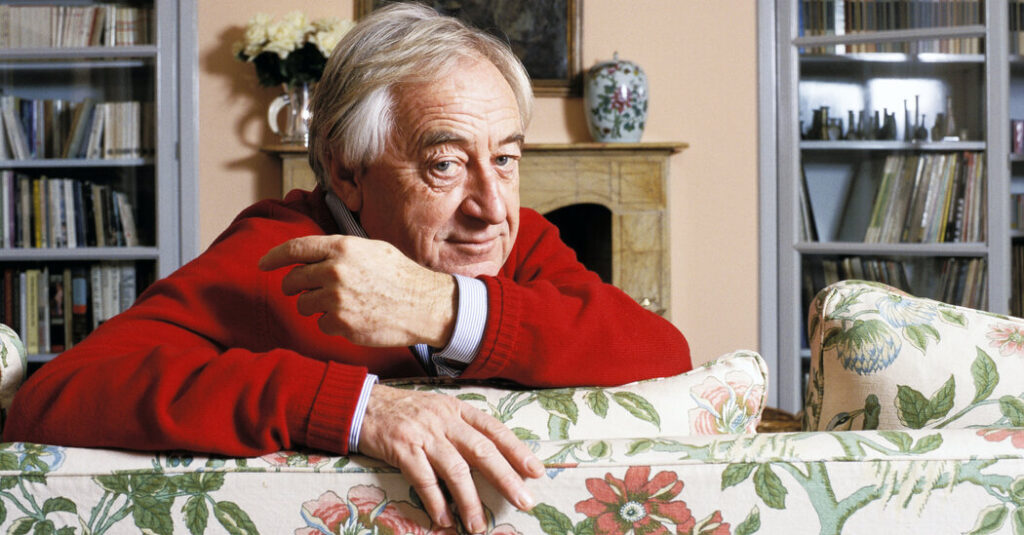
Cees Nooteboom, a Dutch novelist and travel writer whose sprawling body of work explored storytelling, memory and the disconnected fragments that make up a life, died on Feb. 11 at his home in Sant Lluis, on the island of Minorca, Spain. He was 92.
His death was announced by his publisher in Amsterdam, De Bezige Bij.
Mr. Nooteboom’s narrative experiments, erudition and cool, ironic style in novels like “Rituals” (1980) and “The Following Story” (1991) made him a literary hero in the Netherlands, where he received major prizes for dozens of works of fiction, poetry and travel writing. Large swaths of his output were translated into German, French and other languages, and he was often mentioned as a potential recipient of the Nobel Prize in Literature.
Only a fraction of his complete works has appeared in English, though he was called “one of the most remarkable writers of our time” by the Argentine-Canadian novelist and critic Alberto Manguel. He was championed by the influential German literary critic Marcel Reich-Ranicki and, early in his career, by the American critic Mary McCarthy.
In short, philosophical novels, Mr. Nooteboom (his full name is pronounced SACE NOTT-ay-boom) questioned traditional notions of plot, character and form, and his works tended to reflect on their own creation. The novelist and critic J.M. Coetzee wrote in 1997 in The New York Review of Books that Mr. Nooteboom’s work “is as much about its own processes and raisons d’être as it is about the fictitious activities of its personages.”
His fictions felt almost like they had been distilled to the words themselves, the material of Mr. Nooteboom’s poetry. He told the radio station France Culture in 2016 that “poetry is the nut of everything I do. It gives you a knowledge of language that helps you write novels.”
Plot and narrative drive did not concern Mr. Nooteboom. Instead, he mused on what constitutes a life and how a writer can reproduce it in art.
A character in his novel “Lost Paradise” (2004) says: “The riddle that other people represent has occupied me all my life. I know there is a story here, and at the same time I know that I will never find out what it is.” He might be speaking for the author.
In “Rituals,” the disaffected main character struggles to assemble a coherent whole from the shards that make up his life. The story, such as it is, concerns three intersecting lives, told in three sections: the dilettante, sensualist narrator; his austere, misanthropic mentor and foil; and the mentor’s reclusive, suicidal son, whose demise is juxtaposed with the destruction of a rare Japanese tea bowl, in a nod to Mr. Nooteboom’s fascination with Asia.
The narrator says he remembers “mostly unconnected incidents or lengthy stills of objects that for some inexplicable reason had been left behind in the empty attic of his memory.” His life was “a number of barely connected snapshots at which nobody would ever look.”
Mr. Nooteboom’s pointillistic style, evoking what he called in “Rituals” “the whole fabric of sensory perceptions,” reinforced one of his consistent efforts: making the narrator himself disappear into insignificance. Thus, an afternoon stroll in “Rituals” dissolves into “warmth,” “the half-hidden colors of flowers,” “the gently swaying lime trees,” until finally “all this gave him a feeling of not being. So much was happening he could easily be dispensed with.”
Later books play with concepts of storytelling and memory. “In the Dutch Mountains” (1984), for example, is a story within a story, containing a cool retelling of Hans Christian Andersen’s tale “The Snow Queen”; and “The Following Story” is apparently told after the narrator’s own death. “I had waked up with the ridiculous feeling that I might be dead,” the narrator says after finding himself lying unexpectedly in a Lisbon hotel room.
“When looking at my books, I find I have often written to explore questions about literature,” Mr. Nooteboom told The Guardian in 2006. “What is the difference between a myth and a fairy tale?”
Cornelis Johannes Jacobus Maria Nooteboom was born on July 31, 1933, in The Hague, the second of three children of Hubertus Maria Nooteboom, a businessman, and Johanna Carolina Christina Sophia (Pessers) Nooteboom.
The family moved constantly when Mr. Nooteboom was a child. His parents divorced in 1944, and his father was killed in an Allied bombing of The Hague in March 1945.
His mother remarried and he was sent to a series of Catholic schools. “They were rather severe places where I never fitted in,” he told The Guardian, but he learned the foundations of Greek and Latin and would return to classics like Virgil and Homer throughout his life.
Leaving home in 1951, he supported himself with a job at a bank and went on a series of hitchhiking trips through Scandinavia and France that provided the basis for his first novel, “Philip and the Others” (1954).
It was a success and won the inaugural Anne Frank Prize in 1957. But Mr. Nooteboom was skeptical about immediately setting to work writing more novels.
“I started too young,” he told France Culture. “I wrote a novel that became a cult back home. I said: ‘It can’t be that easy. You’ve got to think about it a bit.’ I understood that to write novels you have to know the world a bit.”
He wrote one more novel, “The Knight Has Died” (1963), before a long period in which he focused on traveling, bankrolled by regular articles he wrote about his journeys in the newspaper De Volkskrant and, later, in the glossy magazine Avenue.
“When you travel, you’ve got the time to think and reflect,” he said. “You’re alone in a hotel room, like a monk in a cell.”
“Rituals,” Mr. Nooteboom’s true breakthrough, followed this long period of novel-writing silence. It won the Pegasus Prize for Literature, was the first of his books to be translated into English and was adapted into a film in 1988.
Only a small number of Mr. Nooteboom’s many travel books have been translated, including “Roads to Santiago” (1997), a kaleidoscopic anthology on Spain’s history, art, architecture and geography; “Nomad’s Hotel” (2002), a collection with pieces on Africa, Australia, Germany and other places; and “Venice: The Lion, the City and the Water” (2020).
The travel works have generally been enthusiastically received, not meeting the occasional puzzlement, mixed with admiration, with which some reviewers have greeted his fiction.
Reviewing “In the Dutch Mountains,” Mr. Coetzee identified Mr. Nooteboom’s “peculiar misfortune as writer: that he is too intelligent, too sophisticated, too cool, to be able to commit himself to the grand illusioneering of realism, yet too little anguished by this fate — this expulsion from the imaginative world of the heartfelt — to work it up into a tragedy of its own.”
Mr. Nooteboom is survived by his wife, the photographer Simone Sassen, who became his companion in 1979. They were married in 2016. An earlier marriage to Fanny Lichtveld ended in divorce in 1964.
His ceaseless voyaging was a constant effort at renewal and self-education. His travels were fuel for his novels, and spiritual fuel, as well.
“I didn’t do university studies,” Mr. Nooteboom said in 2016. “My monastery was the world. I don’t have any plan.”
Adam Nossiter has been bureau chief in Kabul, Paris, West Africa and New Orleans and is now a writer on the Obituaries desk.
The post Cees Nooteboom, Voyaging Author of Enigmatic Novels, Dies at 92 appeared first on New York Times.