LONDON — Andrew Mountbatten-Windsor has been driven around in the backs of cars for his whole life. He has been accompanied by police since he was a boy going to school. But nothing in his life of supervised privilege would have prepared him — or his family, or his country — for the ride he took Thursday morning.
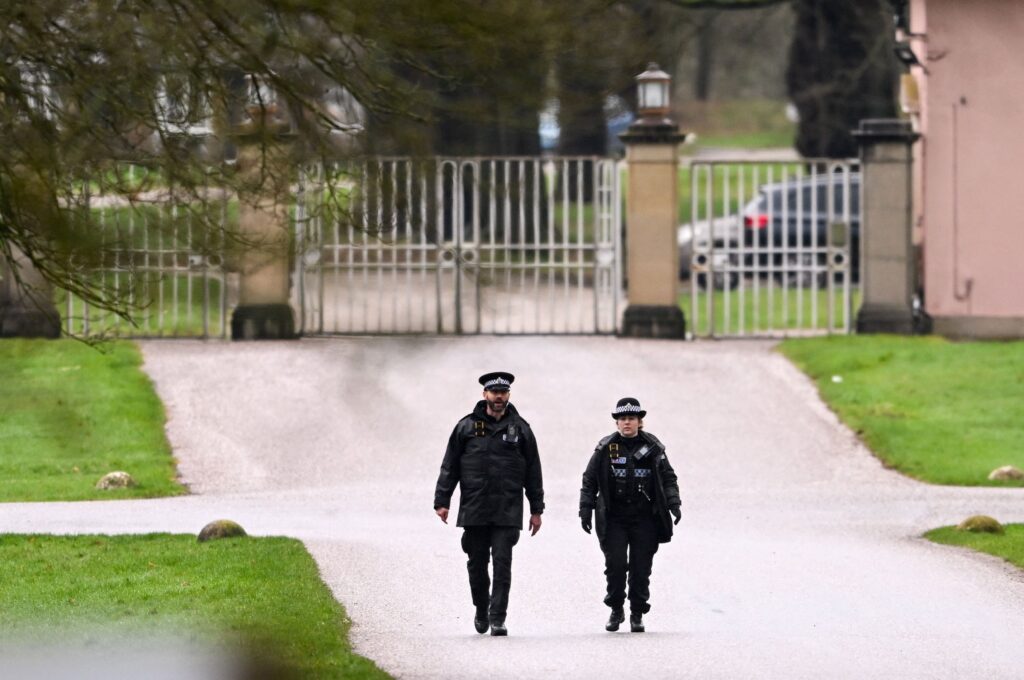
The unmarked cars arrived early on a gray Norfolk morning at Sandringham estate, that most English of royal retreats, where monarchs have gone to hunt, to grieve and to die. This time they came for something else — to arrest the king’s brother on his 66th birthday.
The moment that Thames Valley Police confirmed what the BBC had already broadcast to a stunned nation — that Mountbatten-Windsor, former prince, former Duke of York, former favorite son of the late Queen Elizabeth II and former friend of sex trafficker Jeffrey Epstein, was in custody on suspicion of misconduct in public office — the British monarchy crossed a threshold it had not approached in nearly four centuries.
The last senior royal arrested was King Charles I, in 1647. He was executed two years later. The comparisons are inexact, but the historic weight is not. Mountbatten-Windsor, for sure, will not be beheaded. But a more nuanced question confronts the royal family: Can the House of Windsor survive this one?
The monarchy has outlived scandal before — abdication, divorce, Princess Diana, a thousand lesser storms. It has survived by adapting just enough, just in time. But does that formula still hold in an era when Epstein documents and photos arrive by the millions, and anti-monarchy groups pounce on every misstep?
Is it enough to keep calm and carry on with the muted apologies and symbolic gestures of contrition when social media can outstrip the most disciplined palace PR machine, and when a generation of Britons under 35 looks at the Crown and sees, with increasing frequency, something they did not ask for and do not need?
Mountbatten-Windsor’s arrest, on unspecified allegations of misconduct in public office, came after weeks of revelations over his friendship and dealings with Epstein, and following the release of millions of Justice Department files related to the disgraced financier who died in prison.
The specific charge seems narrow in legal terms but corrosive in symbolic ones — that the then-Prince Andrew, a senior royal and a British official, shared confidential reports about his visits as an official British trade envoy to Singapore, Hong Kong and Vietnam, including details of investment opportunities, with Epstein.
Mountbatten-Windsor also maintained his friendship with Epstein long after the financier’s 2008 guilty plea on a charge of soliciting sex from a minor. Advocates for Epstein’s victims noted the disparity in the official response to allegations that Mountbatten-Windsor sexually abused 17-year-old Virginia Giuffre — stripping him of titles and downgrading his free royal residential quarters — but arresting him only in connection with leaking classified investment tips.
The implications for the royal family may be just as serious. Some polls show that the Epstein affair is badly eroding public trust in the monarchy. A Savanta poll conducted this month showed support for the monarchy at just 45 percent, down from 63 percent as recently as 2020. Support among 18-to-24-year-olds had dropped to 23 percent.
The palace said King Charles III was given no advance notice that his brother was to be taken into custody, which allowed supporters to say that Mountbatten-Windsor was receiving none of the special treatment that saturated his life when he was still Prince Andrew. Any other approach was probably impossible at a time of declining reverence for the royals, even for a man still officially eighth in line for the throne.
“It is the first age in which someone who was very recently a senior royal could be treated like any other common criminal,” royal historian Sarah Gristwood told NBC News. It was, Gristwood said, “an awful day for the evolution of an institution that has lasted over a thousand years.”
For the monarchy, the arrest came not as a bolt from the blue but as the bottoming-out of a long, grinding erosion. Charles had been forced to act against his brother after the Justice Department released an initial wave of Epstein documents revealing how long his relationship with Mountbatten-Windsor endured after Epstein’s guilty plea.
The king stripped his brother of his titles, ordered him to leave the Royal Lodge, and — in an extraordinary public signal after police said they were investigating his brother’s official actions — announced that Buckingham Palace would cooperate with any inquiry.
On Thursday, the machinery of the monarchy grinded on. Queen Camilla attended a lunchtime orchestral concert; Charles received a new Spanish ambassador at St. James’s Palace. But in the midst of their rounds, the king issued a statement distancing himself even further from his brother.
Signed, unusually, as “Charles R” rather than channeled through palace aides, the note was a careful exercise in distance-setting. “The law must take its course,” he wrote. “My family and I will continue in our duty and service to you all.”
It was, in the argot of crisis communications, a severance notice.
Some royal observers said they believed the distance would be enough.
“I think we have to separate the notion of a family from the institution of the monarchy,” royal commentator Jonathan Dimbleby told the BBC. “I do not see that because one member of the royal family was arrested and may be charged with a very serious offense, that brings the institution into disrespect.”
Some polls suggest that the public is making a distinction between the disgraced Mountbatten-Windsor and the monarchy that has slowly booted him from of its inner circle. A YouGov tracker from January found that 90 percent of Britons view Mountbatten-Windsor negatively, while 64 percent still believe Britain should continue to have a monarchy.
William and Catherine, the Prince and Princess of Wales, who have been among the family members most critical of Mountbatten-Windsor, remain highly popular. And the king’s deliberate efforts to remove himself from his brother, painful and belated as they were, reflect a man who at the very least understands the arithmetic of scandal, experts said.
The monarchy’s many critics, however, can well smell blood on the crown. The arrest was triggered, at least in part, by the anti-monarchy group Republic, whose chief executive, Graham Smith, filed the police report said to have set the investigation in official motion.
“Make no mistake, this is a consequence of Republic taking action when others wouldn’t,” Smith posted on X. “The police had to investigate after I reported Andrew on these allegations.”
Smith called on Charles and William to “speak up and admit to whatever they have known, when and why they continued to protect Andrew” — a rhetorical escalation that, while disputed, reflects the direction in which anti-monarchy forces intend to push.
Royal biographer Andrew Lownie, writing on his Substack before the arrest, had framed the confidential-documents allegation in starkly damning terms, noting that no one even needed to blackmail the then-prince to get him to betray the state. “Greed alone was sufficient to lead him to compromise governmental and commercially sensitive documents,” Lownie wrote.
Mountbatten-Windsor can be held for up to 24 hours before police must charge or release him, or up to 96 hours if he is suspected of a more serious crime. The charge of misconduct in public office carries, in the most severe cases, a maximum sentence of life imprisonment.
Not as bad as having his head chopped off, but still a grievous blow for his family and what they represent. And possibly, at least, a mortal one.
The post Arrest of Andrew, brother of King Charles, shakes the House of Windsor appeared first on Washington Post.