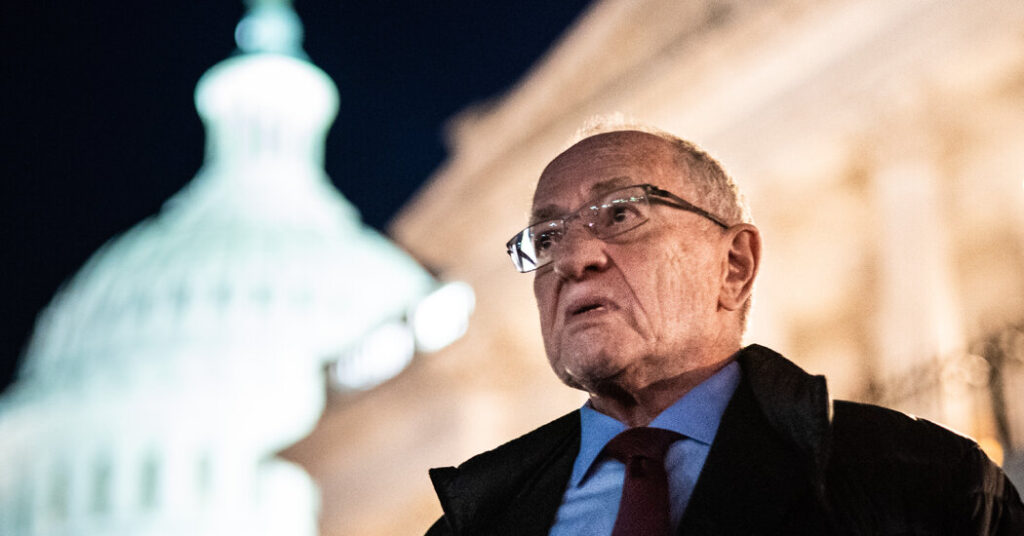
Hello! This week I’m looking at the latest threat to New York Times v. Sullivan — the landmark 1964 Supreme Court decision protecting press freedom — and the surprisingly complicated stance of the man bringing the challenge, Alan Dershowitz.
Dershowitz, the combative Harvard law professor and frequent television guest, has represented O.J. Simpson, Jeffrey Epstein and President Trump. He was also a Supreme Court law clerk in 1964 and so present at the creation of the Sullivan decision.
Now, to hear him tell it in a petition seeking review of a decision rejecting his libel suit against CNN, he wants to destroy it.
“The concerns that animated Sullivan no longer match the reality of modern media,” the petition said. “Sullivan has outlived any claim to validity it might once have had.”
Sullivan and the decisions that followed in its wake made it very hard for government officials and public figures to win libel suits. Dershowitz, who claims CNN defamed him by mischaracterizing his defense of Trump during an impeachment trial, said he would have won but for Sullivan.
CNN, for its part, waived its right to file a response to Dershowitz’s petition, a move usually reserved for cases that are insubstantial if not frivolous.
I might have thought CNN was testing the court’s patience by failing to file a brief, but Dershowitz said he admired the network’s moxie. “If I were CNN, I would have waived as well,” he told me on Monday. “I think that trivializes the case.”
At that point, the justices were scheduled to consider whether to accept the case at their private conference Friday. Two of them — Justices Clarence Thomas and Neil M. Gorsuch — had previously urged the court to reconsider Sullivan. It takes four votes to grant review.
But on Tuesday, the court told CNN to file a brief after all, and put off deciding whether to hear the case until it does. A lawyer for the network did not respond to my requests for comment.
The Supreme Court has in recent terms overturned precedents on abortion, affirmative action and the power of administrative agencies. Overruling Sullivan would be a comparable shock.
Dershowitz Draws a Distinction
As we talked, it turned out that Dershowitz’s take on Sullivan was considerably more nuanced than that passage in his petition suggested. He is fine with the decision itself, he said, noting that it originally applied to government officials and was only later extended to cover public figures like him.
Indeed, he said, he had helped draft a concurring opinion in the case as a law clerk to Justice Arthur Goldberg. It said the majority had not gone far enough.
The majority required public officials to prove not only that the contested statement was false and defamatory, but also that it had been made with “actual malice,” meaning with knowledge it was false or with serious subjective doubt about its truth.
That is a high bar, but Justice Goldberg would have gone further. He called for “an absolute, unconditional privilege to criticize official conduct despite the harm which may flow from excesses and abuses.”
Trump, who has said he wants to “open up our libel laws,” would not be a fan of that approach.
I asked Dershowitz what he thought of Justice Goldberg’s opinion today. He said it was correct.
Why, then, the call for flatly overruling Sullivan in the petition? “It’s a tactical position,” he said. “What we’re doing is we’re basically giving the court every option.”
Most of the petition, to be sure, was concerned with proposed limits on decisions that came after Sullivan and extended its actual malice requirement to private individuals, such as celebrities and people caught up in public controversies. Questioning those moves is hardly a fringe position.
“In extending Sullivan,” Justice Elena Kagan, then a law professor at the University of Chicago, wrote a 1993 book review, “the court increasingly lost contact with the case’s premises and principles.”
The point of Sullivan, she wrote, was to make sure that “the citizenry receive important information about the conduct and policies of government officials.”
Protecting that sort of speech at the cost of harm to officials’ reputations seems a fair trade-off. Speech about movie stars may require a different calculus.
A Portrait of an ‘Intellectual Who Has Lost His Mind’
The CNN case concerns an extended statement Dershowitz gave while representing Trump in 2020 at his first impeachment trial in the Senate. That seems pretty close to Sullivan’s premises and principles.
On the floor of the Senate, Dershowitz proposed a three-part test to determine if a president harbored a motive that could warrant his removal from office. Acting in the public interest was a permissible motive, he said. So was pursuing his own political interest to help ensure re-election. But a desire for “personal pecuniary interest” was fair game for removal.
The bit that got a lot of attention was the second part of his test, and commentators on CNN and many other outlets were outraged. “The Dershowitz Doctrine would make presidents immune from every criminal act,” Paul Begala, a former adviser to President Bill Clinton, wrote in a CNN opinion article.
In his lawsuit, Dershowitz accused the network of willfully distorting his views by omitting his third point. CNN’s goal, he said in his complaint, was “to falsely paint Professor Dershowitz as a constitutional scholar and intellectual who has lost his mind.”
A Judicial Finding of Foolishness and Apathy — But Not Libel
Judge Raag Singhal, of the Federal District Court in Fort Lauderdale, Fla., was not a fan of CNN’s commentary.
“The evidence before the court — while establishing foolishness, apathy and an inability to string together a series of common legal principles — does not establish actual malice under the Sullivan standard,” wrote Judge Singhal, who was appointed by Trump.
Judge Singhal was not a fan of Sullivan, either, calling it “a great example of how bad facts can contribute to the making of unnecessary law, and why judges and justices should not be in the business of policy writing.”
But he reluctantly ruled for CNN. “The Sullivan case, decided at a time when people got their news from Walter Cronkite or David Brinkley as opposed to Twitter, is the law of the land, and this court is duty bound to follow it,” the judge wrote.
The U.S. Court of Appeals for the 11th Circuit affirmed that decision, ruling that even if “commentators did report incorrectly on Dershowitz’s statements, he has offered no evidence that they did so intentionally.”
But Judge Barbara Lagoa, another Trump appointee, said she agreed with Judge Singhal that “the only thing standing between Dershowitz and justice is Sullivan.”
The Supreme Court grants very few petitions seeking review. But, according to one study, a request for a response like the one issued on Tuesday boosted Dershowitz’s chances to 17 percent from just 4 percent.
Other Legal News
-
The United States is an outlier in allowing extreme partisan gerrymandering.
-
Environmental and health groups sued the E.P.A. over its elimination of a foundational “endangerment finding” that justified regulating greenhouse gases.
-
Bayer, the German pharmaceutical company, agreed to pay $7.25 billion to settle lawsuits that claimed the weedkiller Roundup caused non-Hodgkin’s lymphoma.
Mailbag
Justice in the Shadows
What distinguishes the shadow docket from the traditional docket? — Mark Sciumeca
The “shadow docket” is a term coined in 2015 by William Baude, a law professor at the University of Chicago, in an effort to look beyond the Supreme Court’s argued cases to “a range of orders and summary decisions that defy its normal procedural regularity.”
These days, critics use the “shadow docket” to refer to applications that rocket up to the court on thin briefs and yield brisk but consequential orders, which are intended to govern the state of play while a case is litigated in the lower courts. The justices don’t care for the term, preferring “emergency docket” or “interim docket.”
Whatever the name, the court has sided with the Trump administration in a large majority of the orders it has issued in response to its applications over the last year.
Send us your questions at [email protected].
What I’m Reading
-
“Actual Malice: Civil Rights and Freedom of the Press in New York Times v. Sullivan,” Samantha Barbas’s meticulous and gripping reconstruction of the case, which was as much a victory for the civil rights movement as it was for press freedom.
-
“The President Who Would Not Be King,” Michael McConnell’s exploration of the founding generation’s hopes for and fears of a vigorous chief executive.
-
Justin Driver’s “The Insignificance of Judicial Opinions,” an essay in The California Law Review that makes the case that what courts do matters much more than the justifications they offer.
-
Lev Menand’s “The Unitary Executive and the Federal Reserve,” to be published in The Fordham Law Review, questioning whether there is a principled way to let presidents remove the leaders of independent agencies but shield Federal Reserve officials.
Closing Argument
Deepfake Videos, Satire and the First Amendment
Can the law take a joke? Can democracy?
California, Hawaii and at least 20 other states have enacted laws that try to address a threat to the integrity of elections: deepfake videos generated by artificial intelligence that seem to show candidates saying things they never said.
The laws vary in their details, but they generally prohibit videos that could deceive voters. They tend to allow satire and parody, but only if the videos include a disclaimer.
The Babylon Bee, the conservative humor site whose motto is “fake news you can trust,” challenged the laws in California and Hawaii on First Amendment grounds, saying they misunderstood how comedy works.
“Satire and parody make audiences do a double take by believing that they are seeing a serious rendering of an original,” the site’s complaint in the California case said, “and then allowing them to laugh at their own gullibility when they realize that they are really viewing satire or parody.”
Judge John A. Mendez, of the Federal District Court in Sacramento, agreed. “A mandatory disclaimer for parody or satire would kill the joke,” he wrote in a ruling in August that blocked enforcement of the law against The Bee and other plaintiffs.
“The government may not dictate the canon of comedy,” wrote Judge Mendez, who was appointed by President George W. Bush.
Judge Shanlyn A.S. Park of the Federal District Court in Hawaii followed suit last month. Judge Park, who was appointed by President Joe Biden, acknowledged that Hawaii had a compelling interest in “protecting the state’s electoral integrity — an essential democratic function.” But she said there were more targeted ways to do that, proposing, for instance, an educational campaign to increase digital literacy.
The Bee was represented in both cases by Alliance Defending Freedom, a conservative Christian group that has an agenda broader than jokes.
“We can’t trust the government to decide what is true in our online political debates,” Johannes Widmalm-Delphonse, a lawyer with the group, said in a statement last year.
And sometimes the line between satire and reality vanishes. In 2020, apparently thinking it was a real news article, Trump reposted a fake report from The Bee: “Twitter Shuts Down Entire Network to Slow Spread Of Negative Biden News.”
“Wow,” the president wrote. “This has never been done in history.”
See you next Thursday. — Adam
Adam Liptak is the chief legal affairs correspondent of The Times and the host of The Docket, a newsletter on legal developments. A graduate of Yale Law School, he practiced law for 14 years before joining The Times in 2002.
The post A Press Freedom Case in Peril, From a Lawyer Who Helped Write It appeared first on New York Times.