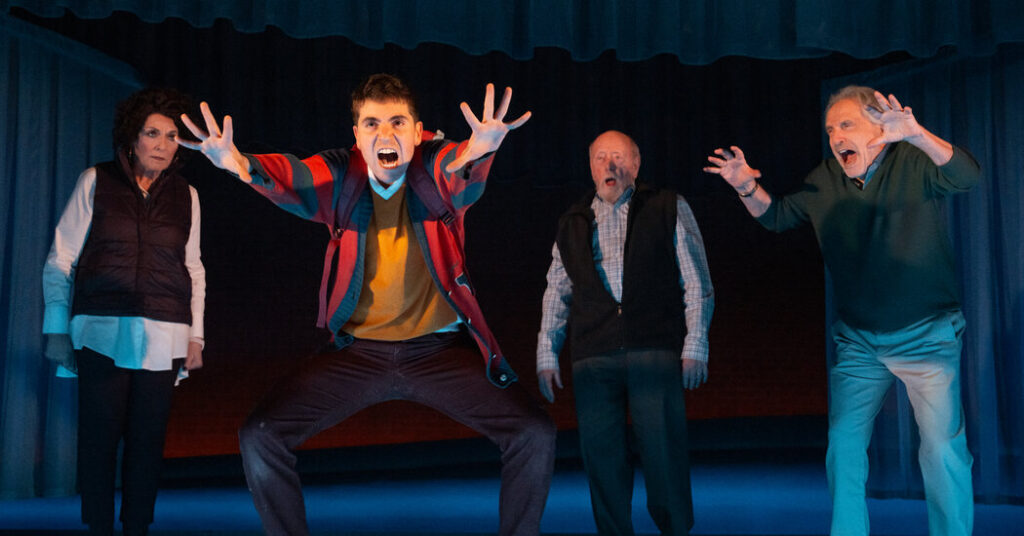
Jacob Perkins got sober in December 2019, only three months before the coronavirus pandemic abruptly suspended ordinary life and, with it, the in-person recovery meetings that he had found so healing. Sticking with his recovery, he transitioned to online sessions, which were fine but not the same.
“So I was dreaming of meeting again, of joining again with other people,” he said one morning this month at Playwrights Horizons, where “The Dinosaurs,” the play he wrote while the world was shut down, is making its premiere on the main stage. It’s the story of a recovery group for alcoholics that convenes weekly for years in the same spartan room, each member keeping a personal tally of time elapsed since their last drink.
When Perkins was writing its first few scenes, he attended an anniversary meeting on Zoom at which people were celebrating sobriety of vastly different durations — “like, one minute,” he said, or 60 years. He added: “And that person who had 60 years could come back tomorrow with one minute.”
Plays about addiction and recovery are having something of a moment in Manhattan. Three are Off Broadway: “The Dinosaurs”; Joe White’s duet of self-destruction, “Blackout Songs”; and Jake Brasch’s intergenerational comedy, “The Reservoir.” A fourth, Nicholas Thomas’s immersive “Anonymous,” is making a return engagement at a small space in Greenwich Village.
Conventional wisdom says that audiences right now crave the escapism of at least semi-mindless hilarity. But at Atlantic Theater Company, which is a co-producer of “The Reservoir,” Neil Pepe, the artistic director, begged to differ.
“If you or I could go over all the plays that we’ve loved over the past 40 years, I think a lot of them probably deal with some pretty heavy stuff,” he said, citing another show about chemical dependency — the musical adaptation of the classic film “Days of Wine and Roses” that Atlantic produced to acclaim in 2023, then moved to Broadway.
Recent seasons in New York and elsewhere have also seen Sean Daniels’s “The White Chip,” Duncan Macmillan’s “People, Places & Things,” David Ireland’s “The Fifth Step” and Michael Levin’s “Sober Songs.”
For all the inherent drama of addiction, though, the subject of dementia is what interested both Brasch and White when they started their plays. White, who lives about an hour south of London, had witnessed up close the destruction that Alzheimer’s disease wrought on friends’ families as the illness unpicked what he called the “patchwork” of memory that human relationships depend on.
“The shared narrative is really important to us, to our identities, our existence,” he said by phone. “And when you see integral parts removed, when you see somebody who can’t remember — you’re telling this story you’ve told every Christmas or whatever, and somebody is just gone, or there’s a blank there — it’s quite violent, really.”
But he didn’t want to write Florian Zeller’s play “The Father” all over again. Then he heard of the death of someone he’d lived with in college who had been an alcoholic, and realized that his own memories of the heavy-drinking time they’d shared were missing or hazy, the chronology out of joint.
He began to imagine a play in which two characters’ meet-cute happens someplace it shouldn’t, at an Alcoholics Anonymous meeting, where dating within the group is discouraged. That would be followed by a second encounter, in which one of them has no recollection of the first.
Currently running at the Robert W. Wilson MCC Theater Space in Hell’s Kitchen, “Blackout Songs” is a headlong, bloody, gap-filled romance between hardcore alcoholics: an oblique memory play, recalled in shards by the half of the couple who’s left standing at the end.
White said that addicts love to tell him post-show whether they think that character will stay sober, or keep drinking for several years more. Opinions are split.
Brasch’s “The Reservoir” is tonally completely different, and for its author, closer to the bone. It opens with Josh, a New York University student on medical leave, waking up at sunrise in Denver, outdoors, with no memory of how he got there.
“It’s not autobiographical,” said Brasch, a recent Juilliard School graduate who is from Denver and has a bachelor’s degree from N.Y.U. “But it’s pretty emotionally autobiographical, and borrows from the darkest time of my life, in which I had to move home and get sober.”
For Brasch, that meant rehab, where he remembers, foggily, watching the Ben Kingsley recovery comedy “You Kill Me.” He isn’t even sure it was good, but it was a catalyst for an important epiphany.
“Taking someone through the narrative of a recovery arc, and having comedy be the fuel that pulls someone through, made me feel so seen as an artist, and as someone getting sober,” he said the other day over coffee in Chelsea. “I was like, that’s what I want to do.”
And so he does in “The Reservoir,” which was staged last year in Denver, Atlanta and Los Angeles. The play braids the story of Josh’s gradual healing with the stories of Josh’s four grandparents, some bedeviled by Alzheimer’s of varying severity, one an alcoholic decades in recovery. Commissioned and developed by Ensemble Studio Theater and the Alfred P. Sloan Foundation, co-producers with Atlantic, the play has a subtle scientific seam. But Brasch very much leads with laughter.
“I’m someone who copes through humor, I’m someone who evades through humor,” he said. “That is how I deal with the difficult things.”
Popular culture contains no shortage of addiction and recovery narratives. Brasch reeled off several others that had affected him: the TV shows “BoJack Horseman” and “Nurse Jackie,” Augusten Burroughs’s memoir “Dry,” David Foster Wallace’s novel “Infinite Jest.”
Still, publicly addressing a topic as personal as sobriety is a complex and vulnerable undertaking.
“This is a play I wrote six years ago, when I was closer to what it felt like to be in the thick of this,” Brasch said. “Now I don’t think I could necessarily write a play that’s this honest to my own experiences, but I also don’t know if necessarily I would.”
A further consideration is the A.A. taboo against shedding one’s anonymity in the media. But he hopes his doing so will help people, the way it helped him when he was, as he said, “in dire straits” and called the one person he knew who had gotten sober.
Perkins, who is in his final semester of graduate study for clinical mental health counseling at Virginia Tech, arrived at the same decision, reasoning that Leslie Jamison’s getting-sober memoir, “The Recovering,” had saved his life when he read it during his first few weeks of recovery.
With “The Dinosaurs,” Perkins also wanted to evoke onstage the kind of safety that he had felt in recovery meetings for queer and trans people. In the play, he has made it a “women’s and trans-inclusive” group, because Clubbed Thumb, which commissioned the script, asked for a majority of female roles.
The actor Keilly McQuail, who said she grew up “in and around” recovery spaces but was not part of a program herself, plays the one character new to the group. To her, Perkins’s depiction of recovery, more welcoming than the patriarchal version she remembers, is akin to “a coming home, but the furniture’s in the right place.”
“It feels like I’m getting to learn all over what recovery is, could be like, wholly separate from the wounds that brought me into those rooms when I was young,” she said.
Downtown, Thomas’s play “Anonymous” — at Spit&Vigor’s Tiny Baby Blackbox Theater, a third-floor walk-up space — enacts a meeting that blends elements of A.A. with a group counseling session. Spectators sit in the circle alongside the actors, albeit with zero audience participation. The maximum capacity is 20 (plus cast), and the hot coffee that perfumes the air is offered to everyone.
Thomas, who is 13 years sober and had never been to an A.A. meeting before he wrote the play in 2023, wanted to give people who had not experienced addiction or recovery “an opportunity to glimpse in that window,” he said.
Perkins, with “The Dinosaurs,” doesn’t beckon his audiences to come that close. But he does see recovery meetings as useful models of acceptance and coexistence in a riven society, with people given the vital space to speak honestly and the latitude to mess up without being banished for it.
“Someone can have a slip and say something offensive or problematic. You don’t kick them out,” he said. “You say, ‘Come back tomorrow.’ That is radical now.”
There is, to his mind, a certain significance even to occupying a seat at a meeting that hundreds or thousands of others also have, or will.
It is “a metaphor for theater, for life, for recovery,” Perkins said. “You are not the only one who will sit in that chair.”
The post 12 Steps and Cups of Coffee: Sobriety Has Its Moment Onstage appeared first on New York Times.