Setting a boundary might seem like something we impose on others — cutting people out of our lives, or having them change their behavior — but the term is misunderstood.
Boundaries aren’t meant to control another person’s actions, said KC Davis, a therapist and author of “Who Deserves Your Love: How to Create Boundaries to Start, Strengthen, or End Any Relationship.” Instead, we set boundaries when we decide on and communicate our personal limits. And we reinforce them when we choose how we’ll behave accordingly.
Doing so, even in the face of pushback, can improve our relationships, Davis said. But that doesn’t make it easy, she added.
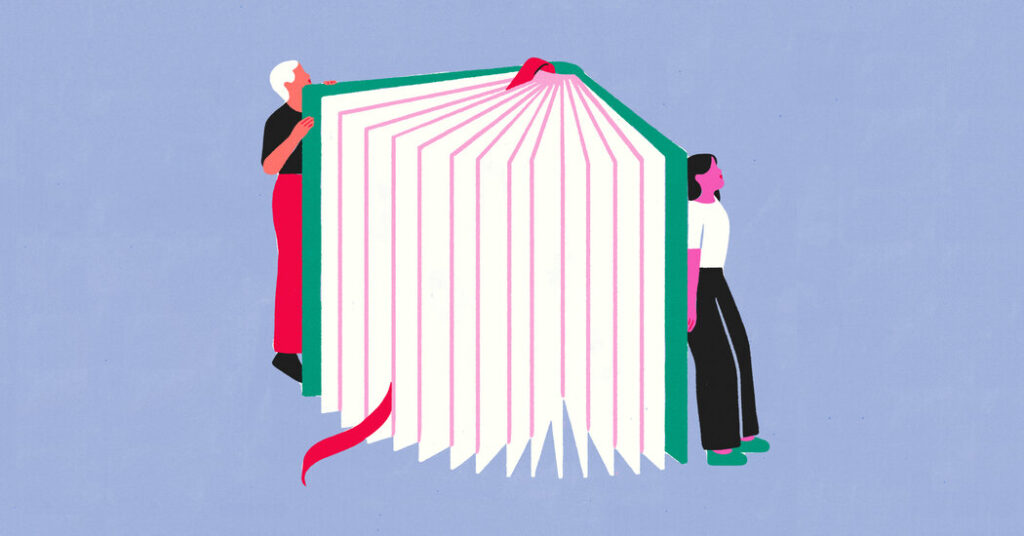
To help people enforce their limits in healthy ways, some therapists direct them to books. Cracking one open can “reassure readers that it’s OK to not immediately know how to do this,” said Alex Iga Golabek, a therapist in Stratford-upon-Avon, England. “It’s OK to try things out and see what works.”
We asked psychologists, therapists and researchers to share the books they recommend. These five titles offer insights and tools for safeguarding your needs.
‘Set Boundaries, Find Peace’ by Nedra Glover Tawwab
Even if we know that we should set boundaries, figuring out how can be daunting. Through real-world scenarios, Ms. Tawwab, a therapist who focuses on relationships, explores what boundaries look like in daily life.
Alexandra Solomon, a clinical psychologist and the host of the “Reimagining Love” podcast, recommends the book, published in 2021, for its useful scripts. For instance, responding to a request with “I can’t help you this time,” or “Thanks, but I won’t be able to make it,” rather than by making up an excuse, can be an effective way to establish a boundary.
Dr. Solomon said she also appreciated how Ms. Tawwab “holds her readers’ feet to the proverbial fire.” We can’t change other people; we can only change ourselves, Dr. Solomon said. The book helps us stay “self-compassionate while holding ourselves accountable for the changes we want to see in our relationships,” she said.
‘Atlas of the Heart’ by Brené Brown
This 2021 book explores how emotions intersect with our self-development. In a chapter called “Places We Go With Others,” Dr. Brown, a professor of social work at the University of Houston, explains the consequences of having porous boundaries. It often leads to enmeshment, a psychological term that describes relationships with such blurry boundaries that it becomes hard to separate or even understand individual needs.
The beauty of Dr. Brown’s work is that it shows the challenges of boundaries, said Ramani Durvasula, a psychologist and the author of “It’s Not You.” Sometimes, she added, “when you set a boundary, you do lose someone.”
‘Boundaries’ by Anne Katherine
Published in 1991, this book is considered a classic. For Jameca Woody Cooper, former president of the Missouri Psychological Association, its thorough description of boundaries, and what to do when they are broken, is invaluable.
Ms. Katherine, a retired psychotherapist who practiced for over 40 years, writes that setting boundaries is an “advanced type of communication.” In her chapter on intimacy, for example, she says that many of us long for more connection with our partners, but failing to set boundaries can prevent us from greater closeness. Expressing what we need helps us become better communicators, speaking and listening with empathy, she writes.
That distinction is helpful because “it shifts the common perception of boundaries from being restrictive to being enabling,” Dr. Woody Cooper said.
‘But What Will People Say?’ by Sahaj Kaur Kohli
People might assume that boundaries involve just two parties — the boundary-maker and the recipient — but this book reminds us that there’s a social system to consider, Dr. Durvasula explained.
Dr. Durvasula recommends this 2024 book to her clients, especially children of immigrants who were largely raised in the United States. Through memoir, research and practical tools, Ms. Kohli, a licensed therapist, urges readers to recognize how larger contexts, including ancestry and extended families, can shape how we understand boundaries.
In some cultures, “boundaries aren’t even a thing,” Dr. Durvasula said. “The guilt, fear, shame and loss of face that can accompany boundary-setting makes ‘no’ a very complicated word,” she said.
Chapters like “What’s Faith Got to Do With It?” and “Uncovering My Family History” break down the environments we were raised in and offer strategies to help in specific situations. Understanding our history, Ms. Kohli argues, is the first step in establishing limits that work.
‘The Assertiveness Workbook’ by Randy J. Paterson
This book directly supports “setting and maintaining boundaries through clear communication,” said Ryan Warner, a psychologist in Houston.
First published in 2000 and recently updated, this workbook includes practical exercises on how to say “no” or handle confrontation. It features an assertiveness scorecard — a checklist you use after conversations, indicating whether you were passive, aggressive or assertive — meant to help you notice your patterns.
It’s “a master class in stronger communication and improved relationships across the board,” said Katherine Morgan Schafler, a former in-house therapist at Google. It’s her “go-to for a boundary reset” when she wants to express herself more clearly, she said.
The post 5 Books for Setting Better Boundaries appeared first on New York Times.