After an avalanche, time is critical for anyone hoping to be rescued from the wall of snow that has been unleashed. But as the hours wear on and search efforts make the grim shift from rescue mission to body recovery, the calculus becomes more complicated. No longer is speed the only imperative — so is the safety of the searchers.
That was the situation that confronted officials working to find and evacuate the 15 skiers who were overcome by an avalanche the size of a football field in a rugged stretch of backcountry near Lake Tahoe on Tuesday.
Six members of the group survived and were able to contact rescuers, who made a perilous trek to reach them on Tuesday evening. At least eight others did not survive, making the avalanche the deadliest in modern California history. Their bodies were found not far from where the survivors had been found. The last member of the group was still missing as of Wednesday afternoon and was presumed dead, officials said.
“Initially, the call-out was much more high risk, since we had at least six survivors,” said Ashley Quadros, a spokeswoman for the Nevada County Sheriff’s Department, which was leading the search and rescue effort. “We’re going to take those risks when there’s a chance people might not make it through the night.”
But now, she said, emergency response officials are weighing numerous other factors before sending search teams — made up almost entirely of volunteers — from across the region to continue their work and bring back the bodies of those who were killed.
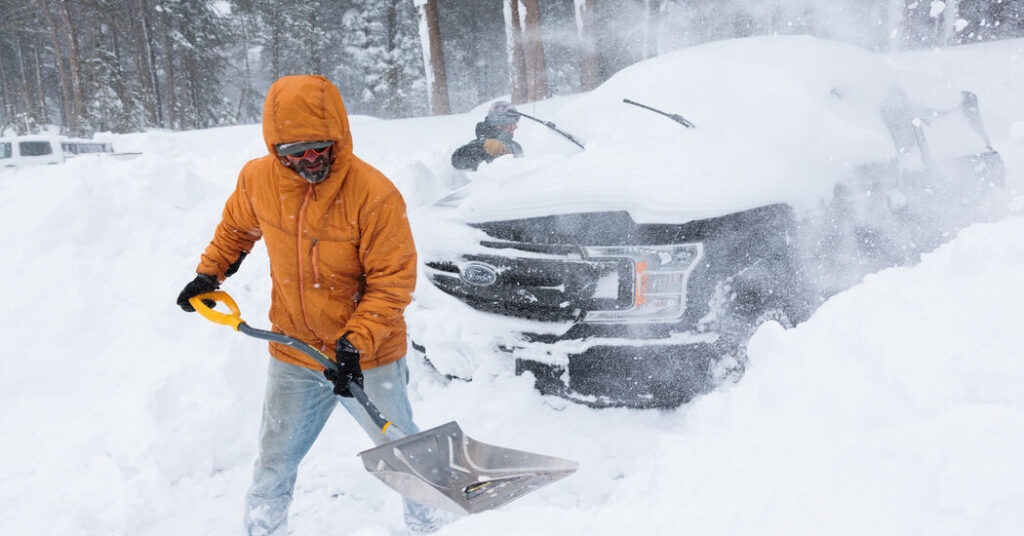
Forecasters have said that heavy snow could continue into Thursday, bringing with it the danger of more avalanches that could both bury remains deeper in snow and engulf rescuers. Experts will continue to test the snowpack regularly to assess whether it is safe for teams to head back to the site of the avalanche.
And while officials in the cluster of communities dotting the northern Sierra Nevada have begged drivers, skiers and others venturing into the backcountry to stay away, there is also the risk that rescuers will be called to other disasters.
That prospect, Ms. Quadros said, is “another variable that’s going to change daily, if not hourly.”
She said late Wednesday afternoon that almost two dozen search and rescue personnel were actively working on the recovery efforts, which she expected to continue into the weekend.
Emergency officials said that they were considering using aircraft to reach the victims if the weather improved.
The group had been staying in cabins on the remote Frog Lake near Castle Peak, a popular skiing destination, for a three-day backcountry skiing expedition led by Blackbird Mountain Guides. The skiers, including four guides, had been finishing up their expedition in the rugged area when the avalanche occurred. The six survivors were able to use a combination of emergency beacons and iPhone SOS functions to contact rescuers, who braved treacherous conditions to reach them.
Sheriff Shannan Moon of Nevada County told reporters on Wednesday during a news conference that she had been in contact with the company, which had provided a trip manifest and other information.
She and other local leaders emphasized that the allure of the backcountry stems from its combination of danger and beauty. On Tuesday, it took hours to reach the survivors in part because a snowcat, a vehicle that runs on tracks like a tank, could not be used to take rescuers all the way to them; the rescuers had to ski the last two miles.
“Extreme weather conditions, I would say, is an understatement,” Sheriff Moon said.
The community of ski guides and other expert backcountry navigators in the Lake Tahoe area is small and tight-knit. They are not unfamiliar with loss.
Although none of the victims have been identified, Sheriff Wayne Woo of nearby Placer County told reporters on Wednesday that one of the people who had been killed was the spouse of a member of the Tahoe Nordic Search and Rescue team.
“I don’t blame people for trying to push their limits,” Hardy Bullock, who represents the area on the Nevada County Board of Supervisors, said on Wednesday. “It comes with risk and loss.” He said he had friends who had died in avalanches or in bike crashes or other accidents.
Across California, emergency agencies rely on mostly volunteer search and rescue teams for a wide array of functions, and they coordinate with one another in a vast network of mutual aid. Many are called upon to scour crime scenes for evidence or to search for lost hikers.
In areas where outdoor recreation is popular, search and rescue teams have specialized areas of expertise. For example, along rivers with treacherous currents, they train for swift-water rescues. During the summers of wet years, they are often forced to wait for the waters to recede to try to recover bodies of unsuspecting swimmers who slip under the water.
Mr. Bullock said that the Lake Tahoe area has one of the most robust search and rescue communities in the country, with a range of teams who know the terrain.
Soumya Karlamangla and Dana Sullivan Kilroy contributed reporting.
Jill Cowan is a Times reporter based in Los Angeles, covering the forces shaping life in Southern California and throughout the state.
The post Top Concern in Avalanche Recovery Effort Is Now Safety of Searchers appeared first on New York Times.