MOJAVE DESERT — The desert tortoise, a once-resilient reptile, is a keystone species in the Mojave Desert, where other animals depend for their survival on the burrows it digs.
But it is imperiled in California thanks in part to an unusual predator: off-road vehicles that race through thousands of miles of trails — official and unofficial — that crisscross millions of acres of tortoise habitat.
A federal judge, Susan Ilston, recently ordered the Bureau of Land Management to shut down 2,000 miles of these trails, saying the off-road vehicles — technically called “off-highway vehicles” or “OHVs” — are “a significant ongoing cause of harm” to the tortoise population. Since the 1970s, tortoise populations have fallen by 96% in some plots monitored by biologist Kristin Berry of the U.S. Geological Survey.
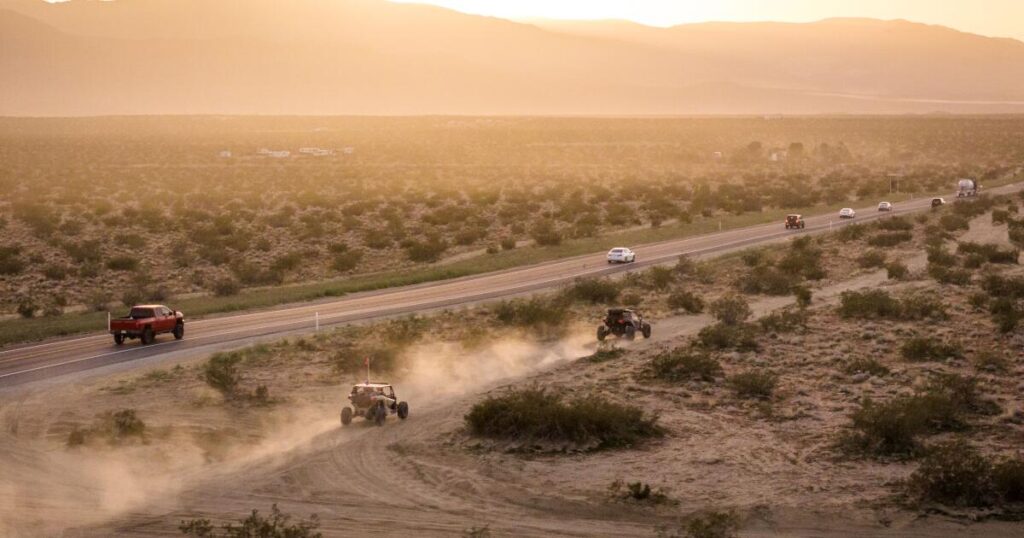
Biologist Ed La Rue, who has taken up the cause of the animals, watched the other day as a lifted pickup truck with a large American flag and a utility task vehicle raced down a trail in the Mojave, sending up plumes of dust. The two vehicles barreled over a road and careened into the Ord Rodman Area, which the federal government has deemed critical to the desert tortoise’s survival. One appeared to then drive off the designated route.
“This happens all the time — the roads give them access, and then once they get there, they just kind of drive cross-country,” LaRue said. “And that’s where you get the burrows crushed.”
In her order, Judge Ilston wrote that tortoise populations in the area have declined precipitously since she began presiding over litigation involving off-road routes decades ago. Citing “a significant ongoing cause of harm” to the desert tortoise in the western Mojave, she said ”closures of areas to OHVs is beneficial to desert tortoise survival.”
Ilston gave the BLM until 2029 to come up with a new network of off-road vehicle routes in the area.
The ruling follows a years-long legal fight led by environmental groups including the Center for Biological Diversity and the Desert Tortoise Council, of which LaRue is a board member. It caps the latest battle between conservationists, off-roaders and other interests in a long-running war over who gets to access the Mojave desert and how.
“These public lands are our shared heritage. They provide important habitats for these species and they’re important for many people who love to recreate,” said Lisa Belenky, attorney for the Center for Biological Diversity. “But right now, one form of recreation, motorized recreation, is dominating these lands and literally ruining them.”
Some members of California’s off-roading community say they’re being unfairly blamed for the tortoise’s decline. “Everybody is quite upset about it,” said Ben Burr, executive director of the Blue Ribbon Coalition, a nonprofit that advocates for motorized recreation. “They think it’s an overreach and this judge went a little too far.” The coalition is petitioning the U.S. Department of Justice to demand an appeal of the decision.
The BLM, which has until April 18 to appeal, declined to comment, citing a policy of not discussing ongoing litigation.
The agency manages nearly a third of the western Mojave, which encompasses about 9.4 million acres stretching from around Joshua Tree in the south to the edge of the Owens Valley in the north, and from the base of the Tehachapi Mountains in the west to Wonder Valley in the east. This swath of desert is a prime destination for off-roading, as well as camping, hiking and rockhounding.
It’s also prime habitat for sensitive species like the Mojave desert tortoise and the Lane Mountain milkvetch plant, both of which are endangered in California, and the Mohave ground squirrel, which is threatened. These desert dwellers typically fare better when humans stay away — especially if they’re traveling on wheels, according to studies presented to the court.
LaRue used to work for the BLM as one of two biologists who helped create the West Mojave Plan, which crafted a strategy to conserve more than 100 native plants and animals, a plan that included a survey of the threats affecting local tortoises. The list included upper respiratory tract disease — which scientists attribute to people releasing infected tortoises kept as pets — as well as habitat loss and degradation from a variety of sources, including development, military maneuvers, livestock grazing and offroading.
Vehicle access is linked to more vegetation destruction and soil disturbances, according to the report. That in turn leads to the spread of invasive weeds, which can crowd out the plants tortoises eat and fuel wildfires.
People are also more likely to dump garbage alongside established roads, which can then attract ravens that feed on baby tortoises.
Climate change-supercharged droughts, and large-scale solar development across the Mojave have also emerged as growing threats, LaRue said, standing atop the tawny Cinnamon Hills in the Ord Rodman Area. But OHV use is different, he said, because it’s “one of the threats that we could ostensibly control.”
In the valley below, what began as a single official road has widened into a braid of routes so vast that it’s difficult to tell which are legal. Behind LaRue, dirt bike tracks snake up into the rocks.
The West Mojave Plan released in 2006 designated roughly 5,000 miles of offroad vehicle routes. Environmental groups sued, saying the BLM didn’t properly account for the impact on wildlife and other natural resources. Illston largely ruled in their favor and ordered the BLM to redo the route network.
The agency revised the plan in 2019, adding nearly 1,000 miles of new trails. Environmental group sued yet again, and in October 2024, Illston found that the BLM violated environmental law by failing to show how it minimized impacts to vulnerable species when creating the route network.
That included the desert tortoise.
Over the next year, the groups tried to negotiate a settlement but talks failed, prompting the environmentalists to go back to the court and request the closures. Finally, Ilston granted the request on Jan. 23.
About 3,800 miles of off-road routes that don’t go through critical tortoise habitat will remain open, as well as some 271,700 acres of open areas where people can drive wherever they want, including cross-country.
To ensure no one drives through tortoise habitat, Illston ordered the BLM to clearly mark closed areas with signs and fencing, and to put in place a monitoring program to ensure compliance.
The order took effect immediately, although the BLM can still ask for a stay or re-hearing.
It’s unclear how the agency plans to enforce the route closures across such a massive and remote area. The Barstow and Ridgecrest field offices have 15 law enforcement rangers tasked with overseeing about 5 million acres of land, which includes most of the critical tortoise habitat in the western Mojave.
“I fear that recent staffing cuts and budget reductions are going to make this a difficult challenge for the BLM,” said Randy Banis, president of Friends of Jawbone, a nonprofit that promotes off-roading in Kern County’s Jawbone Canyon.
Jawbone Canyon is not critical tortoise habitat and will not be directly affected by the closures. Still, Banis, a longtime off-road advocate who’s been exploring the desert in a Jeep since the 1990s, fears the closures will devastate small communities whose economies depend heavily on OHV tourism. He says he’s heard concerns from business owners in places across the region, including Lucerne Valley, Calico and Randsburg.
Travis and Lorene Frankel were initially drawn to Randsburg, a tiny former gold mining town roughly 20 miles south of Ridgecrest, by its proximity to vast open desert where they could off-road and camp. They’d been planning to open a business catering to tourists coming in to use the OHV trail network surrounding the town. But now that it’s slated for closure, the Frankels aren’t sure they’ll stay.
“I’ve compared it to going into a ski town and closing down the mountain,” said Travis.
Most painful is the prospect of losing access to cherished places, Travis said. He and his wife may no longer be able to take visitors to Cuddeback Dry Lake Bed, a massive playa they describe as magical, or to some of the nearby hiking trails they’ve grown to love.
“The vastness and the quiet and the peace you get here is unlike anywhere else you can find in California,” Lorene said. “It is devastating to realize a massive amount of land will be completely inaccessible.”
Many off-roaders are good stewards of the environment and shouldn’t be blamed for the continuing decline of the tortoise, the Frankels said, pointing to the ravens as the real issue. The intelligent corvids were once hard to find in the desert but their numbers have exploded due to increases in food, water and perching opportunities that came alongside human development.
There is one area in the western Mojave where tortoise populations are recovering: the Desert Tortoise Research Natural Area near California City. Its nearly 40 square miles are fully fenced, protecting tortoises from off-roaders and livestock. The nonprofit Desert Tortoise Preserve Committee, which co-manages the land with the BLM, also takes steps to limit raven populations like surveying nests and oiling the eggs, preventing them from hatching.
“If we could do something like that in three or four other places in critical habitat,” said LaRue, “we’d have a chance of tortoises coming back.”
But resistance is fierce, he said. The BLM held dozens of public meetings on the West Mojave Plan over more than two years, where conservationists were well outnumbered by people who wanted to use the desert for something: mining, grazing, war games, recreation. A question the agency received over and over, he says, was “What good is a turtle for?”
“Like they have to have some kind of economic or other value in order to be worthwhile.”
The experience inspired him to write a folk song, which he cued up for me in his car radio on our recent tour through the desert.
“There seems to be a lesson / embedded in their question / It’s OK if turtles and humans die … They went extinct needing to know what a turtle’s for.”
A little later on, LaRue left the vehicle and paced out into the creosote scrub, head down. This area was once among the most densely populated tortoise spots in the western Mojave, he said.
A sidewinder slithered into an old packrat midden. Nearby, a skeletonized cow leg glistened stark white. But despite the unseasonable warmth, no tortoises were out soaking up the late winter sun. LaRue found a piece of dried-up scat, crumbling it between his fingertips. But he spotted no burrows.
Not even a carcass.
The post The Mojave Desert is a hot spot for off-roading. Here’s why a judge shut down more than 2,200 miles of trails appeared first on Los Angeles Times.