When the legal battle between Blake Lively and Justin Baldoni began raging more than a year ago, footage of the two actors slow dancing on the set of the movie “It Ends With Us” became a litmus test of sorts.
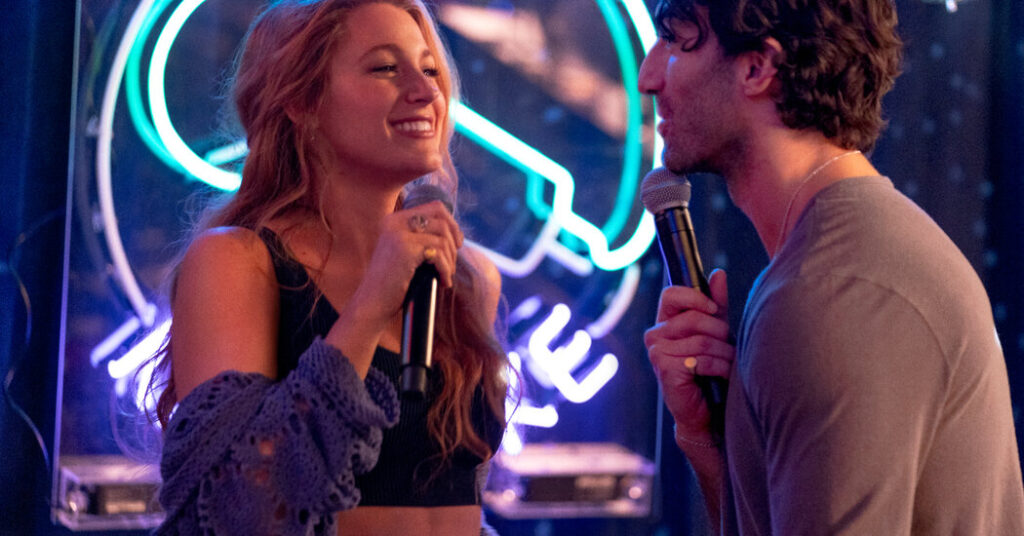
The footage depicted Mr. Baldoni, the movie’s director, leaning in to nuzzle and kiss Ms. Lively, his co-star and romantic partner in the 2024 film, as they danced at the center of a crowded bar scene.
To Ms. Lively and her supporters this was an uncomfortable, unscripted advance and part of a pervasive pattern of sexual harassment on the set.
To Mr. Baldoni and his defenders, the footage — amounting to a total of about 10 minutes — was proof he had behaved appropriately and realistically in a scene meant to depict a couple falling in love.
Once simply fodder for debate on the internet, the footage is now key evidence before the federal judge who will decide whether Ms. Lively’s claims of harassment, retaliation and defamation should proceed to trial this spring.
At a hearing in the case in January, Judge Lewis J. Liman of Federal District Court in Manhattan, made clear he is thinking carefully about the bounds of acceptable behavior in filmmaking — an industry that has undergone a significant cultural shift over the past decade in response to the #MeToo movement.
“Does a director have any ability in that kind of a setting to improvise with respect to what the actors are doing, to go off script a little bit?” Judge Liman asked during the hearing.
“Your honor, an actor can improvise with consent, and that is the issue here,” replied Esra Hudson, one of Ms. Lively’s lawyers.
Ms. Hudson outlined a protocol that has become broadly applied across Hollywood. Brokered by an intimacy coordinator, the process requires that, in advance of filming, actors be given the opportunity to review and approve scenes involving kissing or other kinds of physical touch.
Mr. Baldoni’s team has argued that this encounter, as well as others Ms. Lively cites in her suit, are nowhere close to violations of sexual harassment law.
“We go to federal court when someone leans forward, when someone nuzzles?” asked Jonathan Bach, one of Mr. Baldoni’s lawyers, at the hearing.
This debate is but part of the sprawling civil case filed by Ms. Lively against Mr. Baldoni, his production company and his associates. They are accused in court papers of unleashing a retaliatory campaign against her, one that the suit says was waged by planting and amplifying items on social media and in the tabloid press to destroy the actress’s reputation and to discredit her claims of sexual harassment.
For those in the film industry, the judge’s decision is likely to send a strong signal at a time when Hollywood is still adjusting to protocols and sensibilities that were popularized during the #MeToo movement. Intimacy coordinators are now widespread, as are nudity riders that outline how much skin and simulated sex are on the table. (Ms. Lively’s nudity rider specified that she would show only as much skin as could be seen in a “reasonably modest two-piece bikini,” and she would have the right to approve any changes to intimate scenes in writing.)
But as public attitudes may have changed, the standard of sexual harassment law has not. The challenge for the courts in recent years has been mapping it onto a surge of high-profile cases, some of which stem from the entertainment industry, where sensuality, even vulgarity, can be part of the product.
For example, background dancers who formerly worked for the singer Lizzo objected, in a lawsuit, to being brought to a performance that included nude dancers. Lizzo’s lawyers have argued that outings such as that one were part of her “creative process.”
Mr. Baldoni, whose own suit against Ms. Lively was dismissed last year, contends she used false harassment complaints to seize control of the film. His lawyers say his crisis management efforts were aimed only at protecting his reputation in 2024, when he began to feel that he had been unfairly sidelined from the movie’s premiere. They say there is no evidence that Mr. Baldoni or his associates promoted any false story about Ms. Lively.
Settlement talks last week did not yield an agreement, so unless the judge dismisses the case in coming days, it appears to be heading toward a trial in May. Such a trial would draw enormous attention as dueling Hollywood P.R. machines and high-profile lawyers debate a case involving matters of sex, celebrity and unsealed text messages from Taylor Swift and others.
The movie, “It Ends With Us,” was an adaptation of a Colleen Hoover novel about a relationship devastated by domestic violence. Ms. Lively, who portrayed the woman who suffered the abuse, has said the film itself became a hostile work environment.
She said in court papers that Mr. Baldoni informed her he was circumcised during a conversation about parenting decisions and had once been addicted to pornography. She says he described one of her outfits on set as “sexy” and “hot,” apologized for his remarks, only then to joke that he had missed the sexual harassment training.
Ms. Lively’s suit also says Jamey Heath, the chief executive of Mr. Baldoni’s production company, abruptly showed her a video that he described as footage of his wife giving birth. The suit also accused him of staring at her when she was topless in her makeup trailer, after she had asked him to keep his back turned. Mr. Heath has said the video actually depicted his wife after the baby had been born and that he was asked to show it in the context of planning a scene for the movie. Any glimpse of Ms. Lively in the makeup trailer, his lawyers have said, was clearly inadvertent.
Lawyers for Mr. Baldoni and Wayfarer, his production company, have argued that the episodes amount to “no more than miscommunications and awkward comments.” They say Ms. Lively’s concerns were easily resolved: After Mr. Baldoni and Mr. Heath were made aware of them, no other complaints about their behavior arose.
“Such passing, sporadic comments, while perhaps ill-advised, are not outrageously offensive in an environment where professionals are working closely together to make a deliberately sexually-charged film,” his lawyers wrote in court papers.
Mr. Baldoni’s lawyers have cited a landmark case for the entertainment industry, a sexual harassment suit filed in the early 2000s by a writers’ assistant on the sitcom “Friends.” The assistant described the show’s writers’ room as replete with vulgarity, including graphic discussions of the writers’ own sexual experiences.
The California Supreme Court found against the plaintiff, ruling that on a sitcom with sexual innuendo in its scripts, lewd conversation in the writers’ room “reflected the creative process at work.”
The court also found that the vulgar comments were not targeted at the assistant because of her gender — a legal standard under harassment law that is central to whether Ms. Lively’s sexual harassment claims will proceed.
Mr. Baldoni’s lawyers have argued that the behavior Ms. Lively has cited had nothing to do with her gender and everything to do with portraying the “steamy and turbulent romance” central to the film.
But Ms. Lively’s team has cited the accounts of other women to suggest there was gender animus on the set that made others feel uncomfortable. Jenny Slate, an actress in the film, said in her deposition that Mr. Baldoni had made an unwanted comment about her outfit being “sexy.” Another actress, Isabela Ferrer, said in a deposition she felt uncomfortable when Mr. Baldoni commented, “I know I’m not supposed to say this, but that was hot,” after they filmed a scene about her character having sex for the first time.
Experts said that not every discomfiting experience at the workplace necessarily supports a legal harassment claim, which requires that the behavior rises to the level of “severe or pervasive.”
“One way to think of this case is a clash between broader cultural perceptions of harassment post-#MeToo movement,” said Russell Robinson, a law professor at the University of California, Berkeley, who has expertise in anti-discrimination law, “where I think a lot of people — especially women — would read the allegations and say, ‘that’s inappropriate.’”
“But I think for courts,” he said, “the standard for harassment is much more demanding than the general public perception of what’s appropriate or inappropriate.”
Another issue is likely to be whether the discussions of sexuality on set were related to the work of making the movie, or gratuitous.
“You can consent to being in a work environment where the discussion or the work is focused on sexually explicit topics,” said Nicole Page, a lawyer with expertise in gender discrimination cases, “but that doesn’t mean you consent to have someone in the room turn to you and ask you about your personal sexual preferences.”
Ms. Lively’s suit says, for example, that while proposing a scene in which the two lead characters simulate a simultaneous orgasm, Mr. Baldoni told her that he and his wife climaxed at the same time and asked if she and her husband, Ryan Reynolds, did the same. Mr. Baldoni said in a deposition that he did not recall a discussion with Ms. Lively in which that had been discussed.
The setting of conversations depicted as objectionable are part of what judges ponder. In one of several lawsuits brought by women in the “Real Housewives” franchise, Leah McSweeney, a cast member, objected that the host of a reunion special, Andy Cohen, had asked her about sexual experiences with other women, among other complaints.
In dismissing the gender discrimination claims, Judge Liman noted that if the conduct she described had occurred on “the factory floor or in the executive suite,” it would rise to a valid harassment claim. But this was reality television, the judge ruled, and the cast members were well aware of the agitating role that Mr. Cohen had long played as moderator of the reunions.
As the two sides in the Lively case await Judge Liman’s decision, the trial in the court of public opinion is already well underway on social media, where users have dissected a trove of evidence that has been unsealed over the past month.
Reddit threads analyze unsealed text messages. Podcasters parse emails surrounding Mr. Baldoni’s damage control efforts. Armchair legal analysts on TikTok and YouTube pick apart footage from the set.
Underlying the social media debate and legal sparring is a battle of wills between two wealthy Hollywood celebrities and their teams of zealous advocates. Central to that battle is the question of who had more power during their ill-fated collaboration. Was it Mr. Baldoni, who directed the film made by a production company he co-founded? Or was it Ms. Lively, whom Mr. Baldoni has accused of leveraging powerful allies such as Mr. Reynolds and Ms. Swift to increase her influence over the film?
“You can tell there’s a P.R. battle happening alongside the legal arguments,” Professor Robinson said. “Each side wants to portray their client as the victim.”
Julia Jacobs is an arts and culture reporter who often covers legal issues for The Times.
The post Lively v. Baldoni Tests What Crosses the Line on a ‘Steamy’ Movie Set appeared first on New York Times.