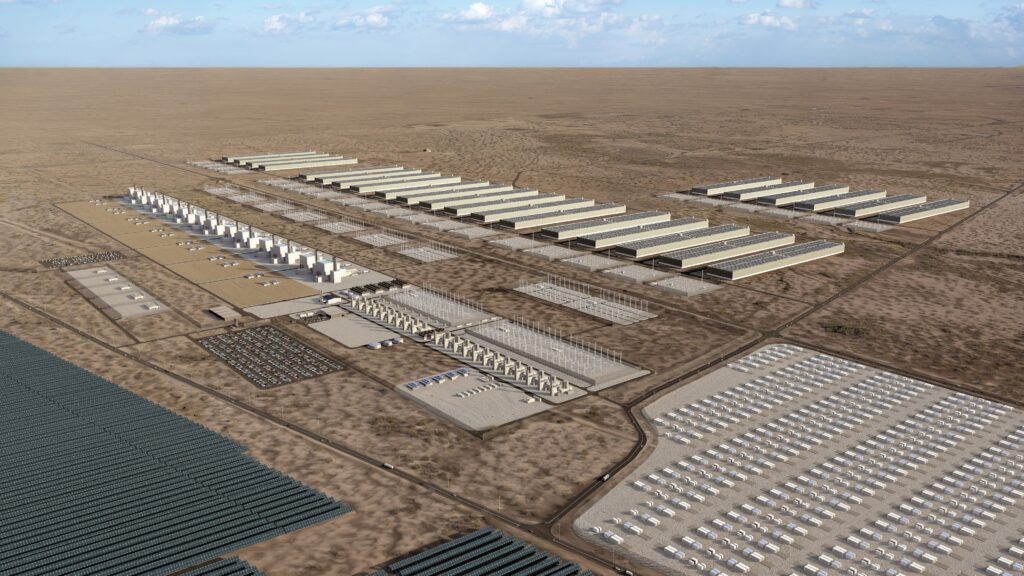
The GW Ranch project approved on 8,000 windswept acres of West Texas will look like many of the other data centers that have sprung up across the country to support Silicon Valley’s ambitions for artificial intelligence. Dozens of airplane-hangar-size warehouses packed with computing hardware will consume more power than all of Chicago.
But it’s missing one standard feature: The mammoth project, recently green-lit by state environmental regulators, won’t need new power lines to deliver the electricity that it guzzles. GW Ranch will be walled off from the power grid and generate its own electricity from natural gas and solar plants installed on site.
GW Ranch is set to become part of a shadow power grid emerging across the country with potentially far-reaching consequences for the U.S. electricity system and environment.
After the rapid growth of data centers triggered pushback from politicians, utilities and local residents over the pressures they place on the grid, tech companies are now building their own fleet of private power plants, mostly fueled by natural gas.
Dozens of sprawling off-grid data center projects are planned across Texas, New Mexico, Pennsylvania, Wyoming, Utah, Ohio and Tennessee, according to a review of regulatory filings, permits, earnings call transcripts and other documents by the energy industry research firm Cleanview. Several are already under construction.
Companies rushing to develop the facilities include Meta, ChatGPT-maker OpenAI, business software provider Oracle and oil giant Chevron. (The Washington Post has a content partnership with OpenAI.)
The off-grid projects already approved by state energy and environmental regulators could power all of New York City several times over, a vast new energy infrastructure that will bring huge new industrial facilities to communities across the country and increase U.S. emissions of carbon dioxide and other air pollutants. A handful of states have passed laws to encourage off-grid data centers by loosening rules around who can build power plants and where they can be located.
The projects are sparking alarm from El Paso to Davis, West Virginia, from residents unhappy to learn that gas plants large enough to fuel major cities are set to sprout in places they were never expected.
“This came out of nowhere,” said Amy Margolies, a resident fighting an off-grid data center planned near Davis, in one of West Virginia’s major tourism corridors. The project was permitted to operate a gas plant large enough to generate roughly equivalent power to that used by every home in the state. It is being propelled by a 2025 state law that eased approvals for off-grid data centers.
“They removed local control completely for this speculative gold rush,” Margolies said. “Everything is shrouded in secrecy, and the public is removed from the process.”
The idea of taking data centers off-grid is the latest in a line of provocative strategies adopted by the tech industry in its pursuit of more electricity that also includes reviving old nuclear plants, backing long-shot fusion energy schemes and planning to plunk down hundreds of compact nuclear power plants in communities across the U.S. But while these approaches are fossil fuel-free, most of the sector’s immediate investments will be in gas power, driving up the planet-warming emissions the companies long promised to take a lead in curbing.
Billions of dollars are now being invested in power plants for off-grid data centers, even though key engineering challenges have not been solved, according to veteran energy developers.
Most of the projects rely on natural gas because the variable output of solar and wind is difficult to manage without the grid as backup. But the most efficient gas turbines are back-ordered for years, forcing developers to use more wasteful and polluting equipment.
“It is catastrophic for climate goals,” said Michael Thomas, founder of Cleanview, which has identified 47 behind-the-meter projects nationwide.
Others warn that off-grid projects could struggle to keep the lights on. Gas plants typically spend a third or more of the year down for maintenance, but data centers generally operate around the clock. “I get that cost is no object for these companies and they just want to get online,” said Jigar Shah, an energy entrepreneur who helped manage federal energy investments for the Biden administration. “But they have not figured out even with unlimited funds how to make these plants run with 24/7 reliability.”
Shah said the projects could also drive up prices for customers who still use the power grid, as developers outbid utilities for equipment and leave other ratepayers to bear the costs of maintenance for older energy infrastructure. “This whole thing feels like a fairy tale concocted on the back of a napkin,” he said.
Developers of the projects have said they can use backup generators or gas plants to keep data centers operating without interruption. President Donald Trump and White House officials have argued that loosening regulations that gave utilities a monopoly over power generation will make electricity more abundant and protect ordinary consumers.
“President Trump’s vision really since the beginning of the administration is … ‘Let the AI companies become power companies. Let them stand up their own power generation as they built side by side with these new data centers,’” said David Sacks, Trump’s AI and crypto czar, during a podcast interview at the World Economic Forum meeting in Davos, Switzerland, last month. “We get this infrastructure, [and] residential rates don’t go up.”
Silicon Valley’s build-out of AI infrastructure is “too onerous for the power grid to take on,” said Kevin Pratt, chief operating officer of Pacifico Energy, the energy developer building GW Ranch in Texas. “We were hearing, ‘We want you to build these projects, but the utility can’t give us the power we need. What can you do?’”
The off-grid strategy appears to have worked for Elon Musk. In 2024, his company xAI got a Memphis data center up and running in months — instead of the more typical years — in part by largely sidestepping the grid and powering the facility with dozens of portable gas generators.
Last month, the Environmental Protection Agency ruled the setup illegally breached emissions rules, and required the company to get permits. But tech industry officials say xAI had put rivals on notice that unless companies found work-arounds to lengthy wait times for power grid hookups, they risked being left behind.
The fallout is now reverberating in places like Tucker County, West Virginia. Residents learned through a legal notice in the community newspaper the Parsons Advocate that developer Fundamental Data was seeking to build a massive, off-grid data center with a large gas plant on a ridgeline near Davis.
The state law promoting such projects strips local officials of their usual authority to vet and approve new developments if these proposals are related to data center campuses using off-grid power. Fundamental Data received a state environmental permit for the gas plant over the loud objections of residents and officials in surrounding communities.
The company declined to say how many gas turbines it plans to use or what kind they will be. It would not comment on whether the data center would be for AI development, crypto mining or something else.
“As designed, it is intended to operate independently and does not rely on ratepayer-funded infrastructure or impact existing residential customers,” Fundamental Data said in a statement.
The project is one of at least three large off-grid data center developments that builders are pursuing in West Virginia under its 2025 law. One of the others, the Monarch Compute Campus in Mason County, will initially use gas to generate enough electricity to power 1.5 million homes, plans say, and later quadruple its output. That would see the site generate and consume several times the total electricity consumption of West Virginia residents.
The major tech companies that will tap this shadow grid are mostly keeping their names off the projects while developers go through the messy process of permitting, overcoming community opposition and construction.
Meta is one exception. Through a subsidiary, it is working with natural gas colossus Williams on a project called Socrates in New Albany, Ohio, that will install a pair of off-grid gas power plants that will each sprawl across 20 acres. Williams says it will be operational this year.
The social media giant has another off-grid project in El Paso, where it is working with the local utility to create a large gas generating facility by linking together 813 modest generators. Local officials and activists have protested the plan, alleging that Meta won lucrative city and county incentives after leaving the impression its data center campus would be powered by clean energy.
Meta’s local partner, El Paso Electric, wrote in regulatory filings first reported onby the Texas Tribune that using solar panels and battery storage “would require thousands of acres adjacent to the Data Center site which are not available.”
Meta said that the fossil fuel power used in El Paso will be paired with purchases of renewable energy. “As with all of our data centers, including dozens of renewable projects throughout Texas, we work to add energy to the grid and match our data center’s electricity use with 100% clean, and renewable energy,” company spokesman Ryan Daniels said in an email.
Oracle and OpenAI are also developing off-grid power plants for their data centers. Construction is underway at their Stargate Project Jupiter campus in New Mexico, which will be powered by massive natural gas systems.
OpenAI chief executive Sam Altman is an investor in aerospace firm Boom Supersonic, which has refashioned a jet engine design to power off-grid data centers. The first batch will go to developer Crusoe, which is building one of the world’s largest data center campuses in Wyoming.
Despite the immense capital invested and shovels in the ground, the AI industry’s off-grid plans do not compute for some veterans of big energy projects.
Developers are “trying to rush to market with a bunch of clankety old stuff that was headed to the scrapyard, or with dozens to hundreds of small generating units strung together,” said Aaron Zubaty, CEO of California-based Eolian, which builds large energy installations.
Those untested designs will inevitably develop maintenance problems that cause cost overruns, malfunctioning equipment and unanticipated outages, Zubaty said. He predicted that spending on the projects may be more likely to pay off by creating pressure on utility companies to accommodate more data centers on the grid.
“If you are a utility, this can’t be your future,” he said. “You can’t have your biggest customers never need you again.”
The post Silicon Valley is building a shadow power grid for data centers across the U.S. appeared first on Washington Post.