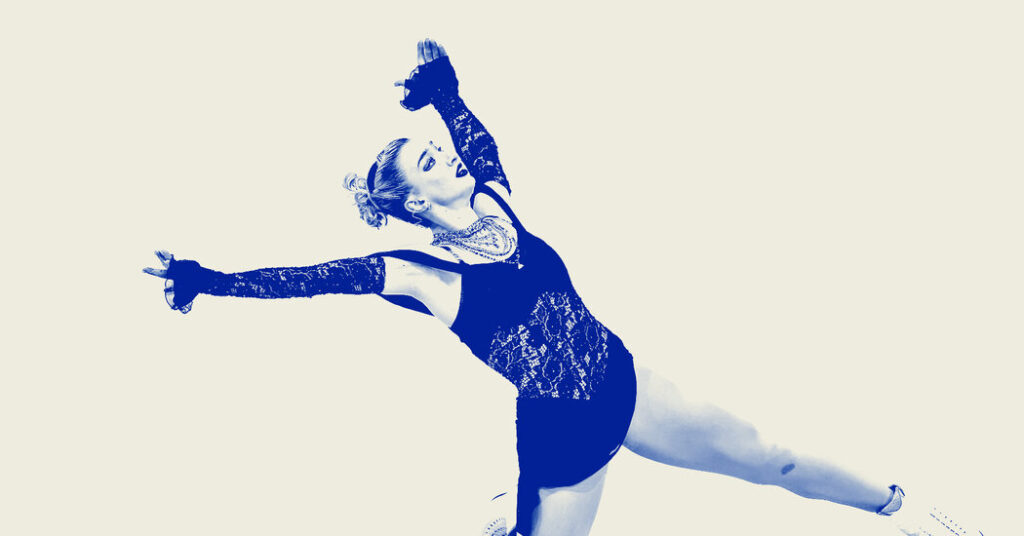
The Winter Olympics are underway, and all eyes are on Milan. In a round-table discussion, the Opinion editor Steve Stromberg speaks with the contributing writer Esau McCaulley, the writer and podcaster Kelly Corrigan and the Olympian Sasha Cohen on the joys, awe and escapism of the Games — as well as the inescapable politics surrounding them.
Below is a transcript of an episode of “The Opinions.” We recommend listening to it in its original form for the full effect. You can do so using the player above or on the NYTimes app, Apple, Spotify, Amazon Music, YouTube, iHeartRadio or wherever you get your podcasts.
The transcript has been lightly edited for length and clarity.
Steve Stromberg: I am Steve Stromberg, an editor for New York Times Opinion and a huge Olympics fan. I’m joined today by two fellow Olympics devotees: the Times contributing writer Esau McCaulley and the writer and podcast host Kelly Corrigan. Also with us is Olympics royalty — we’ve got Sasha Cohen, a figure skater who won silver in the 2006 Winter Olympics.
Thank you for being here.
Kelly Corrigan: Thanks for having us.
Esau McCaulley: Thank you for having us.
Sasha Cohen: Great to be here. Thank you.
Stromberg: The Games aren’t over, but I want to hear some of your superlatives of the Winter Olympics so far. What has been your favorite, most outrageous, most inspiring or most unexpected moment of the Games?
I should note that we are recording this on Wednesday morning, and it’s probable that some amazing new things will happen by the time people hear this.
We already heard this morning that Mikaela Shiffrin won gold in the slalom. So, her drought is over.
Esau, why don’t you start?
McCaulley: My favorite story for this Olympics so far has been Federica Brignone. She’s an Italian skier and she broke her tibia and fibula. She had a complete knee disc location 10 months ago, she just returned to gentle skiing in November, and she won two gold medals.
She talked about how she thought that she may never ski or walk normally again. For her to come back and to win two gold medals, that’s been my favorite story from the Olympics so far.
Corrigan: It really makes you think about the times that you complain about your occasional shoulder pain.
McCaulley: Listen, I hurt my back in November during a snowstorm when I was ——
Corrigan: You should have a gold medal around your neck by now.
McCaulley: I’m not back to shoveling the snow here in Chicago yet.
Corrigan: You’re such a slacker.
Stromberg: Kelly, give us a superlative.
Corrigan: Francesca Lollobrigida and her 2-year-old son, Tommaso.
Announcer: She is the first Italian woman to ever win a speedskating gold and has Italy’s first speedskating gold since Torino 20 years ago.
She is away from this kid 250 days a year — and then, there he was. As a mom, I can’t even imagine what it would do for me, for my kid, to see me excel at my thing. The way that the husband and the kid were jumping up and down like lunatics, I mean it was like a gonzo moment.
I loved Ilia Malinin coming off the ice after that really hard moment with such composure and using the words “grateful.”
Announcer: The back-flipping skating sensation known as the Quad God had one of his worst performances and failed to medal in the free skate finals.
Reporter: Was it something physical, or do you think it was more mental out there?
Ilia Malinin: I think it was definitely mental. I mean, just now finally experiencing that Olympic atmosphere — it’s crazy. It’s not like any other competition. It’s really different, and it’s just such — I’m still so grateful that I was able to put in this work and effort to get to where I am. But of course, that was not the skate that I wanted.
And I love the insane arguments I’ve been getting into with my husband over all the equipment stuff, like Penisgate — somebody had to bring it up. But also about the brooms they use for curling, and whether a blue suit moves you faster than a red suit. All that seeming minutiae to a layperson has been fun to engage in.
Stromberg: Just to add a little context, Penisgate is, of course, about ski jumping and whether there was too much fabric in the — uh — sensitive areas of some of the competitors, which would give them a little bit of extra lift.
Sasha, do you have any superlatives for us?
Cohen: What comes to mind is watching Maxim Naumov. It just gave me goose bumps because I saw him as a little kid; I knew his parents. For people that don’t know the story, his parents were on the flight that crashed about 13 months ago. He didn’t think he was going to skate anymore.
And he came back with such joy. I was talking to him at the Winter House and he carries a picture of his parents from when he was maybe 5 years old — at the rink, everywhere. You saw him, after he skates, show it to the camera. He was saying: I’m just so thrilled to be here. This is my parents’ dream. I’m living their dream. This last year has been the highest highs, the lowest lows. But I’m so grateful to be here and to live out this Olympic dream because it was also my parents’ dream.
To me, that just captured the Olympic spirit at its best. It was the ethos of “I am so grateful to perform at this level and put my life’s work on display and share my dream and my family’s dream with the world.”
I just thought that was such a beautiful expression of what the Olympics are about in some aspect. So, that was definitely my favorite moment.
Stromberg: Yeah, totally.
McCaulley: Did you see the conversation — I think it was with a skier; I don’t remember her name, forgive me. And she won the silver.
Reporter: Do you see these as two silvers gained or two goals lost?
Eileen Gu: [Laughs.] I’m the most decorated female free skier in history. I think that’s an answer in and of itself.
The way that she reset and allowed us to understand the actual pressure of an athlete and how those of us who are watching the sports can be excessively critical. I don’t know how you felt. Did you see that interview, Sasha? How did you feel about it?
Cohen: I think I saw a headline that referenced it, but I didn’t see the actual interview, and I think it’s so true. One statistic I remember reading is that those that win third place and first place are the happiest, and second and fourth are the most disappointed — either just missed the podium or just missed gold.
But I think a lot of it depends on the color of how you won this over — did you defy expectations and move from fifth to second or were you leading the competition and made a mistake and dropped down to second? I think that really colors how an individual athlete might think about the color of their medal.
I think it’s wonderful to reframe “I’m the most decorated female freestyle skier in Olympic history” — something like that to say, “This is all that I’ve done and it’s icing on the cake.” It reminds me of Lindsey Vonn.
Announcer: Oh, my goodness. No! Oh, my goodness.
Even though the Games did not go as we wanted and as she wanted, she showed us that so much of it was about showing up and the attitude that you walk through life with. Despite the adversity and your body falling apart, you choose to show up and compete. That in itself is going to be so memorable for her and everyone watching.
So, I think reframing is very important, especially as athletes are older and are further along in their careers, and it’s their third or fourth Olympics, because they realize how special it is just to have a spot at the Games and get to do this for a living with the world watching.
Corrigan: I’m fascinated by behavioral psychology, and I feel like this is the golden age of the layperson understanding mental health. I feel like that’s very evident in this Games. I repeatedly have this sensation of, “Oh, these young people are either balanced or striving for balance in a way that you didn’t hear 20 years ago.”
Stromberg: Yeah, a lot of gratitude we’re hearing from the men skaters. Kelly, you mentioned Ilia Malinin, the Quad God. If your household was anything like mine, your 4-year-old daughter screamed “Quad God!” every time he appeared onscreen — in a promo, in an ad, anytime. So, pretty much constantly.
Expectations for Malinin were so high that it would’ve been hard to meet them, even for the best of the best. But it’s hard not to feel for him. Did he have a bad night? Was he unprepared mentally? It just seems like there’s something about Olympics competitions that makes the stakes feel higher than others. I mean, Sasha, you’re the expert on this. How do you see this?
Cohen: He is the crème de la crème of men’s figure skating, and he has set the bar so high that the point lead that he typically has over his nearest competitor is 20, 30 points. It’s such a cushion that everyone thought he could fall two or three times and still win. So, I think it really took the spectators by surprise.
But then, I also know what it’s like getting onto the ice, skating last and knowing that this is your time and you’re four minutes away from securing your dream. That can be very rattling. It’s almost like your system short-circuits, where you’re trying to process so much information coming in and everything’s compressed into a few minutes, and then it’s compressed into each jumping pass.
It can be just an extraordinary amount of energy and intensity and nerves bouncing around in your body, not to mention every thought that’s going through your head. I find the interesting juxtaposition here is that as an athlete, what we should do is train our body, trust our body and tell our mind to be quiet.
And you have different ways to do this, like just breathe in and out, arm goes left, right. But then your mind wants to be involved, like, “Hey, this moment’s too important. I can’t let the body just do it by itself. I need to optimize. What can I be doing to help?”
I think that’s where you get into a lot of trouble, when the mind just really tries to be involved and perfect each moment, and that can lead to just one millisecond of delay or moving a little bit too quickly and changing the timing on a jumping pass. Then, I think, once you miss one, you’re just carrying another set of expectations and disappointment that you can’t really process in real time because you have to keep going.
Ilia Malinin: I blew it. That’s honestly the first thing that came to my mind was: There’s no way that just happened. I was preparing the whole season. I felt so confident with my program. So confident with everything — and just to go out and that happened was, I have no words, honestly.
It was that culminating moment of: “It’s all here. It’s in my hands. I’ve got it. I’m four minutes away from the dream.” And that’s when it started to unravel.
Corrigan: Every maternal bone in my body wanted to sweep him up in my arms, and I was like: “I’m so proud of you for your composure. You just saved a lot of kids down the line. There’s a 10-year-old and a 15-year-old who learned more from you in that interview than they did by watching you on the ice.”
That’s the human trick: composure under pressure.
Stromberg: Sasha, while we have you on figure skating, let’s turn to the women. We have a trio of American female figure skaters known as the Blade Angels. Of course, you were the last woman from the U.S. to win an Olympic medal in figure skating, and that was 20 years ago. The Blade Angels are hoping to end that drought on Thursday. Is this the year?
Cohen: I just watched the ladies’ short program yesterday, and the depth of the field was really stunning. Not only the technical abilities, but the artistic package that most of the lady skaters have. Alysa Liu — an American from Oakland — is in third place going into the long program.
Isabeau Levito is, I believe, seventh or eighth, and Amber Glenn is 13th. So, I think it’s going to be a lot tougher for our second- and third-place ladies to get up to the podium. But I think Alysa Liu has such a good shot.
I have to say that I’ve been out of the sport for a long time. Going to nationals this year in January was the first time I really watched figure skating since I competed, and I went to the Olympics and watched as a spectator. It was hard. There’s a little bit of PTSD and just reliving my own nerves in watching Olympic skaters. So, I took a long break.
Coming back to watch nationals this year was just so awe-inspiring to see Alysa because she comes out there with this grace, this ease, this joy that I’ve never seen in someone competing at the highest stakes, and it makes you root for her more.
She’s so, so different, and you don’t see that clenching, like, “This is my moment on the line and I’ve got to meet these expectations.”
I think she’s our shot at a medal on the podium.
Corrigan: Yeah. And she’s really saying the right things. She specifically said: “I don’t evaluate my performance by the outcome. I evaluate it by what it feels like and what the process leading up to it has been.”
That is the healthiest attitude you could possibly have.
Cohen: It’s amazing because she lives what she says. I think a lot of people say that, but they don’t really feel it. She really seems like she’s living proof of that.
Corrigan: Yeah, I believed it. When she said it, I was like, “I believe you.”
McCaulley: I want to follow up on something that you said when you mentioned taking a long break from watching the Olympics. Can you explain what it’s like for someone who’s had that kind of spotlight and had that much of their life dedicated to something, as you have, and then just to say: “The pressure is so great, I need to turn off even watching my sport for a period of time.”
Can you explain what that experience is like or what leads someone down that road? Is it the attention that comes with it? Is it the pressure? Is it the scrutiny?
Cohen: I think it’s probably different for each athlete. Personally, I can speak to my experience, and my Olympic Games in Torino did not go as I hoped it to. I ended up with a silver medal. I made two mistakes. I was injured going in and not able to prepare, and I just lived in this pressure cooker.
I didn’t go to the opening or closing ceremonies. I stayed in an apartment away from the village to try to focus, and I just knew everything that I had been training for was going to boil down to these few minutes. How was I going to do it when I wasn’t prepared? Twenty years later, I am so grateful for that silver medal, for that experience, and for skating a really strong program after my mistakes.
But I couldn’t watch for a while. Every time I saw the Olympic rings or heard that music and saw other skaters warming up backstage or about to take the ice, I would relive my own programs and disappointments. If somebody fell, it would remind me of my own mistakes. If someone skated perfectly, I’d say: “That was a program I wish I could have done.”
It was a lot. I think I needed space to develop as a person and have other outside interests. You wait long enough and then I realized that, hey, no matter what I do, skating is always such an integral part of who I am.
It defined me. The people that I love, that I trained with, that I competed with, the way that we have moved through life and have oriented our goals and dreams around a moment in the Olympic Games and making crazy decisions and sacrificing so much because the Olympics are such a big dream — it was a homecoming to come back.
Now it’s so exciting because I’ve been watching at home with my kids and they’re like: “Mom, you were in the Olympics. Were you better than her? Were you better than her?” I was like, “Yeah, 20 years ago.”
I’m really enjoying watching, and that is such a gift that I can watch the Olympic Games again, because that’s how it all started.
Stromberg: I remember cheering you on in Torino and just being so happy and proud when you won. It always blows my mind when you hear about the silver medalists being disappointed. You got a silver medal. You did amazing. We’re all so proud of you!
McCaulley: Yes. In the entire world, there is one person who did slightly better. I just can’t imagine. I understand this is the nature of the sport, but I’m not in the top three of any particular thing — like, nothing. So it’s just amazing.
Cohen: Twenty years later, I have the perspective where I can appreciate the silver medal and, yes, I want to go back in time and skate my personal best. But not training and being injured, I wasn’t able to prepare.
Twenty years later, it’s just another reminder that the human body does not always do what you want it to do — whether as a normal person with your health or as an athlete being able to prevent injuries and be at your best at the moment when it is the most important.
I think I’ve given myself some grace and understanding of not only the life cycle, but the strength and the frailty of the human body, and also how much we can’t control — even when we try to control everything.
Stromberg: We all love figure skating. There are a few other sports in the Winter Olympics. Kelly, any big stories out of some of the other events that have stuck out to you, that you’ve been interested in, proud of, sad about?
Corrigan: So Elana Meyers Taylor is my person.
News anchor: Bobsled driver Elena Meyers Taylor came from behind to win the women’s solo event last night. Coming into these Games, she had won five medals in four Olympics, but this is her first gold.
She has two young children. They are both deaf and one of them has Down syndrome. A few weeks before Christmas, she was texting her husband saying: I don’t think that this is where I should be. I don’t think I can do this. And then two months later, she’s wearing the gold and signing to her children: I did this. I did it.
I mean, that is what I live for. That is my perfect story: a mom who didn’t cut herself off, who didn’t put herself in a cage and say, “This is as big as I’m allowed to be.” And then gets that moment of connection with her kid, saying: I did it.
Because I want kids to see adults having great lives. I feel like part of the anxiety and depression that we see is that younger people are looking at our generation and saying: That doesn’t look that good. So it looks good — being a little older looks better after these Olympics than it has ever looked.
Stromberg: Before we move on to politics, I just want to give a shout-out to Jordan Stolz, the pride of Kewaskum, Wis.
Announcer: And it’s official. Jordan Stolz is the fastest speedskater in the world. Two events, two golds in Milan, with two more races still ahead of him.
And did you see his quads? I mean, they’re enormous!
Corrigan: Many times the question has floated through my mind: Is that what a human body is supposed to look like? Is that what a leg is? Is that what a butt is? Because there’s just zero — you know, the Venn diagram of my legs and butt and their legs and butt, it’s the null set. There’s no overlap. And part of the awe and wonder of the whole thing is like this Adonis feeling that you are seeing somebody do with their body the most that can be done with a body. And that is a very uplifting thing to witness.
Stromberg: Yeah. As a friend of mine said, he needs to stop skipping arms day.
Corrigan: Well, that’s a funny thing about the Olympics, too; when you get a little cocky on your couch, while you’re eating your bagel and you think: That was not very good. Or like you could have put another spin on that jump.
Stromberg: You’re watching the biathlon and suddenly you’re an instant expert.
Corrigan: Totally.
Cohen: There was something a friend of mine said that was so hilarious, which I think would be great for viewing. It’s that you add one normal human to every Olympic sport.
Corrigan: Yes!
Cohen: Just so you can see how actually difficult what’s going on is, because everyone makes it look relatively easy. But if you just put one ordinary human in each sport ——
Corrigan: I think that’s so brilliant.
Cohen: I think that would give us a whole world of context and entertainment.
Stromberg: All right. Politics is never far away from the Olympics. But this year has been particularly fraught for American athletes. Last week a reporter asked American freestyle skier Hunter Hess about representing the United States:
Hunter Hess: It brings up mixed emotions to represent the U.S. right now. I think there’s obviously a lot going on that I’m not the biggest fan of and I think a lot of people aren’t. I just think if it aligns with my moral values, I feel like I’m representing it. Just because I’m wearing the flag doesn’t mean I represent everything that’s going on in the U.S.
Stromberg: Now, President Trump responded by calling Hess “a real loser,” though I guess we’ll see when he competes in the halfpipe on Thursday. Other American athletes have spoken out about the Trump administration’s immigration crackdown. Esau, athletics intersecting with politics is nothing new, as you recently mentioned in a guest essay. What, if anything, is new about what you’re seeing here?
McCaulley: Well, one of the things that makes this particularly complicated is the nature of the American political division at the moment, because most of our division is around how we treat the immigrant and the foreigner. The spirit of the Olympics is international cooperation and competition, and one of the things that’s been great about the Olympics is how we’ve seen American athletes be gracious in defeat. That’s actually, I think, one of the key stories that has come along.
So when we are the people who are saying, “Oh, we want to take Canada, we want to take Greenland,” it’s kind of hard for us to say we want to see America dominate in an international competition. That was at least how I thought I would go into the Olympics. But I just did a bit of research, and what the athlete just said was actually true, that an American Olympian does not represent the current policies of a particular administration that’s in power.
And one of the things that’s been surprising is how little I’ve thought about Donald Trump during these Olympics. I’ve been watching the athletes, and I have found myself being able to celebrate them in a way that I hadn’t necessarily expected I would be able to do this year. So that’s been, for me, it’s been easier than I thought. I even bought some Olympic gear. Ralph Lauren tricked me into buying one of those snow bears. So yeah, I’ve been full Olympics.
Stromberg: Kelly, you wrote about the awe of the Olympics. Have you been awed and have you been able to escape from the constant worry about the state of the world?
Corrigan: Yeah, I think of it as a place to recover and restore so that you can be ready for the next act of participatory democracy that is surely going to be demanded of all of us. So you can’t be in that vigilant state 24/7. As my friend the neuroscientist Lisa Feldman Barrett says: “Vigilance is metabolically expensive.” It is exhausting.
And so this is a place to rest. And on top of that, if you could get a touch of awe, if you could be filled with wonder — which is so easy when you’re watching the Olympics — it’s a huge neurobiological reset. And who doesn’t need a neurobiological reset? In fact, they talk about aesthetic chills and they call them skin orgasms. I was like, more skin orgasms for everyone.
I think the thing about America that I like the most is that we’re allowed and actually called upon to be critical thinkers at all times about what’s happening in our country. That’s the defining piece for me.
So the idea that Hunter Hess is a loser for doing the thing that we are all required to do, which is to stay alert and comment on when things seem to be going awry and participate in the shaping and directing of the next policy decision, that’s the best thing about us. That’s what makes me want to drape myself in an American flag.
McCaulley: There are a couple of things that I’ve noticed about this particular administration: The president seems to be trying to almost take over sports. This administration’s been omnipresent in a lot of sporting events — not just the Olympics, but also a lot of the fighting events. There’s the whole U.F.C. thing that’s supposed to be happening at the White House. More than any other president, there’s a way in which he’s trying to wrap sports into a certain aggressive agenda.
And so I think allowing our American athletes themselves to define Americanism — especially, one example is Chloe Kim. When she didn’t win the gold, she rushed over and joined in the celebration.
Announcer: And watch this classy move: 17-year-old Choi Gaon says she was inspired and mentored by Chloe Kim. Choi gets the first medal for South Korea in this event, and it’s gold.
And that, to me, is what America is supposed to be: being able to celebrate and cooperate with our global neighbors. And we’ve seen this happen over and over again, where in the hardest moments, America’s been gracious in defeat. And I think that’s actually, in its own way, even if they weren’t trying to make a political statement, giving a different picture of what America can be.
Not that we dominate everything, but whether we win or whether we lose, hopefully we treat people with dignity and respect. And I think that’s been an interesting message from these Olympics — one that counters, in its own way, the aggressive nature of what the Trump administration has been doing vis-à-vis the rest of the world.
Stromberg: Yeah, you saw the same thing yesterday with Mac Forehand, the men’s big air skier.
Corrigan: Amazing.
Announcer: It’s going to take a score that no one has dropped so far in the competition. Oh! Mac Forehand! Are you kidding me?
He put down some amazing jumps and yet went into silver, and the first thing he did was, they all hugged.
Announcer: He drops the hammer of Thor with a 98.50. Tormod Frostad gets the second goal for Norway in this event.
Corrigan: They were jumping around like best friends. I loved that scene.
McCaulley: Sometimes I think we’re a little unfair to our athletes, because they spend their entire lives preparing to do a sport. Some of them have political opinions and the ability to speak about them and nuance them well. But for others, this isn’t their area of comfort — speaking in front of an audience. We expect our athletes to be world-class performers and world-class political commentators.
And so sometimes I’m happy that we do have the occasional athlete who feels comfortable speaking up. But for people who want to allow their performance to tell its own story, I’m completely fine with that.
Stromberg: Well, I for one am going to be rooting on Hunter Hess in his event on Thursday, and I hope a lot of Americans join me.
Wrapping up, the closing ceremony is coming up on Sunday. When you think about the next Olympics, are you thinking about the 2028 Olympics in L.A. or the next Winter Olympics in 2030 in France? And yes, I am hoping to incite a debate about whether the Summer or the Winter Olympics are better.
Corrigan: The Winter Olympics are smaller, so you feel like you can really get to know these people, and they often perform multiple times over multiple days. So then you feel really connected to them and it’s like you’ve been caring about them for decades all of a sudden. So that’s nice. But I’m going to go with the Summer Olympics because I was a little girl who watched Nadia Comaneci, and it was the first time that I was bug-eyed, one foot from the television set, quieting down my brothers in the background.
But also in L.A., the Summer Olympics are going to include lacrosse, which is my longtime family sport. My cousin is the coach at Notre Dame and my dad and all his brothers were all-Americans way back when. So I just kind of can’t believe that lacrosse is coming.
McCaulley: I’m not going to choose between Winter and Summer, because I feel like it’s the same idea: country versus country, people dedicating their lives to one moment. So I’ll just say that as experiences, I will keep the Winter and Summer Games a tie. I watch them both equally. But I would say my favorite sport is track and field, probably the 400. So I’m looking forward to that.
And once again, seeing what women’s gymnastics looks like in 2028 is something else I’m really looking forward to.
And as a basketball fan, maybe they can somehow convince a 50-year-old — or 46-year-old — LeBron and Steph Curry to give it one more run in L.A.
Corrigan: Please, please, please.
Stromberg: Sasha, as a Winter Olympian, how do you feel about this?
Cohen: So I have mixed emotions. I feel like I have to go with the Winter Games because I’m finally back in it and watching figure skating. So I’ll be excited to follow as the next cohort of athletes develops and matures in this four-year cycle.
But I was born in 1984 in L.A., two months, three months after the Olympic Games. So that’s going to be very special, and I’m hoping to get down there and watch a few events. I’ve never been to a Summer Olympics, and I’ve heard it has quite a different energy and vibe, and it’s much bigger and it’s much warmer. So I’m really excited to make it down. And so I guess I’m cheating by choosing both.
Stromberg: I have to admit that one of the biggest sources of tension in my marriage is whether the Summer or the Winter Olympics are better. I’m a Winter Olympics stan.
I have to say, for bang for your buck, there are fewer events — that’s true — but all of them are kind of incredible. It’s just people throwing themselves in the air. Everything is on a slick surface. The skill and the daring that’s required — think about the first time some of these ski jumpers went off the normal hill, let alone the higher one. I mean, how do you even get to that point? To me, it’s just amazing.
Corrigan: And the skeleton athletes, with their chins like three inches above the ice — you can see their skin kind of shaking on their cheeks under their helmets. I mean, it’s insane.
Stromberg: We will continue the debate some other time, but for now, Esau, Kelly, Sasha, thank you so much for joining us.
Corrigan: That was a blast.
Cohen: Thank you. Pleasure to be here.
McCaulley: Thanks a lot for having us.
Thoughts? Email us at [email protected].
This episode of “The Opinions” was produced by Derek Arthur, with help from Vishakha Darbha. It was edited by Kaari Pitkin and Jillian Weinberger. Mixing by Efim Shapiro. Original music by Isaac Jones. Fact-checking by Mary Marge Locker and Kate Sinclair. Audience strategy by Shannon Busta and Kristina Samulewski. The deputy director of Opinion Shows is Alison Bruzek. The director of Opinion Shows is Annie-Rose Strasser.
The Times is committed to publishing a diversity of letters to the editor. We’d like to hear what you think about this or any of our articles. Here are some tips. And here’s our email: [email protected].
Follow the New York Times Opinion section on Facebook, Instagram, TikTok, Bluesky, WhatsApp and Threads.
The post ‘Skin Orgasms for Everyone’: Highlights of the Winter Olympics So Far appeared first on New York Times.