The event promised to be a global coming-out party for India’s artificial intelligence aspirations.
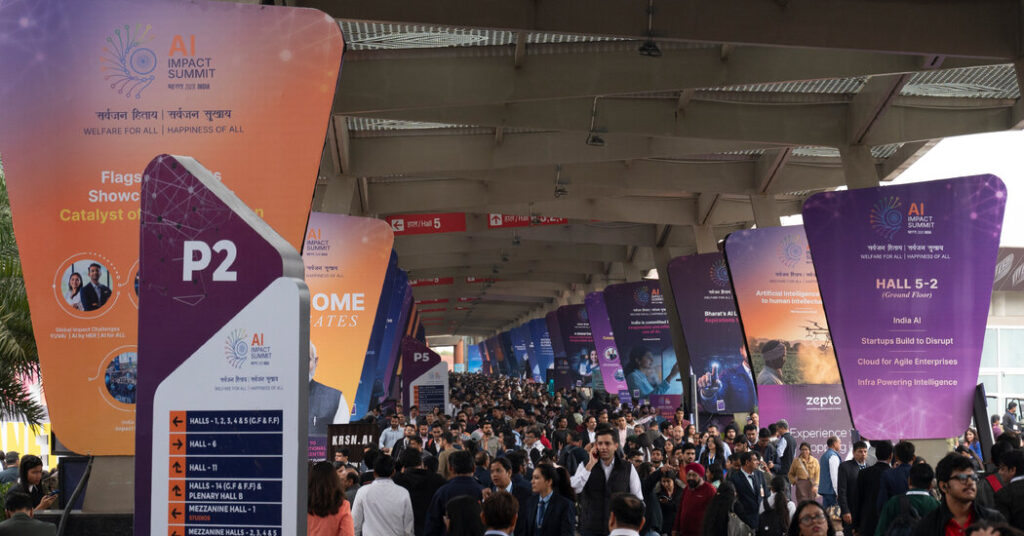
The India A.I. Impact Summit has been a whirl of more than 300 exhibitors and 500 sessions, sprawled across 120 acres of New Delhi this week. The organizers expected 250,000 participants and visitors.
A fleet of world leaders arrived, including President Emmanuel Macron of France, the keynote speaker, and President Luiz Inácio Lula da Silva of Brazil. The tech world is well represented: Google, Microsoft and all of India’s big companies sent their bosses.
This summit is the fourth in an annual series on A.I. that began at Bletchley Park in Britain in 2023, before moving to Seoul and then to Paris.
The headline topics of the earlier meetings were motivated by fear of doomsday scenarios, like the prospect of A.I.’s turning into a sentient overlord, and sought to devise regulations to make it safer.
India’s version is draped in announcements about business deals and billions in investment, as well as entrepreneurs touting clever fixes to real-world problems.
The host, of course, is India’s prime minister, Narendra Modi, whose face is featured on billboards for the event that span India’s capital. He was expected to speak on Thursday.
Home to 1.5 billion people and the fastest-growing of the large economies, India is an appealing venue for the world’s exuberant A.I. investors and engineers. While investors see an opportunity, India is off to a slow start on A.I. development relative to the United States or China.
With a huge and underemployed work force, India does not look like a natural fit for the labor-saving promise of A.I. India is short on the land, water and electricity needed for data centers. India brims with tech talent but not the companies that command it.
In his nearly 12 years in office, Mr. Modi has espoused the power of technology to transform the lives of the masses. He backed an existing biometric-ID system to the hilt, helping to stitch hundreds of millions of Indians into the world’s biggest real-time digital payments system. His allies distinguish India’s A.I. potential from the American approach, which has benefited mainly the private sector, and China’s, which strengthens state control.
Muzzammil Sabuwala, 22, a social media content creator from Mumbai in the process of becoming an A.I. entrepreneur, expressed a popular conviction: “If you stay active with this tech, and not dependent on it, you will find success.”
Ashwini Vaishnaw, the cabinet minister in charge of India’s A.I. policy, said $200 billion worth of A.I. investment was expected in India, much of it flowing from abroad.
The American A.I. company Anthropic, represented at the summit by its chief executive, Dario Amodei, announced a deal with Infosys, a giant among India’s first-generation tech firms. The two companies said they would integrate the services they offered to clients, such as regulatory compliance reporting and precision engineering. Infosys, along with Tata Consulting Services and other big Indian I.T. firms, has been battered for months by a stock sell-off on fears that A.I. threatens its business model. On Tuesday, the share price of Infosys sprang up 5 percent.
Claude, Anthropic’s main large language model, already counts India as its second-largest market, accounting for almost 6 percent of its worldwide usage. Such A.I. systems learn by digesting vast amounts of words and images, making India, with its massive population and numerous languages, a great place to do business.
OpenAI, the force behind ChatGPT, also sees an enormous market in India. Amitabh Kant, a former government official, said Indian users now shared 33 percent more data with OpenAI’s ChatGPT than Americans did.
India consumes more data than any other country. The companies running so-called frontier A.I. models and those that build data centers and the infrastructure they require are scrambling to keep up with demand.
This year, OpenAI will set up an office in India, its first in the country. Sam Altman, its founder, told a U.S. congressional committee last week that the future of artificial intelligence was contested between an “American-led, democratic A.I.” and China’s ruling Chinese Communist Party.
This week’s show was marred by delays and logistical confusion, which is typical of many enormous events in India but not the way the Indian government wanted to present itself to the A.I. world.
On Wednesday, it was announced that the convention center would be closed on Thursday, to make way for eminences like Mr. Modi and Mr. Macron, and that an extra day had been added to the summit. And shortly before the summit was to begin, Jensen Huang, the founder of Nvidia, the Silicon Valley company that supplies most of the chips that run A.I. data centers, canceled his appearance. One exhibitor, an Indian university, was kicked out after being accused of passing off a Chinese robo-dog as its own.
Still, there were heaps of deals to announce, featuring big players from inside and outside the A.I. sphere.
Blackstone, the private equity firm, put $600 million into Neysa, an Indian cloud-services provider. Each of India’s biggest three dominant industrial conglomerates — the Adani Group, Mukesh Ambani’s Reliance and Tata — are pouring money into new data centers. India’s government is ready to spend billions on projects ranging from rural nursery workers to surveillance along its border with China.
Smaller pavilions and kiosks were teeming with Indian entrepreneurs, each with a neat idea or two, and some with budding businesses.
Omnipresent Robot Tech said it had harnessed A.I. to anticipate 90 percent of airplane bird strikes, first to protect fighter jets and now deployed at the commercial airport in Agra, a city 100 miles south of New Delhi.
Sivi, owned by a husband-and-wife team, called itself one of 95,000 image-creation apps, but the only one that produces editable designs.
Another start-up, Zeko, showed off its product: so-called A.I. agents, based on a company’s work force, capable of interviewing job seekers.
Zeko’s co-founder Samyak Jain, 28, acknowledged that A.I. was making it harder for many young Indians to get a job, especially those trained for conventional tech jobs. His company charges its clients based on the volume of interviews they conduct using Zeko’s A.I. service. More job seekers mean more interviews.
One of the darker sides of A.I., the threat it poses to labor, was also not hard to spot at the summit.
The largest expense for most of these Indian start-ups are the fees they pay for what in A.I. circles is called compute. That is money made primarily by American companies, including Amazon and Microsoft.
Mishi Choudhary, a technology lawyer and activist who works between New Delhi and New York, had harsh words for the business model.
“The U.S. hyperscalers are selling snake oil to all of us, because they want to eliminate labor,” she said. “But we can’t eliminate jobs in India — there will be civil war, if anyone does it.”
Across India, there is widespread anxiety about whether India’s students are able to compete for good jobs in an age of A.I., with technology changing so rapidly.
Renee Wadhwa, a 19-year-old computer science student in the central Indian city Bhopal, said her syllabus was “completely outdated.” For graduates in her program, she said, it is harder to find jobs. “The pay packages are the same, but there are fewer of them,” she added.
But Ms. Wadhwa is confident that her specialization, concerning health care, will be in demand as long as she does her homework on A.I. “You have to up-skill yourself” to meet the moment, she said.
This is not something she was taught in class. Instead, she said, “I use A.I. to understand what I should do with A.I.”
Cade Metz contributed reporting from San Francisco, and Meaghan Tobin from Taipei, Taiwan.
Alex Travelli is a correspondent based in New Delhi, writing about business and economic developments in India and the rest of South Asia.
The post Money Talks as India Searches for Its Place in Global A.I. appeared first on New York Times.