For mere mortals, qualifying for the Olympics would be the achievement of a lifetime. Then there are those who excel in more than one sport, and in disciplines so vastly different that they belong to an even more elite club: participants in the Summer and Winter Games.
Roughly 130 people have competed in both over the entire modern history of the Olympics, dating to 1896. The combinations of sports have included sailing and ski jumping; cycling and speedskating; and skateboarding and snowboarding.
The most common ticket to the dual-season club appears to be track and field and bobsled. Bobsled teams need brakemen and brakewomen who are very strong and very fast to push the heavy sled quickly at the start of the race, hop in, take the ride and brake at the race’s conclusion. Track and field events at the Summer Games are full of muscular, speedy contenders.
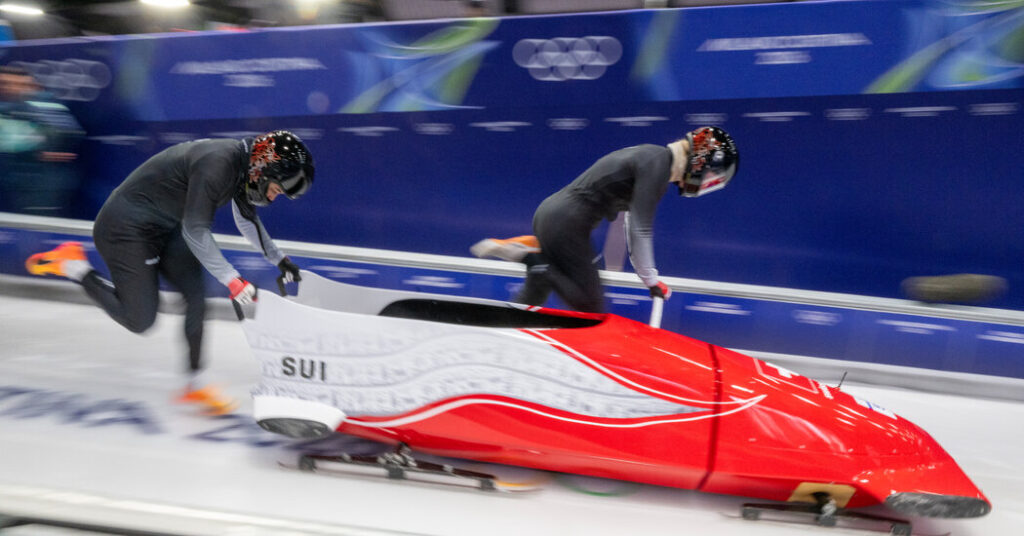
Salomé Kora, 31, will compete for a two-woman Swiss bobsled team this week as a brakewoman — having tried bobsled for the first time only in November.
As a sprinter, Kora competed in three Summer Games: Rio de Janeiro in 2016, Tokyo in 2021 and Paris in 2024. Bobsledders for years had asked her to join them on the ice track, but she never really considered it until last year.
“I wanted to discover something new,” she said.
She acknowledged that joining the rarefied club of dual-season athletes appealed to her competitive nature. In 2025, with the Winter Olympics around the corner, she thought that it was time to try. That first ride in Cortina d’Ampezzo, Italy — on the same ice track where she will compete at these Games starting Friday — did not go well.
“It was horrible,” she said with a laugh. “There are G-forces pressing your head down. You get some hits from the side, and sometimes the ice is not that smooth.”
But she gave it a few more tries, and came to like the adrenaline rush and speed. Within several weeks, incredibly, she had qualified for the Olympics. She is so new to the sport that she has never even toppled over in her sled.
“They say you’re only a real bobsledder when you’ve crashed, once, but I’m fine with not being a real bobsledder,” she said.
Ashleigh Nelson, a 34-year-old brakewoman for Britain, has been on a similarly fast timeline. She sprinted in the Rio de Janeiro and Tokyo Games, but needed surgery on her Achilles’ tendon in 2023 and did not qualify for the next year’s Paris Olympics.
“I thought my career in elite sports was over,” she said.
Then she received a fortuitous Instagram message from Adele Nicoll, a British shot-putter and discus thrower who also races a bobsled. (Nicoll has not participated in the Summer Olympics, but has done well in other major track and field championships.) Nicoll needed a brakewoman, and Nelson agreed to give it a try in the fall of 2024. They will compete in the two-woman bobsled competition this week.
“I never had this on my bingo card, but here we are,” Nelson said.
Nelson said she, like Kora, hated her first ride down the bobsled track.
“It was a bit bumpy and a bit wild, and I got out of the sled and said, ‘No.’ I felt sick,” she recalled. “I called my mom and said, ‘Mom, this is not for me.’”
But she, too, came to love it. She said she especially appreciates that so many bobsled athletes are people of color because of the pipeline from track and field. Many winter sports, including skiing and snowboarding, require expensive travel, equipment and training that can seem out-of-reach to many children of color, she said.
“In the Summer Games, it’s you and your spikes, or you might have the occasional javelin or shot-put. It’s so accessible,” she said. “With winter sports, if you don’t see people who look like you, you don’t always put yourself out there.”
In her mind, the Winter Games don’t get as much attention as those in the summer, but she said the sports are spectacular, bordering on dangerous, and should get more attention.
“I’ve probably got the easiest gig here at the Winter Olympics being a brakewoman. I’m watching everybody else — I’m watching Ilia backflip — and I’m like, I could never do that!” she continued, referring to the American figure skater Ilia Malinin.
Patrick Saile, Kora’s coach, who has worked with other track and field and bobsled athletes, said it’s easier for women to go back and forth between the two sports than it is for men. Athletes and their sleds are under strict weight requirements, and male sprinters tend to have to bulk up significantly to participate. Women do not have to change their bodies as much and can return to sprinting more easily, he said.
While the Olympic dual-season club is small, there is an even tinier echelon within it. Seven athletes have won medals in both the Summer and Winter Games. Count the sprinter and bobsledder Alexandra Burghardt of Germany among them. She won a silver medal in the two-woman bobsled race at the Beijing Games in 2022 and a bronze in the 4×100-meter relay in Paris.
Adding bobsled to her repertoire was “the cherry on top of the cake,” she said. But the sliding sport requires far more hours of training and working on the equipment than sprinting did, and after one season, she was done.
Burghardt, 31, came to Cortina as a fan, but she said she might have one more Olympics left. She is eyeing the Los Angeles Summer Games in 2028, provided her body holds up.
“I only want to do it as long as I’m having fun,” she said. “My fire is still burning.”
Heather Knight is a reporter in San Francisco, leading The Times’s coverage of the Bay Area and Northern California.
The post These Olympians Excel on Two Types of Tracks appeared first on New York Times.