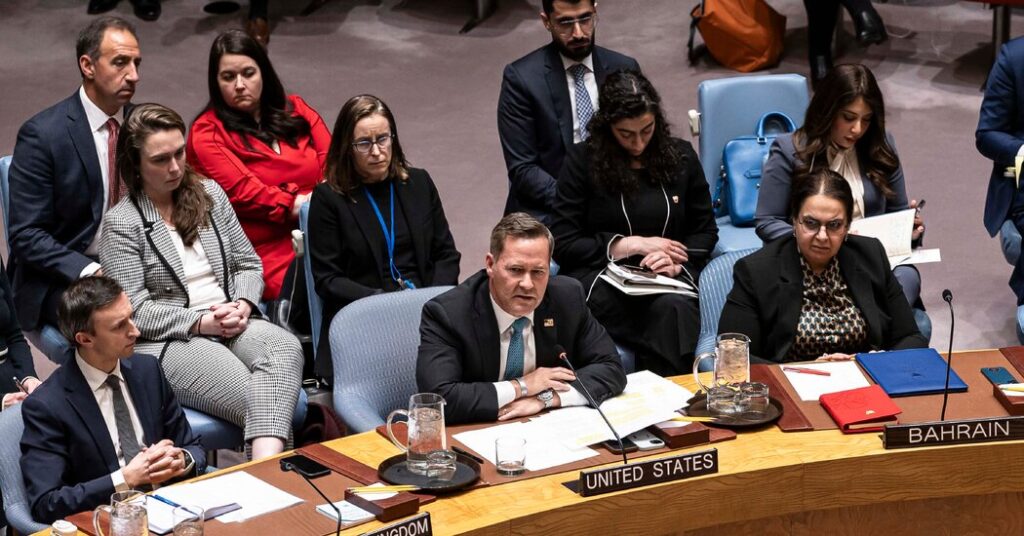
A day ahead of the inaugural meeting of President Trump’s Board of Peace, his initiative for ending the war in Gaza, diplomats at the United Nations Security Council raised concerns about continued Israeli attacks on Gaza, the amount of aid entering the territory and Israel’s increasing military raids and expansion plans in the occupied West Bank.
Amid the criticism of situation there, and recent pushback from some countries about the expanding mandate of the Board of Peace, Michael Waltz, the U.S. ambassador to the U.N., defended the board and reminded the Council that it had voted in November to adopt Mr. Trump’s 20-point peace plan for Gaza, including the board.
“We’re hearing the chattering class criticizing the structure of the board, that it’s unconventional, that it’s unprecedented. Again, the old ways were not working,” Mr. Waltz said. “We had choices of Hamas continuing to control Gaza, and occupation of Gaza, or a new way.”
The plan calls for demilitarization of the enclave, disarmament of Hamas and an international stabilization force to secure Gaza, leading to the eventual and full withdrawal of Israel’s military.
Mr. Waltz said the board planned to pledge $5 billion to the reconstruction and rehabilitation of Gaza, when it meets on Thursday in Washington. The United Nations has estimated the cost of rebuilding the territory at more than $50 billion.
Rosemary DiCarlo, the U.N.’s political and peace-building chief, told the Council that after years of conflict and suffering, the Middle East had an opportunity to change course, and the Board of Peace meeting was an important step. However, she said, peace on the ground was still illusive.
“The U.S.-led comprehensive plan must be implemented fully, alongside urgent action to de-escalate and reverse the dangerous trajectory in the occupied West Bank,” Ms. DiCarlo said.
Earlier this month, Israel made it easier for Jewish settlers to buy land and undercut the Palestinian Authority in parts of the West Bank that it administers.
Wednesday’s high-level meeting brought together Britain’s foreign secretary, Yvette Cooper, and the foreign ministers of Israel, Jordan, Egypt, Indonesia and Pakistan, most of whom will continue on to the Board of Peace meeting. The Security Council meeting, initially scheduled for Thursday, was moved after Mr. Trump announced he would be hosting the board on the same day.
Over two dozen countries have joined the Board of Peace. But some of the United States’ European allies, including Britain and France, two permanent members of the Security Council, as well as Germany, have declined, expressing reservations about the board’s sweeping mandate extending beyond Gaza. Some diplomats have raised concerns that Mr. Trump is attempting to create a parallel body to rival the Security Council, which is mandated to maintain peace and stability around the world.
Trump Administration: Live Updates
Updated
- A senior Justice Dept. official described dozens of violations of court orders in New Jersey as accidental.
- Donald J. Trump International Airport? The president’s company trademarked it.
- Workplace inspections by OSHA dropped over a six-month period of 2025.
Many critical parts of the plan are up in the air, including disarming Hamas, demilitarizing Gaza, ensuring a withdrawal of Israeli forces and deploying the international force. Hamas is reluctant to part with its weapons.
Ms. Cooper said the cease-fire in Gaza was fragile and that violations had occurred on both sides, with 600 Palestinians in Gaza killed, undermining the first phase of Mr. Trump’s peace plan.
She added that Britain planned to convene a peace-building conference in March to bring together members of Israeli and Palestinian civil society to build trust and make a pathway for a two-state solution. “Palestine must be run by Palestinians,” Ms. Cooper said.
On Tuesday, all the members of the Security Council — minus the United States — joined more than 70 countries and the Palestinian representative to the U.N., Riyad Mansour, to condemn Israeli actions in the West Bank. In a statement they strongly opposed any annexation of the West Bank and demanded Israel reverse course.
“Palestine belongs to the Palestinian people. It is not up for grabs and it is not for sale. It is not a land without a people,” Mr. Mansour told the Council. He said Israel’s goal was to remove the Palestinian people and seize their lands. “The scale and the pace has changed dramatically,” he said, “but the tools and the objectives are the same.”
Israel’s foreign minister, Gideon Saar, told the Council that the lands of Israel belonged historically to Jews. He held a jug handle and a coin, which he said were over 2,500 years old and which he said proved Jews had ancestral ties to the lands, including what he described as Judea Samaria, the term some Israelis use for the West Bank. He said in any future peace deal, the population of Israelis who have settled in the West Bank would remain intact.
“The truth is simple, we are the Indigenous people in the land of Israel,” Mr. Saar said. “How can Jewish presence in our ancient homeland violate international laws?”
The U.N. spokesman, Stéphane Dujarric, said on Wednesday that the United Nations would not be represented at the Board of Peace meeting but that it was engaging with the board on the humanitarian operations in Gaza and providing it with information. He said the U.N. chief for humanitarian affairs, Tom Fletcher, was invited but had a scheduling conflict.
Farnaz Fassihi is the United Nations bureau chief for The Times, leading coverage of the organization. She also covers Iran and has written about conflict in the Middle East for 15 years.
The post U.N. Security Council Meets on Gaza, a Day Before Board of Peace Gathering appeared first on New York Times.