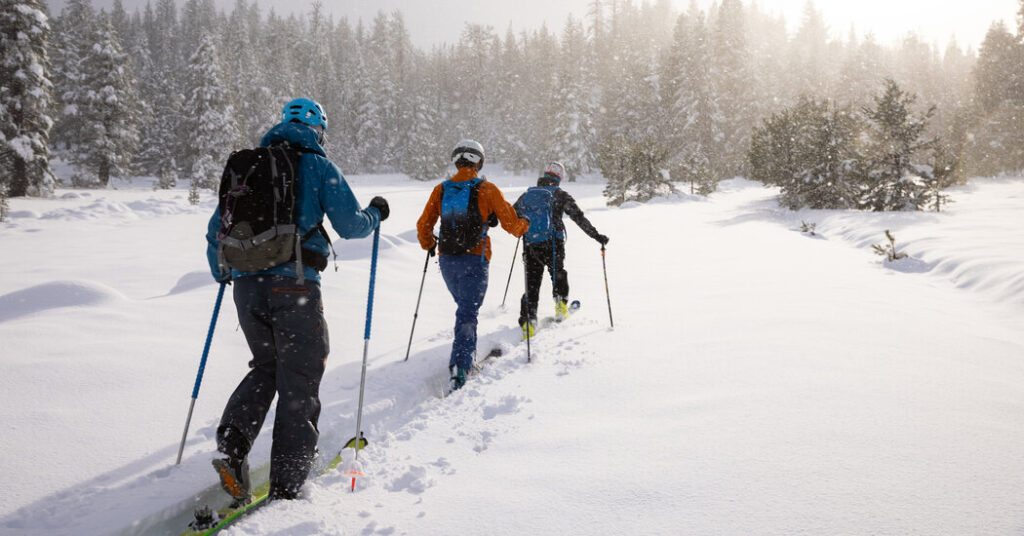
The company that guided a group of backcountry skiers in what became a deadly three-day trip in California’s Sierra Nevada was known for high-end adventures and safety courses in mountain recreation.
The company, Blackbird Mountain Guides, has led excursions, provided skiing lessons, taught courses like alpine rock climbing and instructed people how to partake in these activities in rugged conditions. Employees also taught safety courses like crevasse rescues and avalanche precautions.
On Wednesday, though, the company was dealing with the tragic consequences of the Sierra Nevada trip — eight people killed and a ninth person still missing and feared dead — a heartbreaking reminder of how dangerous these kinds of trips can be and the risks involved.
Videos posted by Blackbird indicated that the company was aware of some of those risks, at least in the broader area. One posted on Sunday said that a weak layer of snow in the area could lead to “unpredictable avalanches.” The video was filmed on Mount Rose, about an hour drive from Castle Peak near Lake Tahoe, where the avalanche occurred on Tuesday.
In a statement on Wednesday, Blackbird said it was focusing its efforts on the continuing operation on the mountain. The bodies of those killed remained there.
“At this time, our leadership and guides are fully committed to supporting the ongoing search and rescue operations, and we are in active communication with the families and loved ones of those involved,” the statement said.
The company was founded in 2020 by Zeb Blais, an American mountain guide who has skied, climbed and guided people on mountain ranges in locations that included Alaska, Antarctica, Japan and the Himalayas. Efforts to reach Mr. Blais on Wednesday were unsuccessful.
Blackbird has locations in California, Washington and around the world. But in the Lake Tahoe area, it is part of a small, tight-knit community of ski guides and tour operators. Many in the industry were hesitant on Wednesday to discuss the expedition.
Jenny Fellows, who co-founded the North American Ski Training Center in Truckee, Calif., with her husband in 1994, said that “mountain environments are dynamic, and even experienced teams face rapidly changing conditions that are hard to predict.”
Bruce Tremper, the former director of the Utah Avalanche Center and author of “Staying Alive in Avalanche Terrain,” said that backcountry skiing — skiing in remote areas where the snow is largely untouched — involves more risks than skiing at a resort.
“You’re in charge of your own safety in the backcountry,” Mr. Tremper said. “It’s like stepping back to the Stone Age. There’s lions, tigers and bears and avalanches.”
One of the safest ways to ski in backcountry trips, Mr. Tremper said, is to use a local mountain guide who is familiar with the terrain. These experts talk with avalanche centers to get forecasts based on factors like the stability of the snow and where these slides have been occurring. It was unclear on Wednesday exactly what the Blackbird guides did and did not know.
The probability of avalanches in one area does not mean that skiers will avoid the mountains altogether, Mr. Tremper said. Sometimes, skiers will change to a different path to avoid the avalanche risk. Fatal avalanches are rare, he said, and the vast majority of them are triggered by people. Few avalanches are caused by Mother Nature.
“In that case, it’s just a matter of bad luck, just being in the wrong place at the wrong time,” he said, adding, “There’s always a degree of uncertainty out there, especially when it comes to weather.”
Jill Cowan, Rylee Kirk, Christina Kelso and Amy Graff contributed reporting.
Christina Morales is a national reporter for The Times.
The post Company That Guided Sierra Ski Trip Specialized in High-End Adventures appeared first on New York Times.