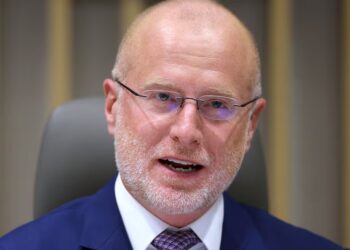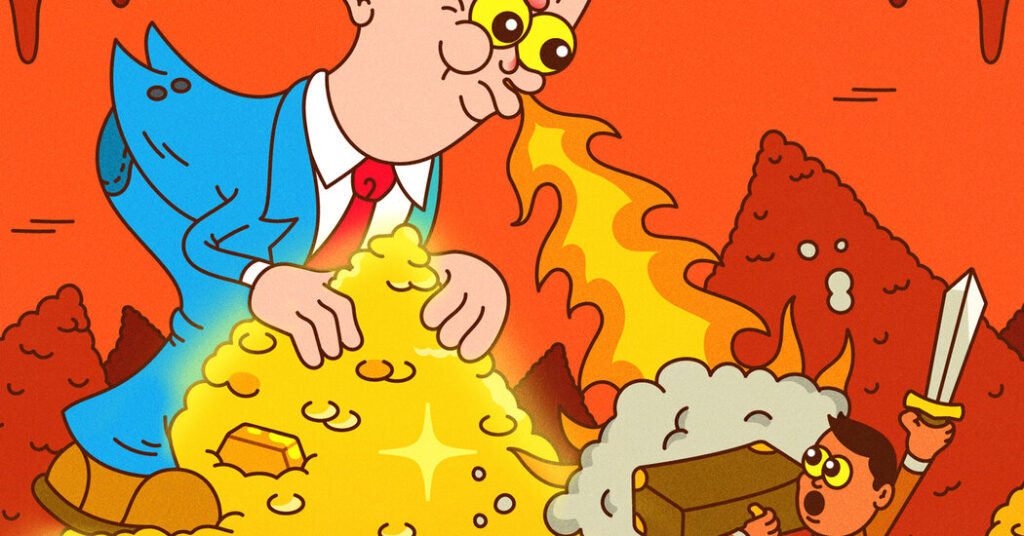
Andrew Wiederhorn lived large. His Oregon estate, on a bluff overlooking downtown Portland, had 10 bedrooms, a 2,000-square-foot pool and an indoor basketball court. Even after he lost the property, he flew on private jets, took luxury vacations and in less than four years spent nearly $700,000 on shopping and jewelry alone.
How did Mr. Wiederhorn get this money? According to the Justice Department, largely through fraud. Mr. Wiederhorn was the chief executive of the fast-food company that owns Johnny Rockets and Fatburger, and according to prosecutors, he stole some $47 million from the business in secret payments disguised as loans. (Mr. Wiederhorn and his legal team denied any wrongdoing.) This wasn’t even the first time Mr. Wiederhorn was accused of a criminal scheme: Two decades earlier, he spent over a year in prison for his role in a plan to steal from a union pension fund.
Mr. Wiederhorn was never convicted for the secret payments; his case never even went to trial. In late 2024, his company donated $100,000 to President Trump’s second inaugural committee. A few months later, the prosecutor on his case was fired by a White House official, and a few months after that, the government dropped the criminal case entirely. Mr. Wiederhorn, who had left his job after being indicted, returned to running the business he allegedly stole from. Shortly after, the company went bankrupt.
Mr. Wiederhorn is one of many defendants helping to forge a new path in American justice, one that takes the rich quite literally beyond the reach of the law. Their corruption threatens our economy and our democracy, and is so widespread and so brazen that it is easy to feel powerless. But we are not. There are legal tools that we can use to stop this corruption without waiting for the Justice Department, or anyone else, to act. We can fight back. But first, we need to understand who we’re fighting.
Consider, for instance, Trevor Milton, who was convicted of defrauding investors in his electric vehicle company. (Among other tricks: A video of his electric semi truck was allegedly forged by simply dragging the inoperable vehicle to the top of a hill and then letting it roll down.) Mr. Milton was sentenced to four years in prison. After he gave nearly $2 million to Trump-allied political committees, the president pardoned him. This meant that, among other things, Mr. Milton would not have to pay the $660 million that prosecutors demanded be returned to his defrauded investors.
Or consider Changpeng Zhao, the cryptocurrency executive whose company, Binance, served as a conduit for terrorists and child pornographers to transfer money. After Mr. Zhao, who pleaded guilty in 2023 to money-laundering violations, helped the United Arab Emirates buy $2 billion of the Trump family’s cryptocurrency, Mr. Trump pardoned Mr. Zhao, and the government’s lawsuit against Binance was dropped.
Whether or not a criminal quid pro quo occurred in any of these cases, they are part of a broader effort by the Trump administration to largely dismantle the infrastructure for prosecuting rich lawbreakers. It has disbanded or depopulated the F.B.I. and Justice Department teams that pursued corrupt politicians. It has unwound the task forces that investigated Russian oligarchs and crypto scammers. And it has announced plans to end entirely the Justice Department’s tax division, which prosecutes wealthy tax cheats.
Mr. Trump is apparently profiting from these cases: The Times estimates that he has made more than $1.4 billion since he was elected to his second term, in part from supplicants seeking his clemency. But his subordinates, too, have benefited from the broader rollback of white-collar prosecutions.
His border czar, Tom Homan, for instance, accepted $50,000 in cash in a paper bag from undercover F.B.I. agents in September 2024 in exchange for promising to secure government favors if Mr. Trump returned to office. (Mr. Homan has denied taking the money.) Such a scheme would have ordinarily resulted in a scandal, and quite likely a prosecution. But the office that would have investigated Mr. Homan has been largely gutted — just five attorneys reportedly remain — and Mr. Homan himself remains in office.
All this self-dealing is a threat to our democracy. Illiberal governments tend to live or die by their ability to sustain corruption. That’s because they rely for support on a network of oligarchs, who in turn are tied to the administration’s success. It happened in Hungary, in Turkey, in Russia and increasingly, it is happening here.
We don’t have to end up that way. As other countries’ experience shows, when bribery is risky, rich criminals are less likely to try it, and less likely to feel bound to a regime’s success. When corruption is revealed, voters often realize that the strongman they elected cares more for a small group of rich cronies than he does about them. That’s why it’s often the corruption that is key to toppling autocratic leaders, like Joseph Estrada in the Philippines, Alberto Fujimori in Peru, Viktor Yanukovych in Ukraine and Otto Pérez Molina in Guatemala.
In a world where the Department of Justice and the president are either indifferent to or actively support rich criminals, what can be done? Fortunately, there is a range of legal tools that ordinary citizens can use to pursue civilly the sort of corruption that would ordinarily be prosecuted criminally.
The shareholders potentially cheated by Mr. Wiederhorn could sue the Trump inaugural committee under the federal civil RICO law — written to destroy the Mafia — for seemingly helping to secure Mr. Wiederhorn’s freedom. Companies that follow the law can sue rivals, like Binance, that do not, under California’s Unfair Competition Law. And investors scammed by Mr. Milton can sue the political committees he donated to if they were “unjustly enriched” by his scheme.
These are established laws and have often been used to pursue rich lawbreakers. But they have rarely been applied to people seeking to buy their own freedom. We must — and can — do so now because the Department of Justice, which once fought white collar crime, now effectively supports it.
When regular citizens can’t act themselves, they can pressure their local prosecutors to do so. Recall Mr. Homan’s $50,000 in cash from undercover F.B.I. agents. This Justice Department may not continue the investigation. But Mr. Homan’s personal business is headquartered in Virginia, and it would be awfully interesting to find out if Mr. Homan reported that money on his state tax returns. If he didn’t, he may well have committed a crime. Most important, the defendants in these cases — both in citizen suits and in local prosecutions — cannot be pardoned by the president, who has authority only over federal crimes.
These cases, brought by individuals and local prosecutors, would raise the legal and reputational cost of corruption. They’d uncover new facts that reporters can’t find by themselves. And they’d focus people on infuriating stories that would otherwise be lost in the scrum of daily news. Collectively, they’d lower the odds that the already corrupt get the benefits they seek and discourage the potentially corrupt from pursuing that path at all.
Criminals and government officials are barely hiding their schemes, and their brazenness is meant to make us feel helpless, to think that nothing can be done. That is false. We already have the legal tools to fight corruption. We just need to use them.
Brendan Ballou is a former federal prosecutor and the founder of the Public Integrity Project. He is the author, most recently, of the forthcoming “When Companies Run the Courts: Forced Arbitration and America’s Secret Justice System.”
The Times is committed to publishing a diversity of letters to the editor. We’d like to hear what you think about this or any of our articles. Here are some tips. And here’s our email: [email protected].
Follow the New York Times Opinion section on Facebook, Instagram, TikTok, Bluesky, WhatsApp and Threads.
The post One Man Stole $660 Million. He’ll Never Pay It Back. appeared first on New York Times.