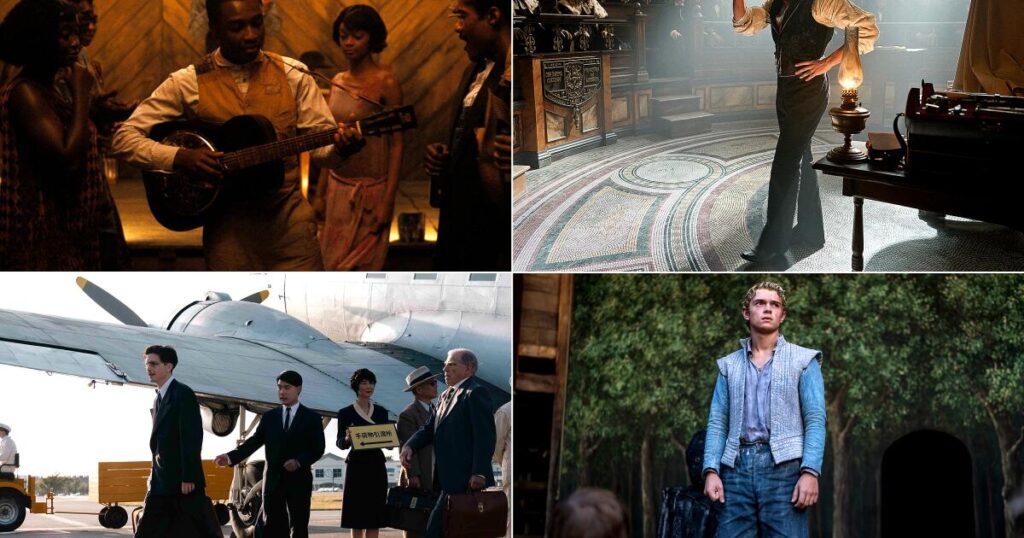
A one-size-fits-all sartorial approach is out of the question for the showmen of “Sinners,” “Hamnet,” “Frankenstein” and “Marty Supreme.” But whether the arena is theater, music, science or sports, all wear garments that accentuate their emotional states and prodigious talents — and leave an enduring mark. Here, Oscar-nominated costume designers Ruth E. Carter (“Sinners”), Malgosia Turzanska (“Hamnet”), Kate Hawley (“Frankenstein”) and Miyako Bellizzi (“Marty Supreme”) discuss defining menswear statements with The Envelope.
In Carter’s third collaboration with Ryan Coogler, Michael B. Jordan’s sharply dressed twins Smoke and Stack return to the Mississippi Delta in 1932 to open a juke joint, tapping their gifted blues musician cousin, Sammie (Miles Caton), to perform. “You see this style that [old blues players] embodied, whether it’s two-tone shoes, the hat, vest, shirts; all of that was laced into the storytelling,” says Carter. He might be a preacher’s son, but Sammie wears his passion on his blues-infused clothing in the record-breaking “Sinners.” “The vest is patched to show the wear from the guitar strap.”
Before the night goes to vampire hell, all eyes are on Sammie in earthy and gold tones as he sings “I Lied to You.” Artists spanning centuries and continents (including an electric-guitar-playing rocker and a Zaouli dancer) add to the mesmerizing sequence before returning to Sammie. “When we come back to him, we’re coming back to his own force and look,” Carter says.
A final scene set in 1992 shows Sammie (played by musician Buddy Guy) still beguiling audiences. Carter incorporates Guy’s real-life signature polka dots to highlight “this is a real story of the blues, and this is a real bluesman.” Stack’s authentic Coogi sweater (a nod to Biggie Smalls) contrasts with Sammie’s classic tailoring, which doubles as a memorial to his other cousin: “The color blue was an homage to Smoke and the flat cap.”
Clothing is also for remembrance in Chloé Zhao’s “Hamnet,” in which a grieving William Shakespeare (Paul Mescal) turns to a meaningful shade in paying tribute to his son during the inaugural run of “Hamlet” at the Globe Theatre in London. “Will, in my head, was imagining, remembering and holding on to the memory of Hamnet,” Turzanska says. “And in a super crude, simplified way, putting the paint and the colors that he remembered onto Hamlet’s character with those brushstrokes.”
Turzanska constructed the players’ costumes from raw linen, using slightly enlarged, period-accurate shapes combined with contemporary latex paint. Using this stage language, Hamlet’s (Noah Jupe) jerkin is “quilted and painted flat,” to conjure Hamnet (Jacobi Jupe): “It was a memory of the vertical stripes.”
Offstage, growing slashes in Will’s leather doublets depict “emotional turmoil.” Still, his turn as Hamlet’s murdered father (the Ghost) is the most overt example. The off-white cloak caked in clay is deliberately drained of all color. Turzanska tested the symbolic shroud (“You put this little harness on”) to ensure Mescal could move freely. Catharsis comes after Will exits the play: “The clay is cracking and falling off. Finally, when he washes it off, we see him break down for the first time and actually cry.”
Not every stage has a paying audience. In Guillermo del Toro’s “Frankenstein,” Victor Frankenstein (Oscar Isaac) reanimates a corpse during a disciplinary hearing demonstration. Clad in red, white and black, the renegade scientist’s sartorial inspiration is not bound to a single era.
“That was the first note from Guillermo [about Victor]. He goes, ‘Dandy, rock star. Look at David Bowie. Look at Prince,” says Hawley. “When we started talking with Oscar, he came in with his Prince stuff. When you look at his performance, you see all those subtleties, the physicality, the swagger.” Piping on the waistcoat is “a kick” to stand out against judges in black.
Hawley embraces “wonderful peacock” 1850s menswear shapes: Victor’s puffed-out chest accentuates the “wasp waist” likening him to a matador. An exaggerated period heel adds flair. “Shoes are what root the actor to the ground and their character,” Hawley says. “It elevates every gesture from there.”
“Marty Supreme’s” Bellizzi is equally mindful of footwear. Bellizzi “worked with Keds to find the shape” resembling a narrow 1950s sneaker for Timothée Chalamet to wear as ambitious table tennis player Marty Mauser. “When he was training, I would give him a few different sneakers to see what looked good but also what felt good,” says Bellizzi. “Because he had to wear them all day and play in them.”
Marty switches from a sedate black polo shirt and high-waisted wool pants while playing at Wembley in London to an eye-catching pink satin set on tour with the Harlem Globetrotters during a lighthearted interlude in Josh Safdie’s propulsive comedy-drama. “We overexaggerated the pants and the sleeves in the body so it is big and flowy,” says Bellizzi.
By the time Marty arrives in Japan, his everyday suit “has been through the wringer.” Luckily, a rigged ping-pong exhibition match allows Marty to embrace his theatrical talents. “It was an opportunity to show him as someone else. He’s undercover,” says Bellizzi. “He has the cap and the jumper.” Ever the showman, Marty relishes ditching the pretense and his wardrobe onstage, embracing his competitive streak. “He turns it into a bigger situation than it should have been, and maybe part of the surprise is that he’s derobing,” Bellizzi says. “It shows how much passion comes out.” Across venues and centuries, each man’s attire is ovation-worthy.
The post Forget the gowns. Menswear takes center stage in this year’s Oscar race appeared first on Los Angeles Times.