The latest round of talks to end the war in Ukraine concluded on Wednesday without any sign of meaningful progress.
But behind the scenes, negotiators have been trying to find a compromise on one of the biggest obstacles to a peace deal: control of territory in eastern Ukraine.
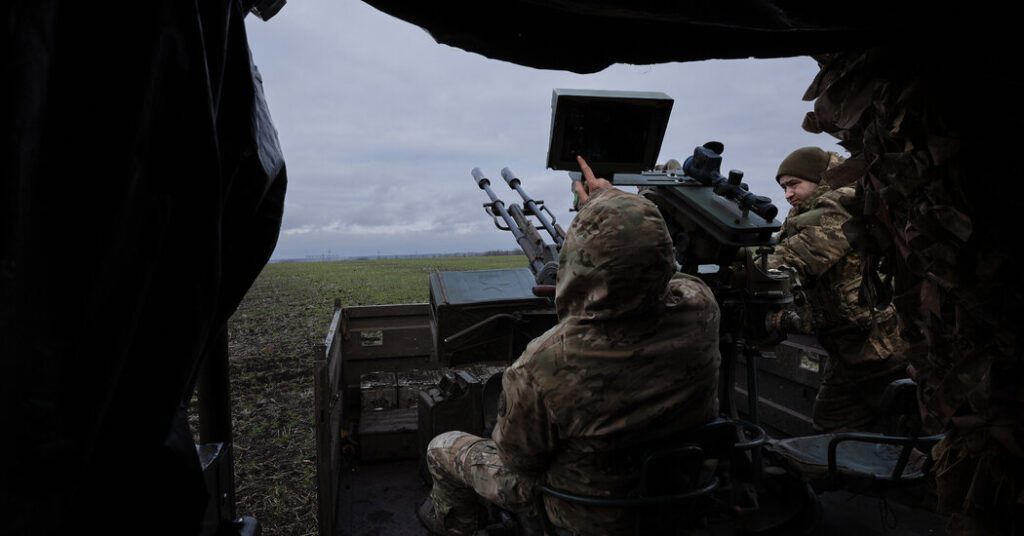
Russia has demanded that Ukraine hand over the land it controls in the Donetsk region as a condition for ending the war. This is a strip of territory about 50 miles long and 40 miles wide that includes dozens of towns and villages, and sits between the frontline and the administrative border of the region.
Ukraine has refused to withdraw unilaterally, saying that ceding land would embolden Russia to attack again, in Ukraine or elsewhere. Kyiv has asked for security guarantees to deter Moscow from violating any cease-fire.
In negotiations over recent weeks, officials have discussed the idea of forming a demilitarized zone controlled by neither army, according to three people familiar with the talks who would only speak anonymously to discuss sensitive negotiations.
This revives a proposal that was included in prior peace plans, including a 28-point one floated by the Trump administration in November.
Over the past week, President Volodymyr Zelensky of Ukraine has repeatedly downplayed the prospects of surrendering land for peace. “Allowing the aggressor to take something is a big mistake,” he wrote on social media on Monday.
Last fall, President Vladimir V. Putin of Russia was noncommittal when asked about forming a demilitarized zone in the Donbas region. The 28-point plan would have put Russia in charge of the area but prohibited it from deploying military forces there. Mr. Putin said the details needed to be discussed.
The Russian president’s foreign policy adviser, Yuri Ushakov, was later more positive, saying Russia could accept the formation of such an area if Russian police or national guard soldiers were allowed to patrol it.
A demilitarized zone could become part of a viable settlement, said William B. Taylor, a fellow at the Atlantic Council, a think-tank, and a former U.S. ambassador to Kyiv. But Ukraine’s interests would have to be protected, he said, and that would require the Trump administration to apply additional pressure on Russia.
“It is important that it be a real solution, not a forced solution, not an unbalanced solution,” Mr. Taylor said. “Any forced solution will not be stable. It will not last.”
To make it easier for both sides to accept the idea, negotiators have also discussed forming a free-trade zone in any possible demilitarized area, though investment possibilities seem limited in a territory that would be wedged between two armies, even with a cease-fire in place. Most industry in the area is in ruins, with only one coal mine still operational, and the risk that the conflict could be rekindled would loom for years.
Mr. Zelensky has also cast doubt on such an arrangement.
Another issue is the withdrawal of troops from the frontline. In December, Mr. Zelensky suggested Ukraine would not withdraw troops from the frontline unless Russia withdrew by an equal distance.
At talks held in Abu Dhabi this month, the Ukrainians discussed options for a partial Russian withdrawal from the frontline that would not necessarily be symmetrical, two of the three people familiar with the talks said. This would signal a softening of Ukraine’s position.
How a demilitarized zone would be governed has also been a sticking point. Ukraine has pressed for an international peacekeeping force to be deployed to the region, which is home to 190,000 civilians including 12,000 children, according to the area’s Ukrainian governor.
The negotiators discussed forming a civilian administration to rule the area after the war, two of the three people familiar with the talks said. This could include both Russian and Ukrainian representatives, one of the people said, but the person noted that the sides are far from an agreement.
Another issue that has re-emerged recently is the sequencing of the various steps, including accepting a demilitarized zone, formalizing security guarantees, creating a framework for postwar reconstruction funding and holding elections in Ukraine.
Last week, Mr. Zelensky said Ukraine wanted an agreement on security guarantees before committing to an election or any agreement on withdrawing forces from the Donbas.
“I would very much like us to sign security guarantees first and then sign other documents,” he said. “In my view, that would be a good signal. This is not even a matter of fairness, but a matter of trust. More trust in partners — if guarantees come first, and then everything else.”
Mr. Zelensky said Ukrainians must “know — not just believe, but know — that in the future Russian aggression will be impossible or that if it does happen, we will not be alone.”
Andrew E. Kramer is the Kyiv bureau chief for The Times, who has been covering the war in Ukraine since 2014.
The post The Behind the Scenes Search for Compromise on Territory in Ukraine Talks appeared first on New York Times.