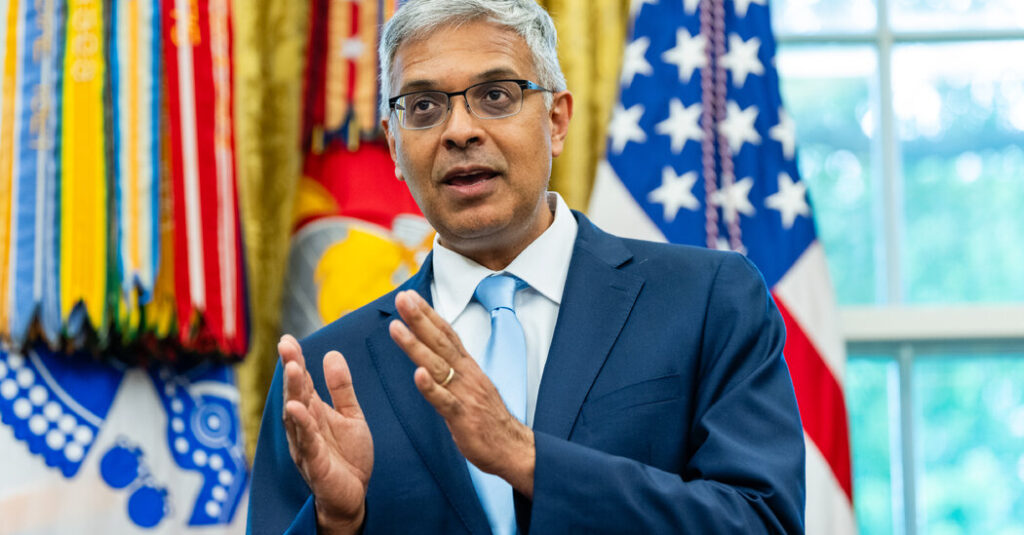
The director of the National Institutes of Health, Dr. Jay Bhattacharya, will take on the additional role of acting director of the Centers for Disease Control and Prevention, two administration officials said on Wednesday.
Dr. Bhattacharya will continue to run the N.I.H., according to the officials, who insisted on anonymity to speak about personnel decisions before President Trump announces them. He will serve until Mr. Trump appoints a permanent director — a position that now requires confirmation by the Senate.
The C.D.C. has run through a series of leaders since Mr. Trump returned to the White House last year.
Dr. Bhattacharya will replace Jim O’Neill, who had been serving as deputy health secretary until he left the health department last Friday. Mr. O’Neill will be nominated by Mr. Trump to lead the National Science Foundation, the officials said. He had been the acting C.D.C. director since last August, when Mr. Kennedy ousted the C.D.C.’s Senate-confirmed director, Susan Monarez, after she had spent less than a month in the position.
The temporary appointment of Dr. Bhattacharya, a physician and medical economist who left Stanford University to join the Trump administration, comes amid a leadership shake-up at the Department of Health and Human Services initiated by Health Secretary Robert F. Kennedy Jr. and the White House. The effort is partly in anticipation of health policy being front and center in this year’s midterm elections.
Dr. Bhattacharya drew the spotlight during the coronavirus pandemic as an author of the Great Barrington Declaration, which advocated an end to Covid lockdowns in favor of letting the virus spread among young healthy people while government resources were directed toward the elderly and vulnerable.
The declaration drew criticism from public health leaders and scientists, who said it was a dangerous approach. Dr. Francis Collins, the former N.I.H. director, called Dr. Bhattacharya and his co-authors “fringe epidemiologists,” fueling anger among conservatives, who embraced Dr. Bhattacharya.
Dr. Monarez told Congress she was fired because she refused Mr. Kennedy’s demands to fire top officials and sign off on new vaccine recommendations put forth by his handpicked advisers, without seeing underlying science and regardless of whether she agreed with them. Mr. Kennedy said he got rid of Dr. Monarez because she answered “no” when he asked if she was a “trustworthy person.”
Of the agencies under Mr. Kennedy’s purview, he seems to be particularly frustrated with the C.D.C. He has promised to tear down and remake it, describing it as “the most corrupt federal agency in the world.”
Dr. Monarez said that during tense conversations she had with Mr. Kennedy, he accused the C.D.C. of “killing children.”
The Trump administration moved quickly to shutter many of the agency’s offices and to reassign their functions to a new “Administration for a Healthy America.” Hundreds of researchers studying a range of issues from smoking to violence prevention have been let go.
The agency’s center on H.I.V. and sexually transmitted diseases was among the hardest hit, losing about 27 percent of its staff. Many of its top officials quit or were pushed out, including three high-ranking leaders — Dr. Debra Houry, Dr. Demetre Daskalakis and Dr. Daniel Jernigan — who resigned the day after Dr. Monarez was forced out.
Mr. Kennedy has managed to install leaders he trusts in other agencies under his purview: Dr. Marty Makary at the Food and Drug Administration, Dr. Bhattacharya at the N.I.H. and Dr. Mehmet Oz at the Centers for Medicare and Medicaid Services.
The C.D.C. has been an outlier. Mr. Kennedy’s first pick for director, Dr. Dave Weldon, a former Republican congressman who pushed for vaccine policy changes in the 2000s, was unable to garner enough Republican support to get confirmed, and the White House withdrew his nomination just hours before his Senate confirmation hearing.
Mr. Trump then nominated Dr. Monarez, who had served as acting director while Dr. Weldon was awaiting the hearing. She was confirmed last July and pushed out less than a month later.
During her brief tenure, she dealt with tragedy. Last August, a gunman, fixated on the Covid vaccine, opened fire on the C.D.C.’s Atlanta headquarters, killing a police officer and terrifying employees. The gunman was found dead at the scene.
In the run-up to the midterm elections, Mr. Kennedy is pivoting away from his vaccine agenda and toward more popular issues like healthy eating. Mr. O’Neill’s departure was among a number of personnel changes the White House and Mr. Kennedy made last week.
They included the elevation of Chris Klomp, a top official at the Centers for Medicare and Medicaid Services, to be Mr. Kennedy’s chief of staff, overseeing all operations. Mr. Klomp has been deeply involved in efforts to lower drug prices, a major priority for Mr. Trump.
Sheryl Gay Stolberg is a correspondent based in Washington for The New York Times, covering Health Secretary Robert F. Kennedy Jr. and President Trump’s health agenda.
The post N.I.H. Director Will Temporarily Run C.D.C. in Leadership Shake-Up appeared first on New York Times.