Classic exercises like deadlifts, squats and push-ups are effective ways to build strength. But unilateral exercises, or those that work one side of your body at a time, can offer some extra benefits.
Most everyday activities involve one-sided movements, said Toryn Middlekauff, a personal trainer in Charlotte, N.C. “When you’re going to the grocery store, you’re not picking everything up with two hands,” she added. Incorporating unilateral exercises into your workout routine, she said, can make similar movements in daily life feel easier and more comfortable.
Bilateral movements, which use both sides of your body, give your dominant side a chance to compensate, but with single-sided exercises, “you can’t hide or mask that,” said Vikash Sharma, the owner of Perfect Stride Physical Therapy in New York City. For that reason, performing unilateral movements can help you spot muscle imbalances or limitations in your strength and mobility. These exercises can also help improve your balance, coordination and core strength, Ms. Middlekauff said.
This kind of training can be time-consuming, since working each side of your body separately takes twice as long, Dr. Sharma said. If you don’t have time for a full unilateral workout like this one, you can choose one or two exercises to add to your usual strength workout.
Before trying each movement, you should feel comfortable with the bilateral version of it, Dr. Sharma said. If you can squat, for example, try the lunges. If you can do an overhead press, try the single-arm presses.
The following routine, which was designed by Ms. Middlekauff, includes unilateral exercises that train your whole body in a variety of movement patterns. As you move, try focusing your gaze on something still to maintain your concentration.
Overview
Time: 30 to 45 minutes
Intensity: Moderate
Rounds: Perform each exercise in order. Complete all repetitions on one side before repeating on the other side and then move on to the next exercise. Complete the full circuit two or three times.
What you’ll need
-
A mat
-
A set or two of dumbbells (one medium, one heavy)
-
A heavy kettlebell (optional)
Reverse lunge
Targets: Quads and glutes
Repetitions: 8 to 12 per side
Stand tall and then step back with one foot, with your heel lifted. Keeping most of the weight on your front foot, bend both knees until your back knee is almost touching the floor. Your torso can lean forward slightly. Press into your front heel to return to standing and then bring your back foot forward to the starting position.
Hold medium or heavy dumbbells in each hand to increase the challenge; place one hand on a wall or a table for balance support, if needed.
Single-leg glute bridge
Targets: Glutes and hamstrings
Repetitions: 8 to 12 per side
Lie on your back with your knees bent and feet on the floor, ankles just below your knees. Lift one leg with your knee bent, shin parallel to the ceiling, then press into your bottom foot to push your hips up. Hold briefly with your shoulders, hips and bottom knee in a straight line and then lower your hips to the floor. Repeat.
If you can complete 15 to 20 repetitions without weight, add a medium or heavy dumbbell across your hips to increase the challenge.
Single-arm overhead press
Targets: Shoulders and upper arms
Repetitions: 8 to 12 per side
Sit or stand tall with a medium weight in one hand, near your shoulder. Your elbow should be bent by your side, and your palm should face forward at a 45-degree angle. Keep your shoulders even and steady as you press the weight overhead toward the ceiling, extending your elbow, and then lower with control.
Focus on lifting and lowering without leaning — your neck should stay neutral and upright.
Single-arm biceps curl
Targets: Biceps and shoulders
Repetitions: 8 to 12 per side
Sit or stand tall with a medium weight in one hand, your arm long by your side. Keep your torso steady and your shoulders even as you bend your elbow to lift the weight toward your shoulder and then lower with control. Make sure your upper arm stays still by your side — focus on using your biceps, not your shoulder, to move the weight.
Single-arm row
Targets: Back muscles
Repetitions: 8 to 12 per side
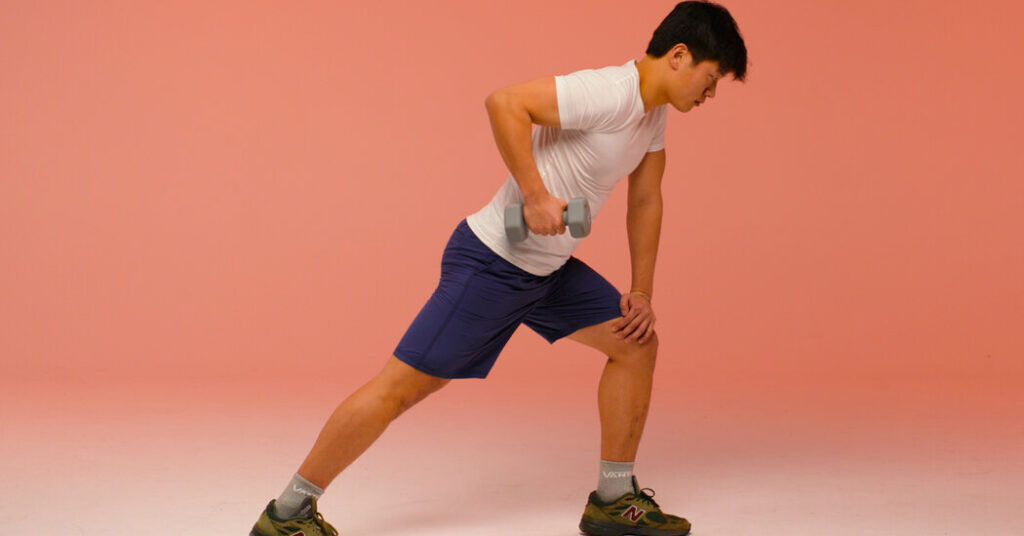
Stand with your feet staggered. Rest your hand on your front thigh, and hold a heavy weight in your other hand, keeping your back flat. Pull the weight toward your hip, pause and then lower with control. Keep your arm close to your side as you move. At the bottom of the row, allow your shoulder to reach forward slightly for a larger range of motion.
Side plank
Targets: Abdominals
Repetitions: Hold for 30 to 45 seconds on each side
Lie on your side with your legs stacked and your forearm on the floor, elbow just under your shoulder. Press into your feet and forearm to lift your hips off the floor and hold.
You can also perform the side plank with your feet staggered (one foot just in front of the other) or with your knees on the floor, just slightly in front of your hips.
Suitcase carry
Targets: Abdominals, upper back, grip strength
Repetitions: Walk for 45 seconds to a minute per side
Stand tall, holding a heavy dumbbell or kettlebell in one hand. Keep your shoulders and hips even as you slowly walk, carrying the weight.
Be sure to engage your core as you pick up the weight and put it back down.
Anna Maltby is a personal trainer, a mat Pilates instructor and the author of the newsletter How to Move.
The post 7 Moves to Improve Your Balance and Overall Strength appeared first on New York Times.