An archetypal surfer’s house can be expected to have a few basic features — such as open space, pure light and a breezy sense of informality. Walls that are the color of sand and a kitchen that matches the sky may also be part of the scheme.
What is not expected is that the home is in the city of Stavanger, on the raw west coast of Norway.
“Stavanger is the perfect place for surfing,” said Bjarte Sandal, an architect who recently renovated just such a property. “We have these long beaches and waves, and even more waves that come from them.”
However, it is cold. “I would never do it,” said Mr. Sandal, whose firm, Smau, has offices in Stavanger, where he grew up, and Oslo, where he lives now.
Not so for his client, Rolv Skjærpe, an interactive design consultant who routinely dons a wet suit and heads for the surf. The townhouse he updated for Mr. Skjærpe with attention to its midcentury roots, is part of a residential complex that emerged in Norway’s postwar housing boom.
Designed by Eyvind Retzius and Svein Bjoland, distinguished local architects, and completed in 1967, the development, called Stokkabrautene, consists of dozens of townhouses with angled roofs. The properties were built as affordable housing for first-time buyers who wanted to be near an urban hub (Stavanger is the center of Norway’s oil industry), yet surrounded by nature.
Today the complex is effectively a landmark. “Everybody knows the building,” Mr. Sandal said. “And everybody wants to live there.” Water views are one of its charms: Many of the houses look out to a large inland lake. A North Sea surfing beach is about 15 minutes away.
Mr. Skjærpe moved to Stokkabrautene in 2000, with his then-wife and their two young daughters. He paid $2.3 million Norwegian krone (about $243,000) for the three-bedroom house of about 1,000 square feet, which are distributed over three levels, each separated by a small flight of stairs. (There is also a basement with a guest bedroom.) The renovation cost about $3 million Norwegian krone, or about $317,000, he said.
Through the decades, the exterior remained untouched, as decreed by historic preservationists, but the interior had drifted from its modernist roots. The kitchen, for instance, which was originally a small, enclosed affair, had been enlarged in a previous renovation, though it remained behind walls. And there was wallpaper in the unit, “awful, bubbly stuff,” as Mr. Skjærpe described it.
Bringing the property back to the shrewd simplicity of its origins without sacrificing 21st-century comfort was a big job. The construction began in 2023 and lasted seven months. All the interior wood and plaster surfaces on the main floor were replaced. The roof, which was beginning to buckle after decades of snow and moisture, was reinforced with a steel beam and stuffed with new insulation.
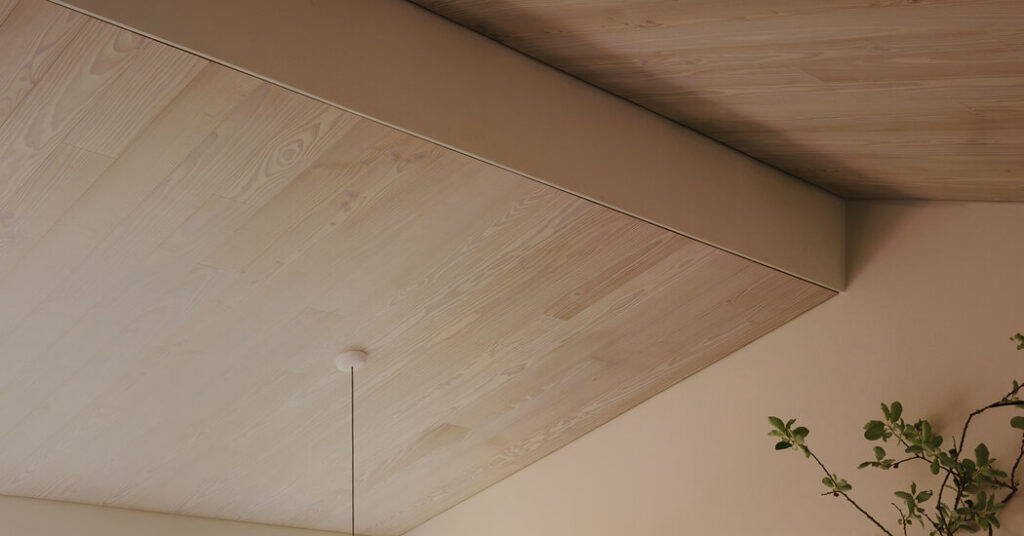
The ceiling on the main floor was clad in Douglas fir planks that were oriented toward a picture window so that they pointed to the water view. The floor was covered in Douglas fir as well, and the walls were painted a beachy beige.
Segmented windows flanking the front door, recreate not the 1967 townhouse design but the original architects’ unrealized conception of what the entrance should have looked like. (Mr. Sandal dug out the plans.) The new foyer floor is terrazzo.
Interior walls were removed, and the kitchen was liberated, though shrunk. “We wanted the kitchen to shine,” Mr. Sandal said of the custom-designed space that now occupied something closer to its 1960s footprint. The Norwegian pine cabinets were coated in sky-blue linseed-oil-based paint that let the wood grain show through.
Mr. Sandal worked with his client to choose furniture that popped like a surfboard’s graphics, including a bright orange USM cabinet. He was delighted with the contrast created by a Norwegian pinewood table and dining chairs that Mr. Skjærpe found in a vintage store.
“That’s kind of my universe, to mix old and new,” the architect said.
Throughout the messy, noisy months of construction, Mr. Skjærpe, who was then on his own, lived in a camper van on the beach and caught the early morning waves.
The home’s surfing theme is low-key to the point of sometimes being indiscernible. The sandy beige hue that dominates the living room is repeated in the lower-level bathroom’s square tiles. Mr. Skjærpe said he was pretty sure the stainless-steel bathroom counter and sink evoked the trim on his camper.
His daughters are grown now, but they still keep their wet suits in the house, “ready to be used,” Mr. Skjærpe said, when their jobs and studies will permit it. Though winter brings the best ocean waves for Norwegian surfers, he often indulges his taste for frigid sports on the lake just outside his home. That is where he ice surfs by standing on a skateboard with runners and catching the wind with a foil sail that he holds in his outstretched arms.
And the ice is solid?
“Yeah, yeah, it’s super solid,” he said. “No worries.”
The post A Norwegian Surfer’s House by the North Sea appeared first on New York Times.