Julia R. Cartwright is a senior research fellow in law and economics at the American Institute for Economic Research.
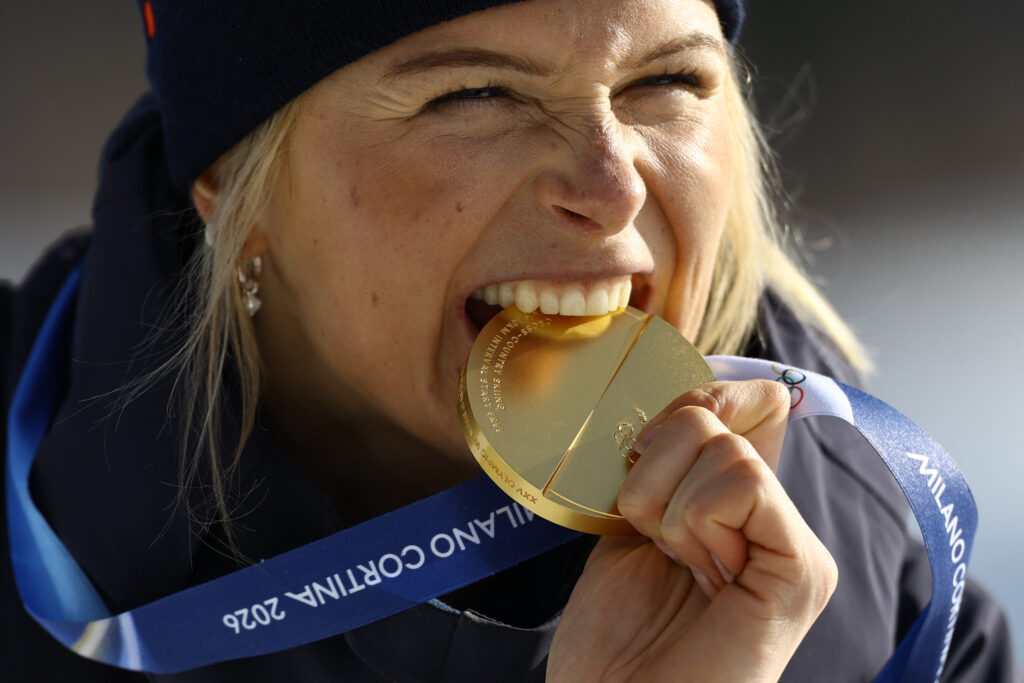
With the 2026 Winter Olympics ongoing in Milan and Cortina, Italy, cameras are again capturing a familiar image: athletes atop the podium, showing off their medals … and biting them. It’s a ritual so ingrained that few pause to question it. Yet, as skiers and skaters flash wide grins for the world, the gesture carries a meaning far older than the Olympic movement itself.
Long before it was a photo op, biting gold was a way to test whether something valuable had been diluted. In an age of fiat money and expanding central bank balance sheets, that ancient instinct to verify what we’re being given feels more relevant than ever.
For generations, people bit gold coins to verify that they were genuine. Gold is a relatively soft metal, so a pure gold coin would show a faint tooth mark. If a coin were diluted with a harder metal, or merely plated in gold, your teeth would quickly tell the difference. The bite was not kitsch. It was quality control.
Biting a coin was a clear signal against debasement. In the ancient and early modern world, rulers frequently diluted gold and silver coins with cheaper metals to stretch their treasuries. By reducing the precious metal content while maintaining the same face value, governments could create more coins from the same stock of gold. It was an early form of inflation.
Here’s how it worked: Imagine a country with a fixed quantity of gold backing its currency. If authorities melted down all the coins and reissued twice as many, each containing half as much gold, the money supply would double. Prices would rise accordingly. Goods would not become more productive or abundant; the measuring stick of value would simply have shrunk.
Gold imposed discipline because it was scarce. You could test it, weigh it and bite it.
In early American history, reputation was dependent on metal content. Before the era of centralized monetary authority, banks issued notes convertible into coinage. The United States Mint competed alongside private mints, especially during three regional gold rushes in the 19th century: the southern Appalachians in 1829, California in 1848 and Colorado in 1858. If a private mint diluted its coins, word spread quickly and customers fled. Sound money was not enforced by regulation alone but by competition and credibility.
That world began to fade with the creation of the Federal Reserve in 1913 under President Woodrow Wilson. The final break came in stages: Domestic gold convertibility ended in 1933 under Franklin D. Roosevelt, and international convertibility ceased in 1971 under Richard M. Nixon. The gold standard was over.
Since then, the U.S. money supply has expanded by more than 3,000 percent. Subsequently, U.S. inflation underwent a clear regime shift, moving from the relatively stable 1 to 3 percent range of most of the 1960s to a period of high volatility and double-digit spikes, exceeding 12 percent at various points in 1974, 1979 and 1980. The material has changed, paper and digital entries instead of precious metal, but the economic logic has not: Increasing the supply of money relative to goods reduces its purchasing power.
The difference is that we can no longer bite the coin.
Under a gold regime, debasement was tangible. You could feel it. Today, inflation is diffused and contested. When egg prices spike, analysts debate bird flu, supply chains, market concentration or corporate greed. All may play a role. But monetary expansion operates in the background, altering relative prices across the economy in ways that are harder to isolate and measure.
Inflation statistics attempt to capture this erosion, but they are inherently imperfect. They depend on shifting baskets of goods, quality adjustments, substitution effects and statistical modeling. Was the coin diluted by 5 or 10 percent? In a gold system, you could assay it. In a fiat system, you must infer it from complex indexes.
That ambiguity is no accident. Modern central banking is built on discretion. Today, the Federal Reserve operates on a far grander and more sophisticated scale. Instead of shaving silver from coins, policymakers create reserves electronically; instead of clipping metal, they adjust liquidity through open-market operations and large-scale asset purchases. The result, however, is familiar. Over time, purchasing power erodes, savers feel poorer, asset prices soar and wage gains struggle to keep pace with inflation.
Without a coin to bite, the public argument over inflation becomes muddled. We focus on individual price hikes rather than asking why the currency itself has been diluted.
There is a broader lesson here about economic power. When money is anchored to a scarce commodity, political discretion is constrained. When it is anchored to institutional judgment, discretion expands. That shift concentrates enormous authority in central bankers, well intentioned, perhaps, but human nonetheless.
Olympic athletes bite their medals for photographers. It’s a ritual divorced from function. But it reminds us of a time when authenticity could be tested with something as simple as a tooth mark. Today, we cannot bite a dollar bill or test a bank reserve by hand. The only evidence of dilution appears gradually, in higher prices, in diminished purchasing power, in the creeping sense that the unit of account is less reliable than it once was.
Perhaps that is why the image resonates. The bite is a demand for proof and a refusal to accept plating for purity.
In monetary affairs, that instinct is worth reviving.
The post Olympic medal bites are iconic. What do they really mean? appeared first on Washington Post.