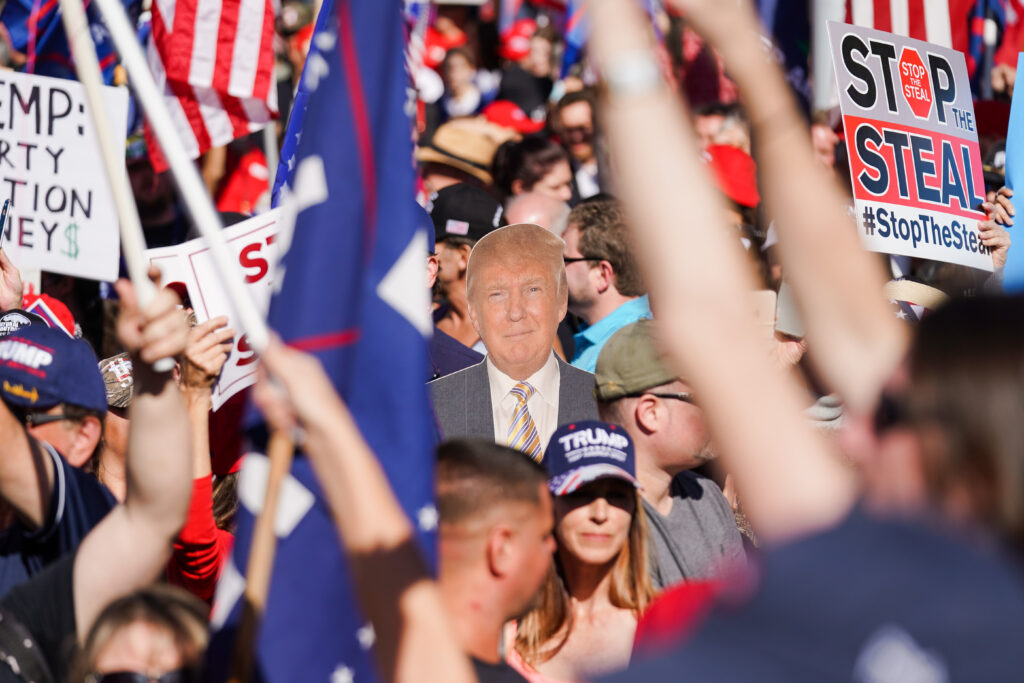
Asked what she thought of an attack on the poet Lord Byron’s morals, a wit replied, “It is the first time I ever heard of them.” You might say the same if asked what you think about proofs that the 2020 presidential election was stolen.
Donald Trump’s belief in widespread fraud in the casting and counting of 2020 ballots is entailed by his belief that it is theoretically impossible for him to lose at anything. His certitude infects millions of Americans, some of whom think it inconceivable that he could ever be mistaken. Others doubt that anyone could win the presidency while obsessing about a complex conspiracy for which there is no evidence.
Remember, however, the aftermath of the assassination of President John F. Kennedy. Many people, reluctant to believe that immense consequences could result from an insignificant person, concluded that the complete absence of evidence of the conspiracy was conclusive evidence of how vast and competent the conspiracy to kill Kennedy had been.
The 2020 election’s contribution to humanity’s history of gullibility continues through Sidney Powell, a former Trump post-election lawyer. Five days after the election, she appeared on Fox News to say there had been “massive and coordinated” malfeasance to “delegitimize and destroy” Trump votes, and “manufacture” votes for Joe Biden. She spoke of a “computer system” in Dominion voting machines “flipping votes” or manufacturing them.
Dominion sued Fox News and collected $787.5 million. Now Powell is defending herself against a defamation suit involving another voting-technology company. Powell is merely a curiosity — an exotic (even by today’s standards) flavor of paranoia, or cynicism, or both. Tulsi Gabbard, however, is important.
She is director of national intelligence. In her spare time, of which she evidently has too much, she is a sleuth who last month appeared at a warehouse in Fulton County, Georgia. There, the FBI, which surely has better things to do, seized ballots from 2020. Gabbard was there to …
To do nothing proper. Writing for the Dispatch, Kevin Carroll, senior counsel to the Homeland Security secretary during the first Trump administration, says the National Security Act of 1947, which established the CIA, was passed by a reluctant Congress only after it was amended to stipulate that the agency “shall have no police, subpoena, or law enforcement powers or internal security functions.” Carroll says the “entire intelligence community is prohibited from collecting information on U.S. persons solely to monitor First Amendment-protected activity — such as voting.” An executive order, updated since Ronald Reagan issued it, prohibits all elements of the intelligence community, other than the FBI, from “acquiring information concerning the domestic activities” of Americans.
A particularly sinister aspect of Richard Nixon’s behavior in the wake of the Watergate break-in was his attempt to draw the CIA into the subsequent cover-up by claiming there was a “national security” dimension to the matter. The Trump administration has offered no intelligible national security rationale for Gabbard’s Georgia grandstanding.
The FBI was there to placate the president, who in January said he should have ordered the National Guard to seize ballot boxes in 2020 swing states — presumably not in any he won. This spoken regret was followed by his wish that congressional Republicans would “nationalize” elections.
Hours after the FBI’s Georgia stunt, Trump posted some conspiracy theories, including — speaking of the exotic — this: China coordinated the use of Italian military satellites to cause U.S. voting machines to flip Trump votes to Biden.
Someone should read to him “Lost, Not Stolen,” a 2022 report by eight conservatives (two former Republican senators, three former federal appellate judges, a former Republican solicitor general, and two Republican election law specialists). They examined all 187 counts in the 64 court challenges filed in multiple states by Trump and his supporters.
Twenty cases were dismissed before hearings on their merits, 14 were voluntarily dismissed by Trump and his supporters before hearings. Of the 30 that reached hearings on the merits, Trump’s side prevailed in only one, Pennsylvania, involving far too few votes to change the state’s result. Trump’s batting average? .016. In Arizona, the most exhaustively scrutinized state, a private firm selected by Trump’s advocates confirmed Trump’s loss, finding 99 additional Biden votes and 261 fewer Trump votes.
It would be reassuring to think that Trump believes nothing he says about 2020: Cynicism in the presidency is less disturbing than delusion. But reassurance is not plausible. As the poet William Blake wrote, “The man who never alters his opinion is like standing water, and breeds reptiles of the mind.”
The post The 2020 ‘stolen election’ obsession: Cynical? Delusional? Reptilian? appeared first on Washington Post.