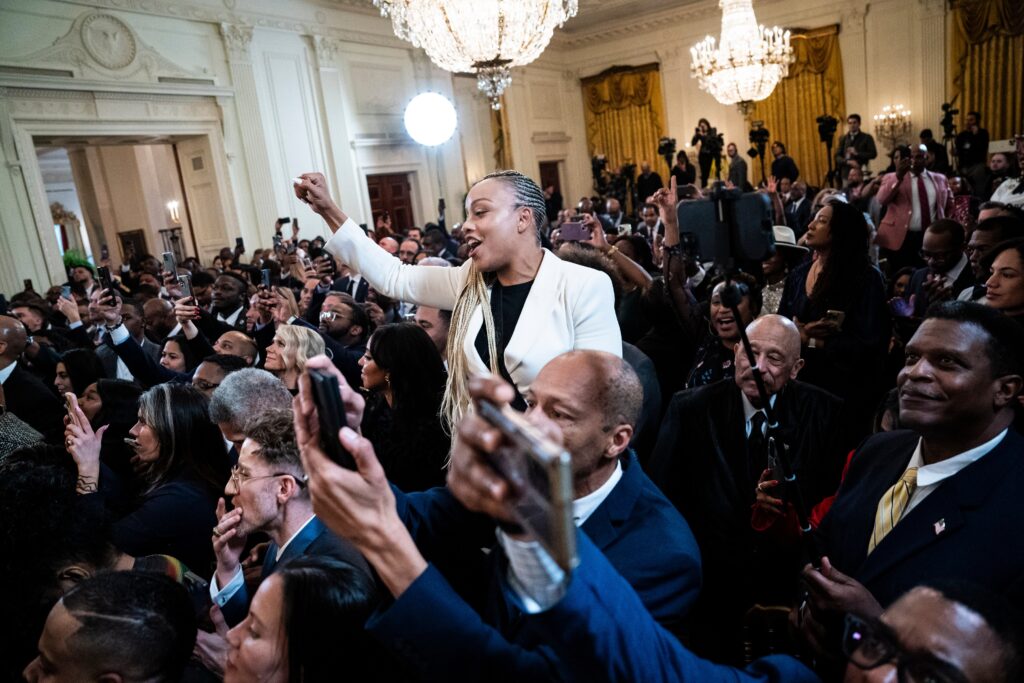
Last year, at the White House’s Black History Month celebration, President Donald Trump took the lectern and basked in victory. He’d just won a second election with more Black support than any Republican presidential candidate in five decades, and 1 in 3 Black Americans approved of the job he was doing. He thanked the room and teased that his first administration never had a Black crowd as large. “I look at this turnout … ” he crowed, “This is just love in the room.”
Today, however, new polling among Black Americans suggests the love is gone. Trump’s favorability has plummeted from 30 percent a year ago to as low as 13 percent last month. His job approval has fallen to 15 percent, less than half of what it was at that White House celebration. His current ratings are about what they were before he lost the 2020 presidential election.
Where did Black MAGA go?
The declining numbers don’t just signal that the president is losing voters; they show that MAGA’s appeal to Black Americans stems less from affection, partisan identity or loyalty to Trump. Instead, their support primarily rests on two pillars — successful implementation of policies they can point to with pride, and a sense of belonging to a movement that outweighs racial differences within it. And, importantly, it requires political competence to guard against the scrutiny that Black MAGA receives from Black Americans for supporting Trump and from the MAGA faithful wary of newcomers. A year later, however, the honeymoon is over. Black supporters sought prosperity and governance, but the Trump administration has mostly delivered chaos; they needed belonging but found hostility.
The easy but incomplete explanation for the attrition is that outcomes have worsened for Black Americans in the past year. At 7.2 percent, the Black unemployment rate borders on recession levels and has returned to being about twice that of White Americans. Deep cuts to the federal workforce and government contracting disproportionately harmed Black workers and small businesses. And Trump has broken almost every promise he made to Black voters in his reelection campaign. But he often characterized these results as corrections for diversity, equity and inclusion programs run amok, something that Black MAGA also believed to be true and needed fixing.
More difficult to excuse, though, is how the Trump administration governs. His Black supporters typically hold hard-line stances on immigration, but the violent and chaotic manner of the deportation operations leaves nothing to defend. Like most of MAGA, many Black voters who backed Trump expected an exit from foreign entanglements and to reap dividends from a bustling economy — they’re getting neither. His presidency has lurched from capricious tariff policy to repeated government shutdowns to indifference regarding long-standing security agreements.
For Black Trump voters, the problem is less the policy than the careless and erratic execution. In a focus group of regretful Trump 2024 voters, one Black man gave Trump a particularly poor grade: “Everything that’s been enacted,” he said, “all these ICE escapades and everything like that, it’s rough, and I just don’t think he’s doing anything about it or helping at all.”
With a friendly Congress and a sympathetic Supreme Court, Trump’s failure to deliver seems either because he isn’t capable or because he doesn’t care to be. Either way, for Black MAGA, the end result is unattractive.
This, too, might be surmountable if MAGA made Black supporters feel more welcomed. Political scientists have found that Black Republicans, particularly during the tea party and MAGA movements, must lean in harder to the party’s ideologies for acceptance. And they’ve noted that Black voters supporting Republicans often face community backlash, making a vote for Trump a risky proposition.
But studies show that MAGA’s racial resentment and anti-wokeness views are particularly high and not at all color-blind. Trump has insisted White people are today’s targets of racism while citing Black and Hispanic people as the root of the nation’s immigration and election problems. And the administration is removing Black history exhibits while planning to install a statue of Christopher Columbus in front of the White House. “We love the Italians,” Trump remarked at a signing ceremony for a Columbus proclamation.
Trump began Black History Month this year not by holding another White House celebration, but by posting a racist video to social media of Barack and Michelle Obama. When paired with immigration agents’ violence toward citizens, high costs of living and a government unconcerned with the will of the people, whatever love remains in the air isn’t enough to keep a substantial number of Black voters in the MAGA coalition.
Black voters have long been pragmatic and sensitive to political expedience — alert to the differences between genuine acceptance and being courted for votes. In the 2024 election, Trump proved there were Black voters willing to give him a shot, and he convinced enough of them that MAGA held a place for them. But their experience in it — and the lack of anything to show for it — did not meet expectations. While Black voters will always make up a minute share of MAGA’s core supporters, many of them didn’t need a year to know it was a bad match. They learned the hard way that, in politics, love is fleeting — respect and belonging, along with results, are why coalitions last.
The post The cratering of Black MAGA appeared first on Washington Post.