A few days before the Italian skiing legend Alberto Tomba ignited the Olympic cauldron to start the 2026 Winter Games, he greeted his pet rooster near his home in the hills outside Bologna and opened a door beside a sign reading “My Happy Place.”
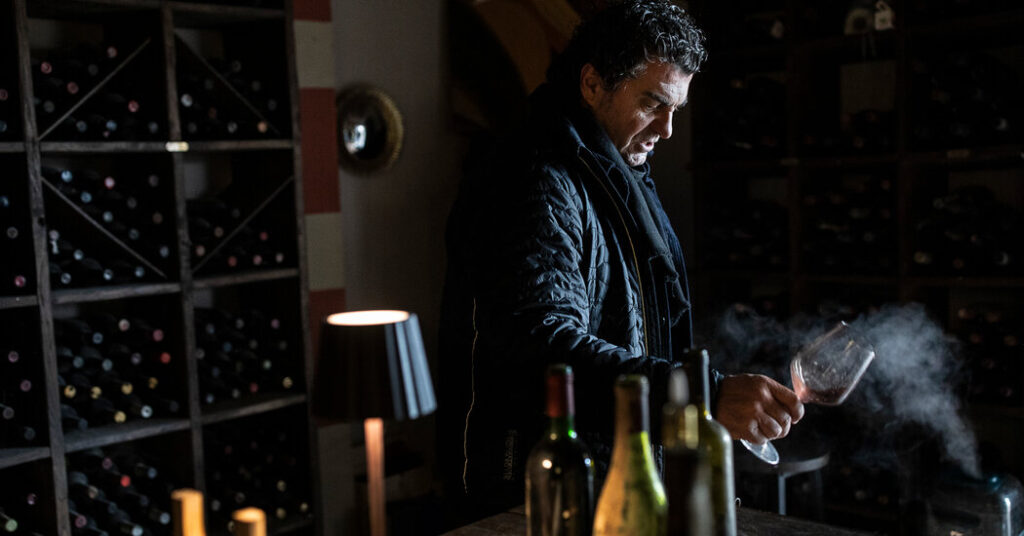
“Here, I have 2,500 bottles,” Mr. Tomba, 59, said as he entered part of a stone farmhouse he had converted into a wine cellar. Dressed in black, with gelled curly hair and oversize sunglasses, the winner of three Olympic gold medals walked under a portrait of himself in his prime and reached for a giant bottle of sparkling wine from 1996.
It featured a caricature of himself racing in a fluorescent ski suit. Known back then as “Tomba la Bomba” for his blazing speed, outsize personality and more outsize appetites, Mr. Tomba has since developed a taste for fine wine.
He has visited “more cellars than slopes,” he said, and read so deeply about wine that, by his own telling, he was named an “an honorary sommelier” by the Italian Sommelier Association (which did not return requests for confirmation). Over the years, many of the labels on his dust-caked bottles have peeled off. He spilled wine that had been sitting in a cloudy glass onto the gravel floor (“The smell is good for ambience,” he said) and refilled it from a label-less bottle.
“I opened it 10 days ago,” he said, swirling the glass. “It’s a ’98.”
That vintage happened to be the year Mr. Tomba ended a skiing career that had made him a national icon. He was so famous that broadcasters once broke away from Italy’s national song competition to let viewers watch him ski. He had so much swagger that he once shouted, “I am the new messiah of skiing!” and ate a piece of Christmas cake between runs. (“I had a small slice,” he recalled with a shrug.) He traveled with munitions of Parmesan cheese and signed women’s ski pants while women wore them. He dated Miss Italy, drove a red Ferrari and became, for a time, the most flamboyant expression of Italy’s late ’80s id.
Nearly 40 years after Mr. Tomba first burst onto the slopes, the return of the Winter Games to Italy this month has brought him back into heavy circulation. Italian media scrums are once again forming around him as he makes headlines.
His face graces the covers of this month’s GQ Italia and the local magazine in Cortina d’Ampezzo, a town hosting some of the Games. He has a book out (“The Longest Slalom”) and is the face of streaming services and luxury brands, one of which brought Mr. Tomba to a Cortina boutique this week where fans mobbed him as he signed hundreds of posters. He drew hearts, blew kisses, accepted blown kisses and tested a super fan who told Mr. Tomba to “ask me anything” about the minutiae of his skiing career.
While Mr. Tomba certainly appears to be enjoying the Olympic limelight, his long après-ski has not been entirely victorious. In 2000, he made his acting debut in a poorly reviewed crime series, playing a cop tasked with protecting a beautiful witness. Mr. Tomba said the “action scenes came natural to me,” but he wished he had started slower “as a supporting actor, an extra.”
He got into flipping houses, but turned down offers to coach and commentate, he said. Mr. Tomba’s father, a wealthy textile merchant, “banned me,” Mr. Tomba said, from taking skiing-related jobs that would diminish his Olympic aura.
For all the medals that had been draped around his neck, Mr. Tomba seemed to carry a chip on his shoulder, harboring old grievances, blaming two-faced friends, the Italian media and nebulous forces for things perhaps not panning out as expected since his retirement.
“In Italy, everything is forgiven except success,” he said during an interview a few days before the Games began early this month.
The truth, he said as he ordered the house red in a favorite trattoria near his home, is that he is a simple, misunderstood guy. He likes feeding his rooster Porto and mourns the death of his other rooster, Gallo, eaten by a fox. He wears a Tomba Fan Club bracelet and, he said, enjoys the company of his devoted fans, some of whom used to follow him to finish lines around the world. He is at peace walking around hilltop vineyards, he said, and listening to music on his phone’s speakers, including a theme tune from “Miami Vice.” He usually stays up until 2 a.m. channel-surfing and avoided skiing because, he said, crowds pursue him on the slopes. “I go fast, and they follow me,” he said.
He ordered a bowl of lettuce and grilled chicken, noting that he had to slim down in preparation for lighting the Olympic cauldron in Milan. To keep in shape, he said, he sometimes runs the roughly four miles from the cellar to his house, where he lives close to his brother and mother, Maria Grazia Dalla Mora. Mr. Tomba used to call her from pay phones after victories and these days, he said, he wakes up early to check on her before going back to sleep.
“You look good,” Ms. Dalla Mora, an elegant 83-year-old, said as she arrived at the trattoria. “Something is different.”
“I shaved,” he said.
His mother told stories about his youth — the way he and his brother performed ski jumps over peacocks, his “notable absences” from school and the way her late husband sacrificed all his free time to drive Albi, as she, like his friends, called her son, around the country. The food arrived and Mr. Tomba started picking from his companions’ plates.
He washed mouthfuls down with wine, and then glasses of water, and then water mixed with wine that he threw back like shots. He greeted a woman he hadn’t seen for decades — “You look great,” he said, taking off his sunglasses — but later argued that “Tomba la Bomba, sex bomb” was a media creation that he had to play along with. His famous televised flirtation in 1992 with Katarina Witt, the German figure skater, “was all set up” by an American television producer. Mr. Tomba said he was not the party animal who, as he once had read, stayed up all night before a race in the company of six women.
“Come on, six women?” he said, his mouth full of a spinach omelet that his mother had ordered but didn’t finish.
He was always joking, he said — that was what no one understood.
“Nothing bad about that,” his mother said with a shrug, adding that her son’s lightheartedness was necessary to combat the “violent stress” and loneliness of the downhill racer. She did wish he had settled down, she said, but family life was “not for him.”
Maybe it wasn’t too late, Mr. Tomba said, emptying a nearby plate of tagliolini onto his own.
“A child now?” his mother said. “It was in ’98 that you should have had one.”
“If I’m a bachelor it’s her fault,” he said, ordering dessert. “Because no one was ever good enough for her.”
She rolled her eyes as his laments mounted. “Calm down already,” she said.
He chuckled and shrugged and drenched scoops of vanilla ice cream with Grand Marnier and finished his mother’s crema Catalana.
“After this don’t eat any more today,” she said. “Or tomorrow.”
Throughout the lunch and his visit to the cellar, Mr. Tomba insisted that his fan club’s headquarters, run by Loris Righi, best captured who he was and required a visit.
“Welcome to Tombaland. Here, the party continues,” Mr. Righi, 66, said as he opened a garage door off a rural road that evening, revealing walls and ceilings papered with bright posters and magazine clippings, thousands of pieces of fan mail (“Dear Alberto, I love you, I love you”), used ski suits, gloves, ski bags. Videos of a young and victorious Mr. Tomba ran on a perpetual loop. Sometimes, Mr. Righi said, Mr. Tomba dropped by and “we live the great memories together.”
Jason Horowitz is the Madrid bureau chief for The Times, covering Spain, Portugal and the way people live throughout Europe.
The post Alberto Tomba Was an Icon. The Olympics Have Brought Him Back. appeared first on New York Times.