NEW YORK — Elected Democrats in major U.S. cities have banded together to try to block the Trump administration from aggressive immigration operations such as the one now winding down in Minneapolis, issuing a slate of policy changes and vowing to prosecute agents who violate local laws.
Over the past two weeks, mayors in Los Angeles, New York, Chicago, Boston, Oakland and Seattle have signed executive orders attempting to restrict how and where Immigration and Customs Enforcement agents can operate in their cities. The policies broadly seek to restrict ICE agents from city property and parks and, in some cases, direct local police to monitor the activities of federal agents.
In a corresponding move, a group of about a dozen local prosecutors is warning that ICE agents will be prosecuted under local law if they commit a crime while carrying out their duties to detain undocumented immigrants. The group, led by Philadelphia District Attorney Larry Krasner (D), vows such prosecutions could occur even after President Donald Trump is out of office.
“Appeasers fail, and people fight back when they are up against an enemy of this nature,” Krasner said in an interview. “And these are the enemies of the United States of America because these people are profoundly and fundamentally anti-equality and anti-American.”
The efforts, coordinated by civil rights and Democratic-aligned groups, represent a new phase in the building battle between Trump and local elected officials, who are worried their city will be the next targeted by the federal government for aggressive enforcement of immigration laws. (On Tuesday, Maryland Gov. Wes Moore (D) signed legislation making Maryland the latest state to prohibit local law enforcement from formal cooperation with federal authorities on immigration arrests.)
The Department of Homeland Security did not respond to requests for comment for this article.
Over the past year, Trump has deployed National Guard troops to Los Angeles and Washington, D.C. while also sending large numbers of ICE and Border Patrol agents to those cities, Chicago, Portland and Minneapolis. White House border czar Tom Homan last week announcedthe end of the surge in Minneapolis, where two U.S. citizens, Renée Good and Alex Pretti, were killed by federal personnel.
The deaths have eroded public support for Trump’s immigration crackdown and galvanized local leaders over how they can try to fortify their cities against ICE operations. Legal experts said the growing divide between federal and local leaders raises complex questions about federalism, qualified immunity and the 10th Amendment, which says that powers not delegated to the federal government belong to the states.
“While we are not on unprecedented ground, we are certainly on historically unusual ground,” said César Cuauhtémoc García Hernández, a law professor at Ohio State University who studies immigration policy. “There are just lots of unanswered questions.”
Many of the newly issued executive orders include regulations banning federal agents from wearing masks and prohibiting them from using any city-owned property to carry out their operations.
New York Mayor Zohran Mamdani (D) prohibited non-city law enforcement agencies from using city-owned property, including parking lots, as “staging areas, processing locations or operations bases.” In a city where parks make up 14 percent of land, the policy could have vast implications for how federal agents would operate.
“The city has control over its property,” said Bitta Mostofi, a top adviser to Mamdani on immigration-related matters. “It’s making it really clear that while there is a delineation of authorities, we are being very clear where we have authority, we are taking action and property is an example of that.”
Mamdani has also stressed that New York’s efforts to form a barrier around its citizens will continue to expand. Last week, he hosted Minneapolis Mayor Jacob Frey (D) to discuss additional steps cities should take to push back against ICE. Mamdani said he is “building relationships with mayors across the country” to “learn from other cities and from what we can share from the lessons of our own.”
As they attempt to coordinate, mayors are being helped by a network of outside groups. The Public Rights Project, is working with dozens of cities on how to draft immigration-related bills and executive orders so that they withstand federal or legal scrutiny, said founder Jill Habig.
“Part of the power that local governments are using really drives from the 10th Amendment,”Habig said. “Cities cannot obstruct the federal government form enforcing the law, but they do not have to use or divert city resources to help and aid in that enforcement.”
Habig accused the Trump administration of “trying to override the checks and balances in the U.S. Constitution.”
A new group, Mayors for America, is working with mayors on model legislation and how to message their policies to the broader public. The group is led by Julie Chavez Rodriguez, a former senior adviser to President Joe Biden and campaign manager for Vice President Kamala Harris’s 2024 presidential campaign.
“Mayors are going to continue to stand firm in their authorities and their leadership as executives in their cities and as stewards of our democracy,” Rodriguez .
But Hernandez, the Ohio State law professor, said there are limits on how far cities can go in attempting to impact the behavior of federal agents. Local officials have the power to “regulate” how public parks are used, he said, but probably cannot deny ICE agents from accessing spaces that are broadly open to the public.
“The more a place is open to the public, the less a local government has a legal right to keep people out, especially if targeting a particular group of people,” Hernandez said. “The federal government and immigration officers do have the right to go into public spaces when they suspect that people are present who are violating federal law.”
Hernandez also expects legal challenges should Krasner, the Philadelphia district attorney, follow through with bringing charges against ICE agents who allegedly violate state or local law.
About a dozen top prosecutors have joined Krasner in making that pledge, including those in Austin, Dallas, Tucson and in Fairfax and Arlington counties in Virginia.
Although Hernandez said federal agents “don’t have unlimited authority to whatever they want on the job,” they can still “use reasonable force to carry out their jobs.”
He said case law about local prosecutions of federal personnel dates back to at least 1906, when the U.S. Supreme Court allowed Pennsylvania authorities to prosecute two U.S. Army soldiers for killing a man they caught stealing copper.
On other local laws such as banning ICE agents from wearing masks, Hernandez said federal authorities generally are “not immune from having to follow state and local laws.” But Hernandez suspects a court would strike down laws that appear too narrowly drafted.
“The more specific a law is, the more it looks like discrimination against particular government entities arising from a disagreement over policy,” Hernandez said.
Krasner said it has fallen to local prosecutors to protect the civil rights of citizens and residents targeted by ICE, taking on a role that the federal government has historically held since the Civil War.
“There is not a lot of precedent for this because it’s always been the Feds who protected us from rogue criminal law enforcement,” Krasner said. “Now, the script has been flipped where they are the Southern sheriffs and we are the Feds.”
Most prosecutors would not waste resources targeting ICE personnel for relatively minor crimes, Krasner said. But he added that such violations could become evidence during the scope of broader investigations.
“If there is a brutal beating, an aggravated assault, we are going to bring that,” Krasner said. “And if you are trying to conceal your identity, and run away from the scene, things like that have consequences in court when juries are constructing the inferences that they can draw from such behavior.”
Trump has repeatedly attacked Philadelphia and other major U.S. cities as overrun with crime, even though violent crime rates have fallen sharply in recent years. He accuses local Democratic officials of refusing to cooperate with immigration enforcement, even though that enforcement has historically been the responsibility of the federal government. Trump also has suggested that Philadelphia could be next in line for a federal law enforcement surge.
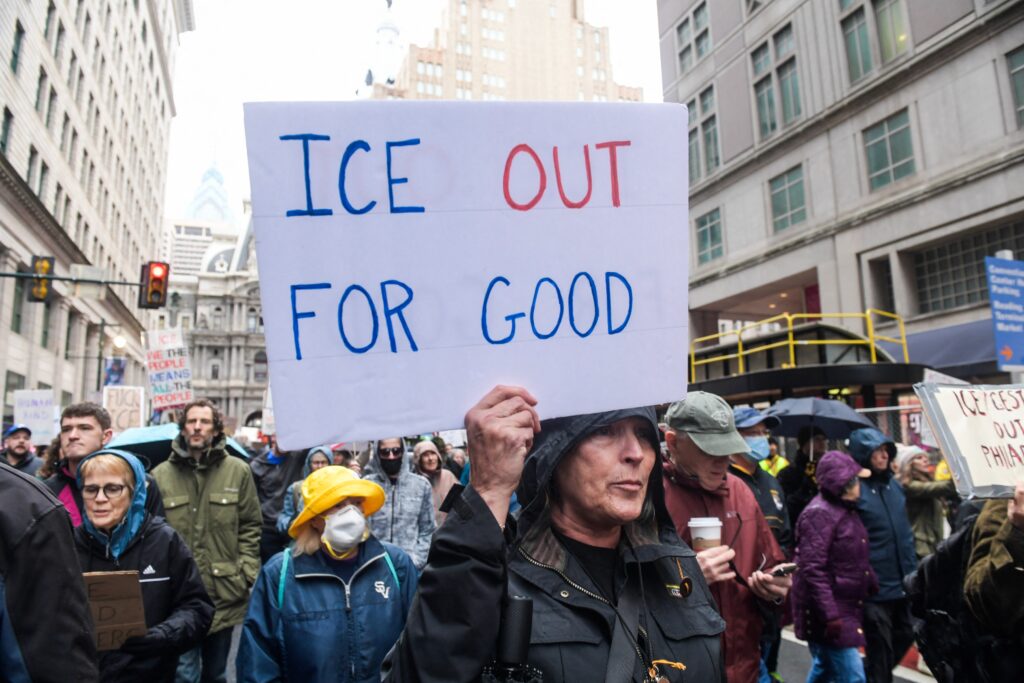
In response, in late January, two members of the Philadelphia City Council, Democrat Rue Landau and Kendra Brooks of the Working Families party, introduced broad “ICE Out” legislation that would ban law enforcement officials from wearing masks or using unmarked vehicles while also prohibiting employees from granting ICE agents access to city-owned spaces.
Brooks said the legislation, co-sponsored by 15 of 17 council members, sends a message to the Trump administration that it will not have an easy time should it deploy large numbers of ICE agents to Philadelphia.
She and other council members are also taking the lead in holding “ICE watcher” trainings, where civilians learn how to record and monitor federal immigration officials.
So far, more than 1,400 city residents have attended.
“Philly takes care of Philly,” Landau said. “We are gritty …. and we are very protective of each other.”
The post Democratic-led cities move to block ICE, setting up clash with Trump appeared first on Washington Post.