I am who I am today in part because of a speech I heard in fifth grade at Matthew A. Henson Elementary School in Baltimore.
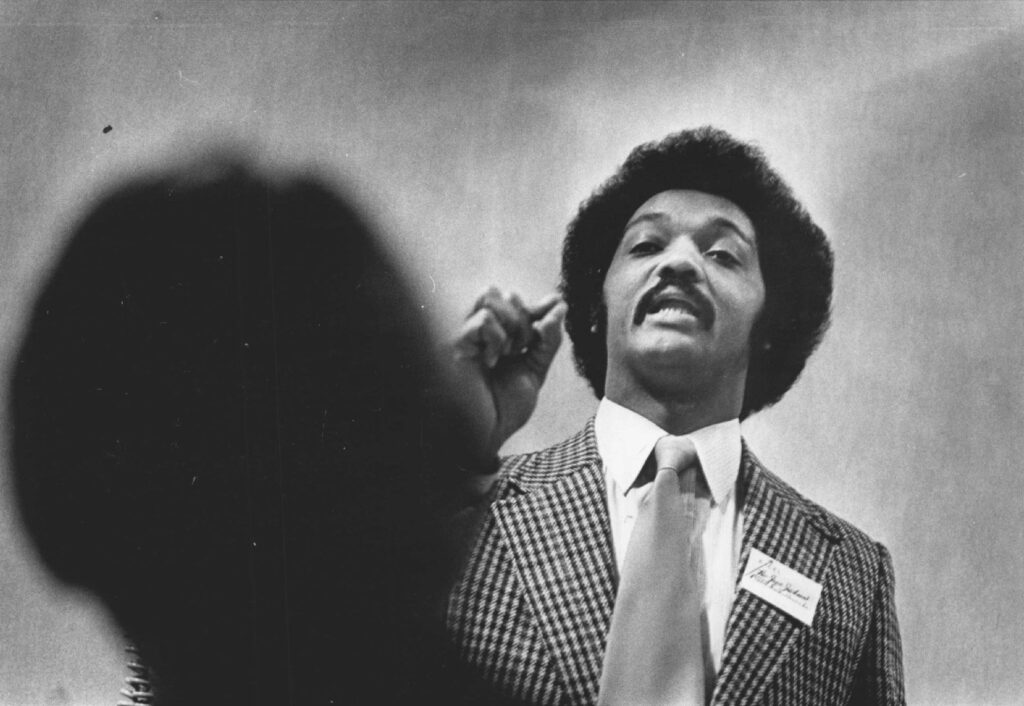
It was 1970, and the auditorium was full of little Black boys and girls, fidgeting, waiting for the speaker to begin.
“I am somebody,” a voice boomed from the stage, shaking us to attention.
I have never forgotten that day when the Rev. Jesse Jackson spoke life into me, eventually inspiring me to go to college. His words pushed me to overcome the feeling of being unwanted. At 4, I had to go live with my grandmother, Big Mama. My four siblings and I — one older, three younger — arrived at my grandmother’s West Baltimore home, disheveled, hungry and sick. We only had the clothes on our backs. Had it not been for my grandmother, we would have been placed in foster care.
My grandmother provided a secure home, but didn’t want me to dream too big and be disappointed. She wanted the best for me, but the granddaughter of enslaved individuals knew all too well the obstacles I would face.
But then came the “I Am Somebody” speech from Jackson, who died Tuesday at 84.
My aspirations to be a writer were motivated by Jackson’s call-and-response keynote.
“Say it after me,” Jackson coaxed us.
“I am somebody!”
The hundreds of little voices shouting those words still stick with me. I yelled it at the top of my voice.
“I may be poor, but I am somebody,” Jackson said. “I must be respected, protected, never rejected.”
That hit home.
I was a weepy child, craving the love of parents who abandoned me. I grew up watching my grandmother drive from one bar to another on Fridays, searching for my grandfather before he drank away his paycheck. My mother drifted in and out of my life, breaking one promise after another. The first time I recall seeing my father was in a prison visiting room.
“I may be on welfare, but I am somebody,” Jackson said during the assembly.
I received free lunch, and my grandmother would get boxes of powdered milk and large blocks of government-issued cheese. I was embarrassed that we needed the assistance.
“I may be on welfare, but I am somebody,” I yelled along with my classmates.
I didn’t need to be ashamed of my situation, because I was somebody.
Jackson had us repeatedly chant, “I am somebody.”
I go back to that day and that speech when I get discouraged, when someone questions my credentials, insinuating that I got into college or a job simply because of the color of my skin. It’s happened throughout my career, even when I arrived at The Washington Post.
I replace their voices with Jackson’s words, “I am somebody.”
Jackson’s death makes me even sadder, given the current attack on diversity, equity and inclusion (DEI) programs by the Trump administration. President Donald Trump posted on his Truth Social profile a video clip depicting former president Barack Obama and former first lady Michelle Obama as apes. Trump deleted the video, but refused to apologize for sharing it.
The National Urban League’s State of Black America 2025 report highlights the dismantling of civil and voting rights and the elimination of diversity initiatives: “We are watching an attempt to turn back the clock to an era when the full humanity of all Americans was not recognized — when the idea of true equality was treated as a threat to the social order.”
Last month, the Joint Center for Political and Economic Studies issued a stark warning: Black Americans are facing a severe economic downturn. The 2026 report argues there are signs of a “Black recession” driven by high unemployment and the dismantling of federal protections.
Black unemployment rose from 6.2 percent in January 2025 to 7.5 percent by December of last year. If this rate were applied nationwide, it would be classified as a national recession, the report said.
The report noted that the sweeping One Big Beautiful Bill Act gutted funding for programs designed to lift Americans out of poverty.
“The systematic withdrawal of protections, investments, and accountability mechanisms that have historically assisted Black communities from economic shocks, combined with a substantive increase in Black unemployment, all point to 2025 as a regression and recession for African Americans,” Dedrick Asante-Muhammad, president of the center, wrote in the report’s introduction.
Jackson’s death comes as we are entering a difficult winter for Black America, one marked by economic regression and the erasure of hard-won protections.
But he wouldn’t want us to have a spirit of surrender.
In a 1988 speech at the Democratic National Convention, Jackson, as he always did, offered hope for the poor who work every day but still can’t afford health care or a home.
“Hold on,” he told the crowd. “And hold out.”
I can still hear Jackson’s call to tune out those who would tell me I’m less than. I found my voice because of Jackson, and I have used it to help people understand personal finance and build legacy wealth for their family.
I am somebody because Jackson told me I was. And I believed him.
The post How the Rev. Jesse Jackson taught me to keep hope alive appeared first on Washington Post.