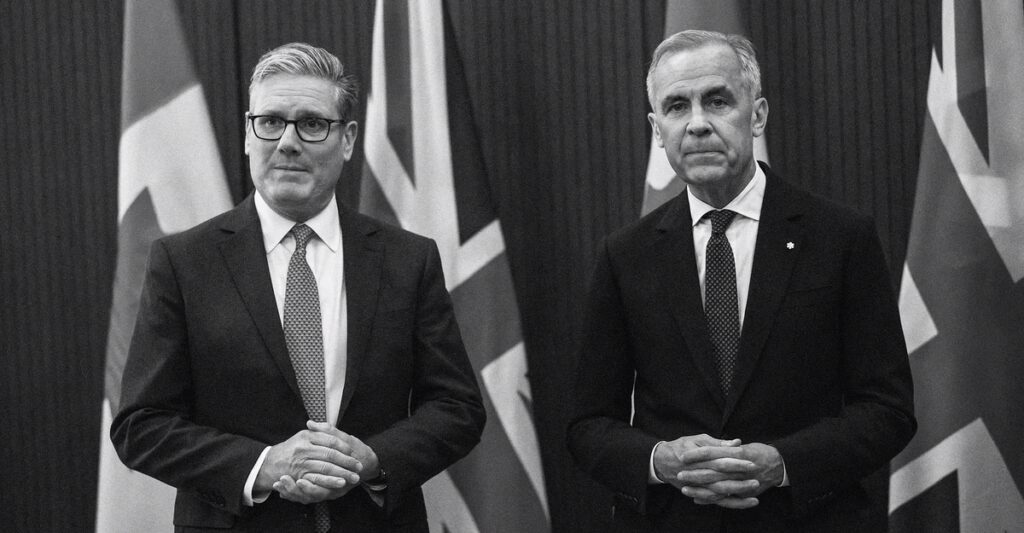
The urge to visit Beijing has gotten stronger lately among allies of the United States. Canadian Prime Minister Mark Carney, who referred to China last year as his country’s biggest security threat, made the trip last month, as did his British counterpart, Keir Starmer. Next week, German Chancellor Friedrich Merz, who heads the largest economy in Europe, plans to meet with Xi Jinping during a three-day visit packed with discussions of security and trade.
In a speech this past weekend at the Munich Security Conference, Secretary of State Marco Rubio said the U.S. “will always be a child of Europe.” But the geopolitical divide between the U.S. and China has made Canadians and Europeans look more like the children in a bad divorce, shuttling between two feuding parents, pleasing neither, and risking retaliation if they take sides. Carney said as much in a memorable speech last month in Davos, where he bemoaned the fact that the superpowers are now vying for dominance in ways that place their own self-interest over cooperation. And they are prepared to dole out punishment to those who offend them. “Great powers have begun using economic integration as weapons, tariffs as leverage, financial infrastructure as coercion, supply chains as vulnerabilities to be exploited,” Carney said.
That approach has forced Canada and other medium-size nations to pursue the same transactional self-interest, Carney noted. Hence his Beijing visit a few days before he gave the speech. “We are seeking to ensure our own economic resilience,” Canadian Foreign Minister Anita Anand, who traveled with Carney to Beijing, told us last week. “That means we have to diversify our trading partners.” And what about Carney’s statement in April, during his election campaign, about the looming security threat from the Chinese? Has it disappeared?
The diplomat stiffened. “Let’s take a step back,” she said, before offering a disquisition on all that President Trump had done to Canada since returning to office a year ago, including imposing steep tariffs on Canadian-made steel, aluminum, cars, and lumber. “Canada is seeking to double non-U.S. trade over the next 10 years,” Anand said. “That was the purpose of the trip.”
Canada’s overtures to Beijing clearly got Trump’s attention. In a post on Truth Social last week, the president wrote that Carney “wants to make a deal with China—which will eat Canada alive. We’ll just get the leftovers! I don’t think so.” Trump then threatened to prevent a newly built bridge between Ontario and Michigan from opening, at least until Canada starts treating the U.S. “with the Fairness and Respect that we deserve.”
It can be hard to keep track of the insults and intimidation that U.S. allies have faced from the Trump administration over the past year. But the indignities have been enough to make many traditionally steadfast American partners talk in private about a permanent rupture in relations with Washington. Carney’s speech in Davos brought the hand-wringing into the open, and it offered a way for “middle powers” to move forward by banding together against global hegemons like the United States.
But in practice, Carney’s response to Trump’s bullying has been a newfound openness to China. He agreed on a plan, during his visit there last month, for the Chinese to lower trade barriers on a variety of Canadian goods, including beef, lobsters, and pet food. As of yesterday, Canadian citizens are now allowed to travel to China without a visa for up to 30 days. “We are forging a new strategic partnership,” Carney declared.
[Read: Trump seizing Greenland could set off a chain reaction]
Yet given the power differential between China and Canada—or, for that matter, between China and any NATO ally other than the United States—such a partnership will not be among equals. And were Canada in the future to veer back toward the U.S., which remains by far its biggest trading partner, Carney could expect the kind of retaliation from Beijing that Trump now threatens. In other words, Canada and others might consider the smart move to be economically and diplomatically hedging their bets between Washington and Beijing. But they are just as likely to get stuck between a pair of repelling magnets, pushed and pulled by the world’s superpowers.
Plenty of European countries have been here before, swinging between the U.S. and China, and they have learned the perils. During the Biden administration, the U.S. pressured its allies to take a harder line against China, and many complied. Among the most eager was the tiny nation of Lithuania, which blocked Chinese companies from building its 5G communications network and other infrastructure.
“At least temporarily, it had a positive impact on our relations with the United States,” the president of Lithuania, Gitanas Nausėda, told us. In part to keep the good vibes going, his government antagonized China further in 2021 by allowing Taiwan to build a representative office in Vilnius, the capital. (China sees Taiwan as a rogue province and aims to take it back by force if necessary.)
The Lithuanian decision to welcome Taiwan earned applause from the American foreign-policy establishment; the Atlantic Council, a Washington think tank, referred to Lithuania as a “trailblazer” in the push to counter Chinese influence in Europe. Lithuania shares an approximately 180-mile-long border with Russia and would not be able to defend that frontier without help from its allies in the NATO alliance. “For us, being so vulnerable, and being in such a sensitive place on Earth, it’s very important to keep the focus of the United States on the one hand and of European allies on the other hand,” Nausėda said.
But the price of maintaining that focus “was quite dramatic,” he said. “China started economic coercion against us.” Lithuanian diplomats were forced to leave their embassy in China, which moved to temporarily block the import of Lithuanian goods. The government in Vilnius hoped the confrontation would pay off with a greater American commitment to its country’s security. “It was a strategic choice,” Gabrielius Landsbergis, who was the foreign minister of Lithuania during the Biden administration, told us. “And our cooperation with the previous administration was very successful.”
Soon after Trump returned to the White House, however, the security dividends that Lithuania had earned began to dissipate. Under the new administration, “small countries do not matter,” Landsbergis said, summarizing Trump’s approach to geopolitics. “That’s a problem for us. When great powers begin carving up the world, we find ourselves no longer at the table, but on the menu.”
In recent weeks, as the tensions between the U.S. and Europe have intensified, the Lithuanian government has come to regret its decision to stand up to Beijing. Lithuanian Prime Minister Inga Ruginienė said earlier this month that it had been a “big mistake” to allow the opening of the Taiwanese representative office. “I believe that Lithuania really jumped in front of a train and lost,” she told the Baltic News Service.
China seems ready to accept Lithuania’s atonement. A spokesperson for its foreign ministry said the door to Beijing remains open as long as Lithuania intends to “correct its wrongdoings at an early date.” But Lithuania’s president does not see a strategic turn toward China as an option at this point. Even as other European countries are rushing to foster relations with Beijing, the Lithuanians intend to stick with the Americans. “There’s no alternative,” Nausėda said in our interview. For the moment, at least, they are stuck with Trump.
Over the long term, if Europeans want to avoid falling under the sway of either of the world’s two dominant superpowers, they can try to form their own geopolitical center of gravity. But that would require speaking with one voice, and their scattershot outreach to China makes that difficult. In December, when French President Emmanuel Macron visited Beijing, his team reportedly wanted the European Union’s most senior official, Ursula von der Leyen, to accompany him.
“This was seen as an effort to ‘Europeanise’ his dealings with Beijing,” the South China Morning Post reported at the time. The Chinese authorities reportedly turned down the idea, preferring instead to deal with European leaders one by one, and Macron agreed to come without his EU counterpart. In preparation for next week’s trip, Germany’s Merz met on the sidelines of the Munich Security Conference with Wang Yi, the Chinese foreign minister. Wang applauded the German leader for planning the trip in a way that would maintain Berlin’s “strategic autonomy and self-reliance.”
That approach has raised concerns among Germany’s smaller allies in Europe, who worry that they could be left behind. Petr Pavel, the president of the Czech Republic, does not have the option of traveling to Beijing. “I am persona non grata in China,” Pavel told us in an interview last week. The Chinese banned him from the country last summer, after he paid a visit to India to wish a happy birthday to the Dalai Lama, who turned 90 in July. (China regards the spiritual leader of Tibet as a separatist “wolf in monk’s clothing.”)
The timing of Pavel’s meeting with the holy man looks unfortunate in hindsight. It took place only a few months before U.S. relations with Europe reached a crisis point, when Trump, in January, threatened to seize the island of Greenland from Denmark, a NATO ally. The resulting rupture sent the Europeans scrambling to line up trips to Beijing. But when I asked Pavel about his regrets, he said he has none. “We have to understand that China is not an ally,” he said. “It is at best our competitor.”
[Read: The hole in Trump’s rationale for acquiring Greenland]
Pavel understands the desire among some of his peers to look to Beijing amid the rising tensions with Washington, but he would prefer they take a more confident and unified approach. “Europe should become its own zone of influence,” he said. “Not looking eastwards and then westwards and back again, always being afraid for our security, but instead to become stronger and on our own, economically stronger and also militarily.” That may be the better long-term strategy, but there remain serious doubts whether the Europeans can pull it off.
Carney is leading his own effort to form, in effect, a third superpower that can resist the gravitational pulls of both the United States and China. Talks are under way among Canada, the European Union, and 12 Indo-Pacific nations to form a new trade alliance that would potentially represent the world’s largest economic bloc. Asked about it yesterday, Carney told reporters that “Canada can play a role” in forming a new alliance, adding that his country is in a “unique position” to “broker a bridge” between the two groups of nations in Europe and Asia.
In the meantime, the U.S. is demanding more if Ottawa wants to remain in Trump’s good graces. In August, Trump increased tariffs on Canadian goods to 35 percent, saying Carney’s government hadn’t done enough of what Washington wants. Last month, Trump threatened to decertify any aircraft made in Canada until the Canadians certify American-made Gulfstreams. Canada is now reconsidering its decades-old agreement to buy F-35A fighter jets from Lockheed Martin and may instead buy Swedish-made Saab JAS 39 E Gripens.
The pressure on Canada seems to be part of a broader Trump-administration strategy to reinvigorate American industries and limit—maybe even eliminate—any products that don’t carry a Made in America label. When Commerce Secretary Howard Lutnick spoke to a Toronto audience last year, he suggested that Canada should not even be making cars. It would be better, he suggested, to consolidate the entire North American auto industry in the U.S. Needless to say, that has been viewed in Canada as just another way the U.S. is seeking to flex its muscles at Canadians’ expense.
“We are being bombarded with complaints, grievances, tariffs, more tariffs,” Giles Gherson, president and CEO of the Toronto Region Board of Trade, Canada’s largest chamber of commerce, told us. “As soon as the concessions are made and they’re pocketed, new demands show up—and relentlessly.”
Ultimately, Trump’s posturing toward Canada isn’t about Canada. It’s about seeking to sustain Washington’s superiority over China and making sure that American allies know their place. The president won’t let anything—not even a very public dispute with America’s friendly neighbor to the north—get in the way.
The post Europe and Canada Are Like the Kids in an Ugly Divorce appeared first on The Atlantic.