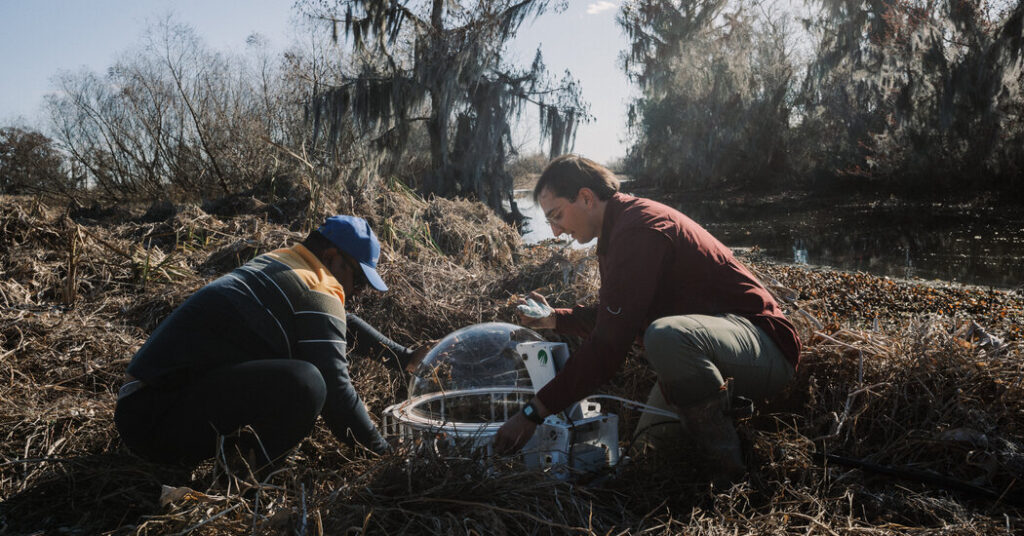
Two scientists were stuck in a swamp. To free their boat, one grabbed a metal pole, the other a paddle, and the two pushed into the mud with all their strength. As the boat floated free, bubbles of gas rose from the muck below.
“That’s methane,” Gage Hunter yelled.
Mr. Hunter, a graduate student, and Manab Dutta, a postdoctoral researcher, were hunting for methane, a potent greenhouse gas produced by bacteria living in this boggy wildlife reserve not far from New Orleans.
While much attention has been focused on how methane, the main ingredient in natural gas, leaks from gas and oil operations, there is growing concern that the amount of heat-trapping gas from wild sources is rising faster.
Researchers estimate that wetlands produce between 180 and 400 million metric tons of methane annually while oil and gas operations and coal mining release between 120 and 133 million metric tons per year, according to the Global Methane Budget, a tally of methane sources updated periodically by scientists.Methane builds up in the waterlogged, oxygen-poor soils, and is released through bubbles, decomposing soils and some plants. As the planet warms, wetlands around the world are spewing out more methane more quickly as the microbes’ metabolisms speed up.
From the Everglades to the Amazon, scientists are trying to refine their estimates of how much methane is being produced by wetlands and under what conditions.
Decoding methane’s life cycle is a pressing task because methane is 80 times as powerful as carbon dioxide at warming the atmosphere in the short term and is responsible for around 30 percent of the rise in global temperatures since the Industrial Revolution.
Some bacteria produce methane; other types eat it. Mr. Hunter studies both kinds. The difference between the two is how much methane escapes to the atmosphere.
“We are the ground crew trying to understand what’s happening to methane down here in the soil,” said Mr. Hunter, who is studying at Louisiana State University’s department of oceanography and coastal sciences. “We’ll leave it up to the other guys to figure out what’s happening in the air.”
Freshwater swamps pump out a slow, continuous stream of methane — more in the hot summer and less in the cooler months — while saltwater marshes produce little or none. That finding suggests that a potential solution is to increase the flow of seawater in and out of coastal swamps, a plumbing effort that would also restore habitat for wildlife and commercial fisheries.
As global temperatures rise, the chemical reactions that produce methane in bacteria are speeding up. And a hotter planet is producing more rainfall, which can expand wetlands.
At the same time, the oil and gas industry has been making an effort to reduce its methane emissions. A study published in December reported that methane from the fossil fuel industry had leveled off over the past two decades.
Ben Riddell-Young, a research scientist at the University of Colorado Boulder and the paper’s lead author, said that emissions from landfills and agricultural operations — which also come from methane-producing bacteria — were growing over the same time period. “There’s more waste and more cows,” he said.
However, other scientists say there’s too much uncertainty in the measurements to be sure that methane from fossil fuels is leveling off.
A new analysis of about half of the world’s oil- and gas-producing regions found that methane emissions were 50 percent higher than previously calculated by the Environmental Protection Agency and the European Commission, which estimate airborne methane emissions based on the amount of fossil fuels produced on the ground.
The data, from a satellite developed by the Environmental Defense Fund and its partners called MethaneSAT that was lost last year, provides a snapshot of industrial emissions at a single moment and has not yet been peer-reviewed.
“I don’t think we have the monitoring in place to fully understand whether industrial emissions are stable or not, and the same would go for agriculture,” said Ben Poulter, a senior scientist at Spark Climate Solutions, a San Francisco-based nonprofit research organization.
For six years, Dr. Poulter was a principal investigator of a NASA-funded research project in the Florida Everglades that flew low-flying aircraft to measure levels of methane and carbon dioxide. The project, BlueFlux, stalled in April after cuts from the Trump administration.
After looking at 23 years’ worth of data from satellites, aircraft and towers across the Everglades, the researchers found that the wetlands had removed around 14 million metric tons of carbon dioxide per year, about 10 percent of the carbon dioxide spewed annually by Florida’s cars and trucks. At the same time, six million metric tons of methane were emitted by the wetlands, offsetting about half the climate benefit, according to a study published on Monday in the Proceedings of the National Academy of Sciences.
Dr. Poulter agrees that methane emissions from wetlands are getting worse as the climate continues to warm.
“We were sort of suspicious early on that the rise in methane could be from wetlands,” he said. “Then in the last three to five years, the scientific community has moved toward a consensus that wetlands are responsible for a large part of the acceleration.”
With each new finding on methane, there are also debates about how best to measure overall methane emissions and how to solve the problem. More than 150 nations, including the United States, signed a global methane pledge to cut emissions of methane by 30 percent of 2020 levels by 2030. Those reductions could come from tightening leaks from natural gas well operations, switching to renewable energy, changing how rice is grown, and cleaning up and trapping methane gas from landfills, for example.
But the pledge did not include natural sources of methane, said Brian Buma, a senior climate scientist for the Natural Resources Defense Council. “When you project out how fast we are warming, countries are using scenarios that are ignoring this growing source of methane, especially wetlands,” Dr. Buma said.
During the 20-minute trip from a boat launch behind a used car lot to the Louisiana marsh study site, Mr. Hunter spotted bald eagles, herons and hawks. Nutria — invasive beaver-size rodents — scurried below the water.
After arriving at the study site, he hopped onto the floating bog and set a dome-shaped clear plastic chamber onto a patch of cleared soil. He connected the chamber to a plastic tube, some wires and, eventually, his laptop, to record methane emissions from the soil over the next hour.
“These marshes hold carbon in the soils, but there’s a big gap in knowing what happens when it is buried,” Mr. Hunter said.
Back at a chemistry lab in Baton Rouge, Mr. Hunter injected a radioactive particle into a sealed vial with swamp mud to trace the methane from microbes to soil to air.
“The bacteria ate the radioactive methane, and they turned it into radioactive carbon dioxide,” he said. “And so the radioactive carbon dioxide is how we’ll measure how much methane they ate.”
The analysis takes only a few hours, but it will take months, if not years, of measurements to get a full picture of what’s happening at this Louisiana marsh. At 26, Mr. Hunter is just getting started. He noted that efforts to restore marshland along the Louisiana coast by adding more fresh water from the Mississippi River might have the unintended consequence of creating more methane emissions.
“We’re trying to get the most complete picture of what restoring marshes would do for impact in the environment,” Mr. Hunter said.
Mr. Hunter and other scientists studying wetlands said that the fastest way to slow down the wetlands methane feedback loop would be to reduce industrial emissions of greenhouse gases, including both carbon dioxide and methane, because that is what drives global warming.
In the meantime, they’ll be hunting new sources of methane in the field, comparing notes with other researchers and running numbers to figure out how the planet’s natural cycle is changing.
“Our lab is trying to measure the complete continuum of methane, from, like, cradle to grave, or from birth to exit into the atmosphere,” Mr. Hunter said. “So as scientists, we want to make sure that we’re doing the best we can to minimize methane emissions, to minimize climate change.”
The post Methane Hunters Track Swamp Gas That Is Driving Climate Warming appeared first on New York Times.