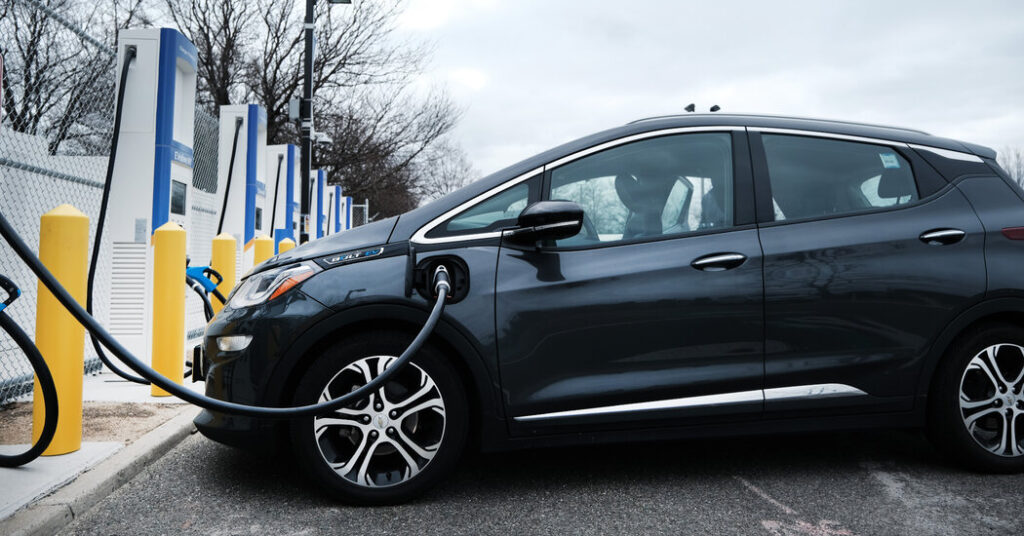
Uber said on Wednesday that it would offer incentives to other companies to install electric vehicle chargers in the United States and Europe, a potential boost for a part of the car market that has been hurt by recent U.S. policy changes.
The company said it would guarantee that chargers installed in neighborhoods where its drivers lived or often picked up or dropped off passengers would be used a minimum amount of time. The offer should allow charging operators to more quickly recoup their investment in new stations. How much chargers are used is a key to whether they make or lose money but difficult to predict.
Sales of electric vehicles have slumped in the United States after Republicans in Congress and President Trump revoked various policies intended to encourage sales of cars with no tailpipe emissions. But construction of charging stations grew at a record pace last year despite the policy shift, in part because of Uber drivers like Charles Iwuoha, one of 13,000 ride-share drivers who use electric vehicles in New York City.
He bought a Kia EV9, an electric sport utility vehicle, last year with financial help from Uber. The car’s battery lasts a full 10-hour shift, he said. And it costs him $20 to $40 less to charge the car than refueling the gasoline vehicle he previously owned.
That is a significant savings, said Mr. Iwuoha, who lives in Queens. “New York rent is too high,” he said. Driving an Uber “pays the bills, but you’re just scraping by.”
Ride-share drivers are among the heaviest users of public chargers, especially the kinds of devices that can top up a battery in half an hour or less, according to analysts and charging companies. The money that drivers for Uber, Lyft and other ride-hailing services pay to charge cars is a big reason for the growth in the number of charging stations.
But chargers are not always built where Uber drivers need them. Mr. Iwuoha, for example, lives in an apartment building and cannot charge at home. He is dependent on fast public chargers, which are often crowded, especially in Manhattan.
Pradeep Parameswaran, Uber’s global head of mobility, said his company hoped to alleviate some of those problems by getting 1,000 chargers built.
“Over time, we think electrification helps bring down the cost of running their business on Uber,” he said in an interview. “And ultimately, it’s good for cities. It brings down emissions.”
Jeroen van Tilburg, the chief executive of Ionity, a European charging company that is working with Uber, said Uber’s data would help it identify the best places to build chargers.
“The biggest concern for every charge point operator is to identify the right location,” Mr. van Tilburg said.
The stations built with Uber’s support will be open to anyone and could be particularly useful to renters and other urban residents who cannot charge at home. Uber said it was hoping to encourage new stations in New York, Los Angeles, Boston, San Francisco, London, Paris and Madrid.
Uber also said on Wednesday that it would spend $100 million to build charging hubs for autonomous vehicles, which are almost always electric. Uber, whose business is potentially threatened by self-driving taxis, has been trying to position itself as a partner to companies like Waymo, a unit of Alphabet, Google’s parent company.
In Austin, Texas, for example, Uber provides charging, cleaning and maintenance for Waymo’s taxis.
Despite headwinds from Washington, the number of chargers in the United States increased 30 percent last year to 70,000 ports, according to Paren, a research firm that specializes in electric vehicle charging. That included a 44 percent increase in the last three months of the year, when electric vehicle sales plummeted after a tax credit of up to $7,500 for the purchase of such models ended.
Early figures for 2026 showed that growth remains strong, said Florent Breton, the chief executive of Paren. That is despite obstacles thrown up by the Trump administration.
Last week, Sean Duffy, the secretary of transportation, proposed a rule that would require that chargers contain no parts manufactured outside the United States in order to receive federal funding under a program passed during the Biden administration. Electric vehicle experts say that’s an impossible standard to meet.
But the practical effect of that proposal is limited because the large majority of chargers being installed in the United States receive no federal funding.
Ride-share drivers are a big reason that demand for charging remains strong. Their cars account for about one quarter of the energy dispensed by EVgo, the third-largest U.S. operator of charging stations and an Uber partner. That compares with about 10 percent in 2021.
“Electrification of ride share is something that we’ve been seeing quarter after quarter, year after year, for several years now,” Badar Khan, the chief executive of EVgo, said in an interview. “Anything that we can do in our partnership with Uber to increase the rollout of infrastructure will just accelerate the adoption of electrical vehicles.”
Charging has become one of the main obstacles to buying an electric vehicle, according to drivers surveyed by Uber.
Used electric vehicles sell for less than comparable gasoline models and are generally cheaper to fuel and maintain, according to calculations by the company. New electric vehicles cost more, but the gap is narrowing.
Uber also offers drivers a $4,000 grant they can use to buy electric vehicles. (Drivers must log at least 100 trips to qualify.)
Mr. Iwuoha, the Uber driver, said he had chosen an electric car in part because he was concerned about the environment, and in anticipation of New York regulations that will require all ride-share vehicles to be zero emission or handicapped accessible by 2030. He bought his Kia new before the $7,500 federal tax credit expired.
If it were up to him, chargers would be available in the parking lots of public parks and at many more gas stations.
“Time is money,” Mr. Iwuoha said.
Jack Ewing covers the auto industry for The Times, with an emphasis on electric vehicles.
The post Uber Will Offer Incentives for E.V. Charger Construction appeared first on New York Times.