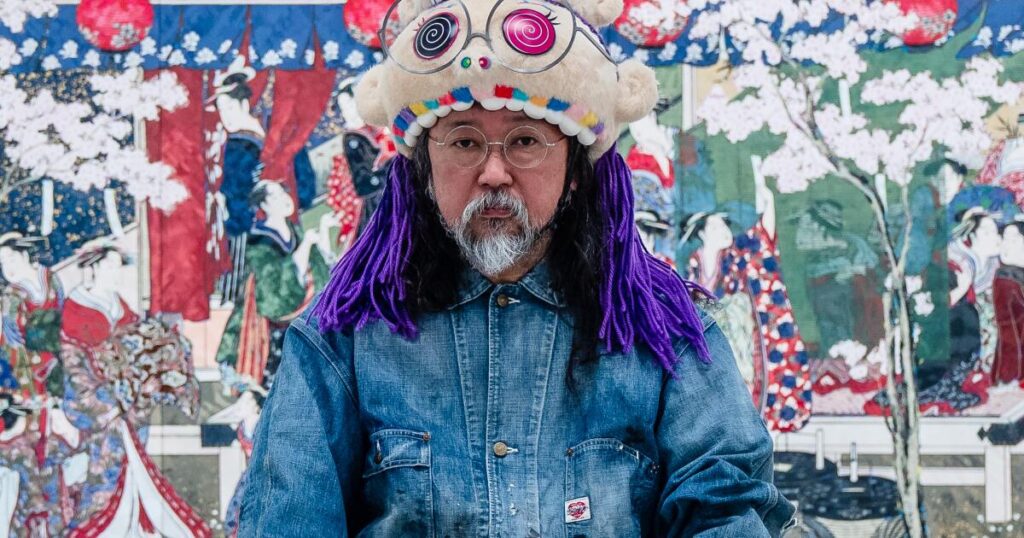
After the COVID-19 pandemic, Takashi Murakami felt like he was losing his way. His generation of artists, he thought, was increasingly untethered from a concrete movement or theme. “The art had become more and more about a struggle against the market or within the market,” he says through a translator during a recent interview at Perrotin Los Angeles on the afternoon of the opening of his new show, “Hark Back to Ukiyo-e: Tracing Superflat to Japonisme’s Genesis.”
Featuring 24 new paintings, the show explores how the Impressionists were influenced by the Japanese genre of ukiyo-e, which translates to “floating world pictures,” and references Japanese woodblock prints and paintings made during the Edo period (between 1615–1867). The colorful artworks largely depict the sensual hedonistic lifestyles of city dwellers including merchants, courtesans and kabuki actors.
Dressed in patchwork jeans, a faded denim jacket and a white long sleeve shirt, Murakami reveals how a recent trip to Claude Monet’s house and gardens in Giverny, France, cemented his understanding of the fundamental connections between genres.
“I came to [Monet’s] garden for inspiration and I thought, ‘OK, we can do anything,’” Murakami says, adding that contemplating the Impressionist legend’s unconventional world helped him to become unstuck.
Murakami is known for eschewing the walls that separate Eastern art from Western art. Superflat, the movement he founded, blends traditional Japanese art with pop culture and anime. As one of the world’s most famous contemporary artists, Murakami is a polarizing figure in his home country of Japan, where older manga and anime fans thought he was appropriating anime culture for the art world, and sometimes viewed his lucrative collaborations with brands like Louis Vuitton and Crocs as a form of selling out.
Forgoing his translator, Murakami said that while certain factions of Japanese society still don’t approve of his practice, “step by step, the younger generation is understanding.”
A wave of art based on anime characters and manga motifs swelled in the wake of Murakami’s success, along with that of Yayoi Kusama and Yoshitomo Nara — but that trend only served to unmoor Murakami from his roots.
“If they paint something like that visually, then they would kind of have a certain level of success,” Murakami said as an assistant brought him sandals to replace his work boots. “So there was a feeling in the air where you don’t have to talk about Pop Art, Simulationism or all these isms and movements, and it’s actually better not to talk about those things. And so I myself felt like I started to lose sight of themes and had nothing really concrete to pursue as a theme for a while.”
At the time, the 64-year-old artist was in the midst of reinterpreting the work of 19th century ukiyo-e master Utagawa Hiroshige for a show that opened at Gagosian New York in May of last year. That show also explored the art of Van Gogh, Monet and Whistler, Impressionist artists deeply influenced by Japanese prints, as expressed by the French term Japonisme.
“I was trying to make sense of how this might be received by the audience and was a little bit worried, so I wanted to come up with more of a concrete theory,” Murakami said.
He turned to Ed Schad, a curator at the Broad, for help sorting out his thinking about the Japonisme influence.
Schad pointed him in the direction of Alfred Barr, the first director of the Museum of Modern Art in New York City, who created a diagram in the 1930s that traced the lineage of every genre of art from 1890 on — Synthetism, Neo-Impressionism, Cubism, Surrealism, Expressionism, Abstract — back to Japanese prints.
“So that meant ukiyo-e had influenced all these Western art movements to the point that it destroyed art, really,” Murakami said with a laugh.
Murakami’s interest in this history took on added contours when he began watching “Shōgun,” the 2024 FX historical drama that unfolds in 1600 at the start of the Tokugawa era — during a time of brutal civil war and epic power struggles. He was struck by how intertwined art and architecture were in the series, and also the way it treated the Japanese sense of life and death — and how death was colored by art.
“Each time samurai would commit the ritual suicide of seppuku, they would first read the death poem they had prepared in order to summarize their life and make sense of it,” Murakami said.
The samurai worldview, thrown into relief by “Shōgun,” highlighted the warrior’s ideas “about what is just, what is correct and how they should live,” said Murakami. “So that really influenced me and I became interested in this very chaotic time before Japan was completely unified — and so that chaotic uncertainty and anxiety about it became my new theme.”
The result of Murakami’s thinking about the cyclical, interrelated influence of art upon itself in different historical eras, spanning east to west and back again, can be seen on the white walls at Perrotin. One room contains four giant paneled canvases measuring more than 10-by-7 feet, with Murakami’s interpretations of work by the ukiyo-e masters Kitagawa Utamaro and Torii Kiyonaga.
A second room contains Murakami’s take on Monet’s “Woman with a Parasol,” which is on display between two classic Murakami canvases inspired by it, one featuring a doe-eyed anime style girl, the other with one of Murakami’s signature smiling flowers sitting on a hill and staring wistfully at the cloudy sky.
Additional pieces contain Murakami’s reimaginings of gilded floral motifs by Katsushika Hokusai, Ogata Korin and Ogata Kenzan; as well as the beautiful women rendered by Kikukawa Eizan.
Murakami gestures to the walls before him, nodding his head sagely.
“Everything is in the melting pot,” he says.
The post How a trip to Monet’s garden inspired Takashi Murakami’s new show in L.A. appeared first on Los Angeles Times.