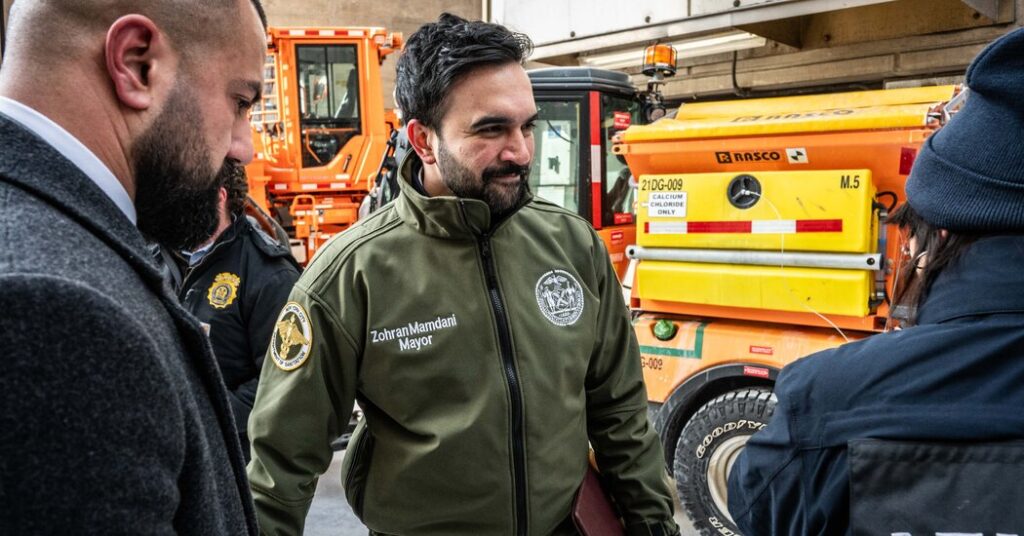
In New York City, a place that traffics in the currency of attention and views and chatter, it stands to reason that City Hall has its first real influencer mayor.
As a storm carpeted the city with more than 10 inches of snow, there went Mayor Zohran Mamdani in a custom jacket, flanked by hulking bright orange sanitation trucks.
To announce the start of the city hiring for lifeguards, the mayor hammed it up, citing the testing requirements while a videographer hit dramatic angles over a buoyant jingle. And in announcing the launch of “rental rip-off” hearings, the mayor posted a flier whose design made the tenant-rights program look as if it had been created by A24 and Supreme.
All this influencing can demand something of a delicate balance between the glossy, light tone of the videos that garner attention and delight and the more serious communication required of someone running the city.
In one video, the mayor announced the start of applications for the summer youth employment program while draped in a bright striped towel; in another, he looked gravely at the camera explaining the city’s free legal resources for immigrants, acknowledging anxieties in the Haitian community over their Temporary Protected Status.
Other major challenges have quickly arisen. He is in the process of coming up with a city budget that fulfills his affordability agenda while heeding a multibillion-dollar gap and of preparing the city for the possibility of immigration crackdowns like those that have already happened in Minneapolis and Los Angeles. And he rushed to expand services for homeless people during a cold spell that led to at least 20 deaths — explaining the rollout in a two-minute video.
“They have a formula that’s working, that gets them eyeballs,” said Joshua Tucker, the co-director of New York University’s Center for Social Media, A.I. and Politics. “It is possible that in these slick videos, you will find one that people think strikes the wrong tone.”
But in crisscrossing New York’s neighborhoods, from Sheepshead Bay in Brooklyn to the Upper East Side of Manhattan, and venues from homeless drop-in centers to Y.M.C.A.s, it seems clear that the videos are finding an audience.
In interviews with more than a dozen people of various ages and backgrounds, many said the videos were inescapable, making it seem like the mayor’s voice is part of their daily routines.
A 17-year-old in South Brooklyn said watching everything the mayor has posted on Instagram makes him feel as if he knew Mr. Mamdani personally; a 65-year-old who is currently homeless said there was a sense of relief in seeing the mayor’s face flash across television screens.
Standing outside in the snow, by the Y.M.C.A. in Sheepshead Bay, Lillybeth Hanson explained that she was not particularly a fan of Mr. Mamdani last year and supported former Gov. Andrew M. Cuomo because she found comfort in his steady television presence during the pandemic.
Ms. Hanson, 69, a retired nursing home worker, said she “woke up with him every morning,” tuning into Mr. Cuomo’s briefings and appearances on “Morning Joe” and Fox News. Now she’s delighted to be feeling that same presence from Mr. Mamdani.
“He’s all over the place, he’s out with the people,” Ms. Hanson said. “He should bring us into Gracie Mansion and let us see him and his wife in action in the kitchen.”
Less than a mile from the mayoral residence at Gracie Mansion, two retired musicians in a community center serving free lunch to low-income aging New Yorkers said they have found Mr. Mamdani’s dispatches to be inescapable. Jose Guevara, 72, keeps stumbling onto videos of the mayor on YouTube; Ronnie Marks, who is in his 80s, listens to Mr. Mamdani on the radio station 1010 WINS. Hearing from Mr. Mamdani so often is endearing to them, and it is also making them antsy for results.
“Free buses — that’s not going to happen!” Mr. Marks said. “He made a lot of promises, but politics is a funny game.”
“As long as he stays away from the high donors, then his credibility will keep increasing,” said Mr. Guevara, who spent decades playing music in the city’s churches. “If I hear any kind of rumor that he went over to the Koch brothers, or over to Park Avenue — forget it.”
Both men are keenly aware that being present and accessible is one thing and delivering results is another. “I don’t want him to be derailed,” said Mr. Marks, who said he says a little prayer for the mayor’s success every day.
Sitting nearby, 90-year-old Glenna Flournoy smiled when she heard the mayor’s name, exclaiming: “Bless his little heart.” Ms. Flournoy likes hearing the mayor talk on television and the radio. But seeing him seemingly everywhere hasn’t made her any less skeptical of whether she will see free buses or safe subways.
“He wants too much of what others wanted but didn’t get,” said Ms. Flournoy, who spent decades working for the city’s Department of Education.
The viral environment surrounding the mayor has even made quasi celebrities of administration officials, many of whom are longtime organizers who built their careers with decidedly non-glamorous rent strikes and policy papers. Recently, Cea Weaver, the newly appointed head of the Mayor’s Office to Protect Tenants, was having a coffee in Lower Manhattan when she was stopped by a fan.
“Are you Cea?” asked Andrea Chalupa, a podcaster who was taking her daughter to a doctor’s appointment.
“Can I get a photo?” Ms. Chalupa continued, nodding to her bundled-up daughter and explaining, “I show her photos of all you guys. This is like meeting Santa Claus.”
Mr. Mamdani is often directly involved in shaping the social media videos that have become, for many New Yorkers, the most immediate gateway to the administration’s goings-on. It was the mayor’s idea, for example, to make the video last month directly addressing Haitian New Yorkers who were worried about immigration crackdowns. He understood that the issue was on people’s minds. A quick iPhone video soon emerged.
After Mr. Mamdani held a news conference on child care that featured a gaggle of toddling, bouncing and bespectacled children, his communications advisers huddled over a crucial question: How would they turn that whimsical chaos into content? An 85-second video followed, chronicling his encounter with “New York’s Cutest.”
There are also, of course, many pockets of the city where people are uninterested in the reams of municipal content and far more concerned about whether the new city leadership is going to leave some imprint on their personal and financial lives.
Nadege Romulus, who lives in Flatbush, Brooklyn, with her two young adult sons and teenage daughter, stays so far offline that she hadn’t followed the news when the new mayor was inaugurated. Snazzy videos, she said, are “not my thing.”
She learned that Mr. Mamdani had taken office when he showed up at her apartment to do a tour, after announcing that his administration was intervening in the bankruptcy case of Pinnacle, her landlord, which had been accused of widespread neglect. She said her measure of Mr. Mamdani’s early performance would be based on a personal metric: whether the cracked tiles in her bathroom will be fixed, a process that’s still underway.
“They started fixing it — painting the walls, putting tiles in the front,” Ms. Romulus, 48, said. “They got a long way to go.”
Emma Goldberg is a Times reporter who writes about political subcultures and the way we live now.
The post Viral Videos Helped Mamdani Win. Can They Help Him Govern? appeared first on New York Times.