For two decades, few corners of global finance were lonelier than the market for Japanese government bonds.
Under the Bank of Japan’s longstanding regime of keeping borrowing costs pinned at zero, yields on the securities, known as J.G.B.s, largely flatlined. Over the years, the few contrarian investors willing to bet that yields might eventually rise were burned so badly that the trade was named the “widow-maker.” In the world’s second-largest government bond market, entire days would pass without a single benchmark bond changing hands.
Those days are gone.
Last month, Prime Minister Sanae Takaichi’s vow to cut taxes sparked anxiety over Tokyo’s ability to service its staggering $9 trillion debt. Yields on the 30-year government bond surged more than a quarter percentage point in a single session, an enormous move in a market where daily changes are typically measured only in hundredths of a point.
The volatility was so profound that Scott Bessent, the U.S. Treasury secretary, called his counterparts in Tokyo seeking reassurances to help steady global markets rattled by the moves. Yields, a benchmark for borrowing costs, jumped again last week after Ms. Takaichi’s party won in a landslide election, which investors viewed as a mandate for her high-spending agenda.
For the broader Japanese economy, the spike signals a potentially grim slide. If yields continue their ascent, some economists and investors warn that Japan risks falling into a “debt trap” — a vicious cycle in which rising interest costs consume so much of the national budget that the government must borrow even more just to pay the interest.
But for J.G.B.s and their veteran traders, the recent movements have generated a return to a level of fervor not seen in decades. After a prolonged professional hibernation, a rare class of traders and strategists — most now in their 60s or older — are finding themselves back in the limelight as global investment firms seek to tap their experience in navigating an environment of actual, moving interest rates.
“It’s becoming a ‘battlefield’ again,” said Hiroyuki Kubota, 67, who dealt Japanese government bonds 40 years ago and has since written several books on the securities. “It’s just like the old days.”
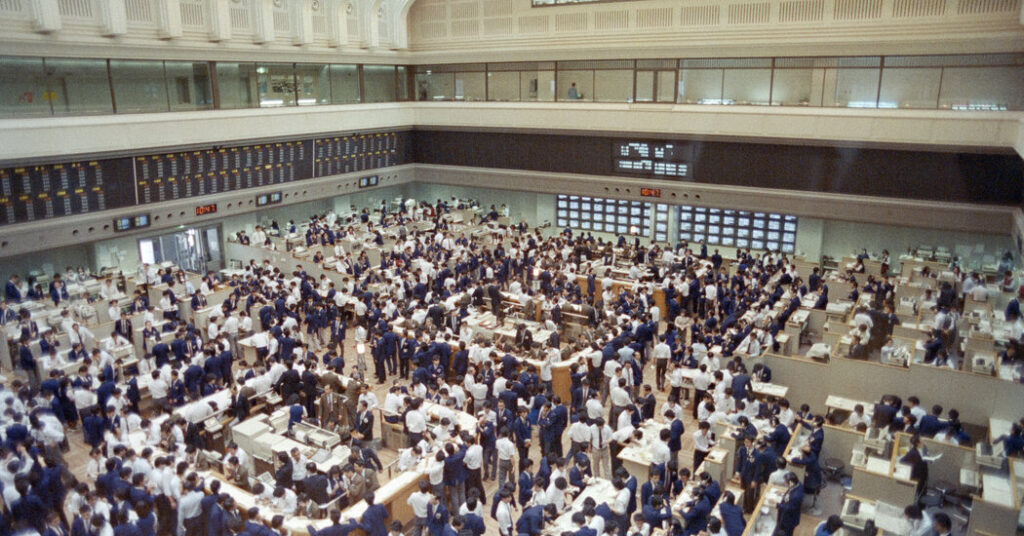
Mr. Kubota began dealing the bonds in 1986, just after a series of reforms meaningfully opened Japan’s government debt markets to global investors. At the time, Nomura Securities, the king of Japan’s bubble-era finance, was hosting boozy, dayslong annual cherry blossom seminars in Kyoto to pitch government bonds to overseas central bankers. The market was booming.
In the 1980s and 1990s, yields shifted rapidly alongside fluctuations in Japan’s overall economy. Yields on 10-year bonds doubled from 4 percent in 1989 to 8 percent in 1990, before falling back to 5 percent by 1992. Investors rushed to profit from the swings. After J.G.B. futures — contracts to buy or sell bonds at a later date — were introduced in 1985, they quickly became the world’s most heavily traded bond futures.
“It was a party,” said Hiromi Yamaji, 70, chief executive of the Japan Exchange Group, recalling the annual Kyoto gatherings of the 1980s. Before assuming his current post at the operator of the Tokyo Stock Exchange, Mr. Yamaji spent 36 years at Nomura. J.G.B.s “were a very lucrative product,” he said. “Everybody was trading them a lot.”
At the time, traders were being wooed by the likes of Goldman Sachs and Salomon Brothers, which were expanding their presence in Tokyo. Top-tier strategists could command compensation packages in the millions of dollars as American firms sought to poach talent from traditional Japanese banks.
Mr. Kubota, the former J.G.B. dealer, started a website in the late 1990s featuring a chat room that he said had attracted market movers and officials from Japan’s Ministry of Finance. He hosted annual parties on a traditional Japanese houseboat, where the elite of the bond world would talk shop while cruising the Sumida River in central Tokyo.
Recent swings in yields “may have been a shock to those who only knew the last 20 years,” Mr. Kubota said. “But to those who know the old days, they aren’t strange at all.”
Paralysis began to set in for Japanese government bonds around the turn of the century.
After the bursting of the Japanese asset bubble and the 1997 Asian financial crisis, the Bank of Japan in 1999 became the first major central bank in recent memory to lower interest rates to zero. As the central bank began buying bonds to force rates down, the 10-year yield hit a record low of less than 0.5 percent in 2003.
For two decades, as policymakers kept rates near zero to combat persistent deflation, yields hardly budged. In 2016, they fell below zero, meaning investors were basically paying to hold the bonds.
“For many, many years, it was a very difficult market,” the Japan Exchange Group’s Mr. Yamaji said. “Nobody had any interest in trading.” With average daily trading volumes tanking, Japan’s local banks, once the most aggressive traders of government bonds, began to close their trading operations. International groups scaled back as well.
Many veterans left high-paying foreign firms like Goldman Sachs or Morgan Stanley. They either “semiretired” or were pushed into less glamorous roles, such as research, at domestic firms, said Yoshiki Kumazawa, a director at Morgan McKinley, a recruitment firm in Tokyo.
“We call it ‘juniorization,’” said Mr. Kumazawa, who compared it to shipping a baseball player who once starred for the New York Yankees off to a Japanese team.
Mr. Yamaji tried to revive the market throughout the 2010s by introducing new trading methods for the bonds, but the stagnation persisted until 2024. That was when a burst of postpandemic inflation led the Bank of Japan to raise interest rates for the first time in 17 years. This prompted a rise in bond yields.
Those yields then spiked higher on Jan. 19, when Ms. Takaichi endorsed a tax-suspension measure estimated to cost more than $30 billion annually. The next day, Japan’s 40-year bond yield broke above 4 percent for the first time since 2007.
Some see the surge as an alarming sign that Japan will struggle to finance its debt.
Kyle Bass, founder of Hayman Capital Management, a Dallas-based hedge fund, was known in the 2010s for his high-conviction bet that Japanese bond yields would eventually skyrocket as the government’s debt load reached a breaking point, a wager widely dismissed as the ultimate “widow-maker.” He acknowledges that the position did not pay off at the time.
Now, with yields rising and Japan’s total debt having risen to a record $8.77 trillion last year, his thesis is becoming harder to dismiss.
“The question is: How do they hold it all together?” Mr. Bass said. Borrowing costs are rising in a number of the world’s largest economies. Japan, however, “is about 10 years ahead of everyone in its financial position,” he said. “I’m afraid of the situation they’re in.”
For others, the commotion is an opportunity. Average daily trading volumes of J.G.B. futures have surged in recent years, and the number of outstanding positions in the market has reached record highs, according to Mr. Yamaji. Global hedge funds have snapped up top local talent, according to Mr. Kumazawa.
Mr. Kubota, the former J.G.B. dealer and well-known bond watcher, said he was concerned about the effect that rising yields would have on Japan’s national budget, but he views the recent volatility more as a “canary in the coal mine” than the beginning of a total crash. At the very least, his annual houseboat party will very likely be injected with more energy, he said.
“It’s feeling like it’ll be even more exciting this year than last,” Mr. Kubota said. “It’s like it’s finally setting in that the era of moving interest rates has returned.”
Kiuko Notoya contributed reporting.
River Akira Davis covers Japan for The Times, including its economy and businesses, and is based in Tokyo.
The post How the World’s Most Boring Market Became a ‘Battlefield’ appeared first on New York Times.