In national political lore, the word — “Hymietown” — still resonates, recalling an infamous incident that ruptured a powerful alliance between Black people and Jews dating back to the civil rights struggles of the 1960s.
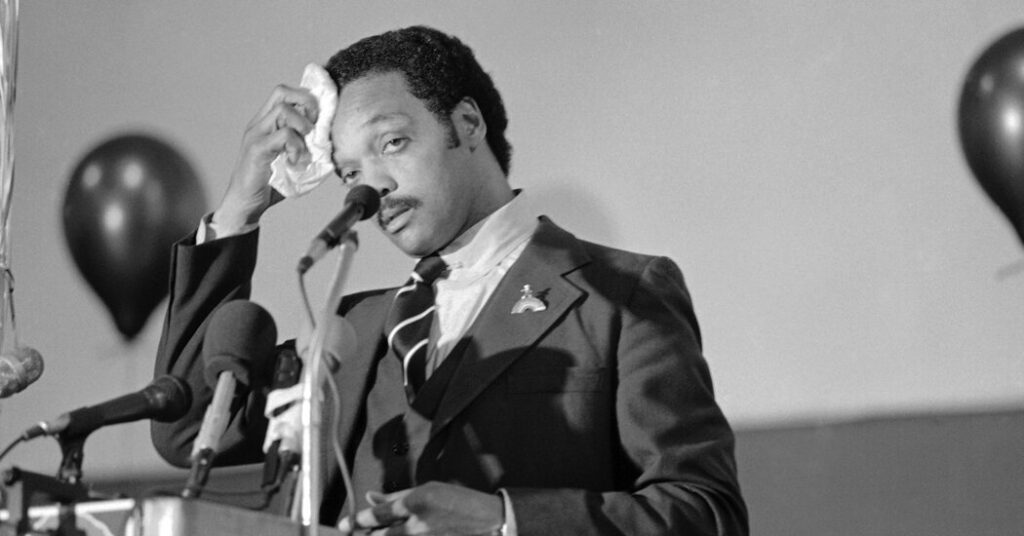
The Rev. Jesse Jackson Jr. was in the midst of his 1984 presidential campaign when he had what he thought was an off-the-record conversation with a reporter for the Washington Post, Milton Coleman. On a shoestring budget and with no institutional support from the Democratic Party, Jackson had created a national, multiracial coalition — the Rainbow Coalition, he called it — that was igniting grassroots working-class support across the nation. The New Hampshire primary was only days away.
And then came the Post report. “In private conversations with reporters, Jackson has referred to Jews as ‘Hymie’ and to New York as ‘Hymietown,’” Coleman wrote.
Jackson initially denied having said it either publicly or privately, hoping the scandal would blow over. But it didn’t. “The fallout really did put the campaign in free-fall,” recalls Donna Brazile, the veteran political strategist who worked on Jackson’s 1984 campaign. “Only Rev. could address it, only Rev. knew what was said and not said. Only Rev. could reassure Jewish leaders. Only Rev. could contain the damage.”
And so he tried, issuing his apology at a synagogue in Manchester, N.H., urging his predominantly Jewish audience to join his coalition. But even Jackson — one of the most stirring and persuasive speakers of modern American politics — could not contain the damage.
“For many Jewish-Americans, Jackson remains frozen in time for that moment,” says Jonathan Kaufman, the author of “Broken Alliance: The Turbulent Times Between Blacks and Jews in America.” “This wasn’t just a parochial event occurring in a small corner of American politics. It really was a seismic event and I think the Democratic Party paid the price for it for years.”
In New York, the word “Hymietown” hit with particular force, not only because of its large Jewish population, but because of its fiercely proud Jewish mayor, Ed Koch, who was not only furious about the remark but also about Jackson’s ties to the antisemitic leader of the Nation of Islam, the Rev. Louis Farrakhan. He called on Jackson to drop out of the race.
It was terrible timing for Jackson, but also for the increasingly precarious political alliance between Black people and Jews. Koch himself had been among the many Jews who had participated in the Black struggle for civil rights: As a young lawyer in 1964, he had gone to Mississippi for eight days to defend civil rights workers who had been registering voters.
But a lot had changed in the intervening two decades. A natural alliance between two largely liberal minority groups, each with a history of discrimination, had come under pressure from the country’s changing political dynamics. In New York City, a 1968 struggle over the control of public schools in largely Black neighborhoods prompted the firing of a group of predominantly Jewish teachers — spurring a citywide strike led by the Jewish head of the teachers union.
During the 1970s, a growing number of Black leaders — including Jackson himself — was becoming more vocal in defense of Palestinian rights. At the same time, a new group of conservative Jewish thinkers — neoconservatives — was emerging, challenging long-held liberal Jewish orthodoxies, including support for affirmative action. The Hymietown remark didn’t create the tension between Black people and Jews; it just made it impossible to ignore.
Among Democrats, that tension has persisted for decades, ebbing and flowing with political currents and events. The era when Jewish and Black leaders worked side by side on the nation’s landmark civil rights legislation has never been recreated. Some national politicians — notably Barack Obama — were able to stitch the coalition back together. But the alliance is under increasing pressure today, as the party fractures over support for Israel.
Jackson ran for president again in 1988. He had tried to make amends with the Jewish community, speaking to numerous Jewish leaders, visiting a Nazi concentration camp, even hiring a Jewish campaign manager, Gerald Austin.
But when he came to New York for the state’s primary that year, Koch was merciless, saying on ABC News’s “Nightline” that “Jews and other supporters of Israel would have to be crazy to vote for Jackson,” words that were inevitably emblazoned across the cover of the next day’s New York Post.
Jackson lost the state’s primary by a 5-to-4 margin to Michael Dukakis, effectively ending his run for president. But he won the city, driving record turnout among voters of color and laying the foundation for the David Dinkins campaign the following year. “We’ve laid a precedent for change in New York,” Jackson told his disappointed supporters in the ballroom of the Sheraton Hotel. They responded with a chant of “Our time in ’89!”
Dinkins was in the ballroom as that chant broke out. And on Jan. 1, 1990, he was sworn in as New York City’s first Black mayor.
Jonathan Mahler, a staff writer for The New York Times Magazine, has been writing for the magazine since 2001.
The post How a Stray Quote of Jesse Jackson’s Led to a Rupture Between Black and Jewish Voters appeared first on New York Times.