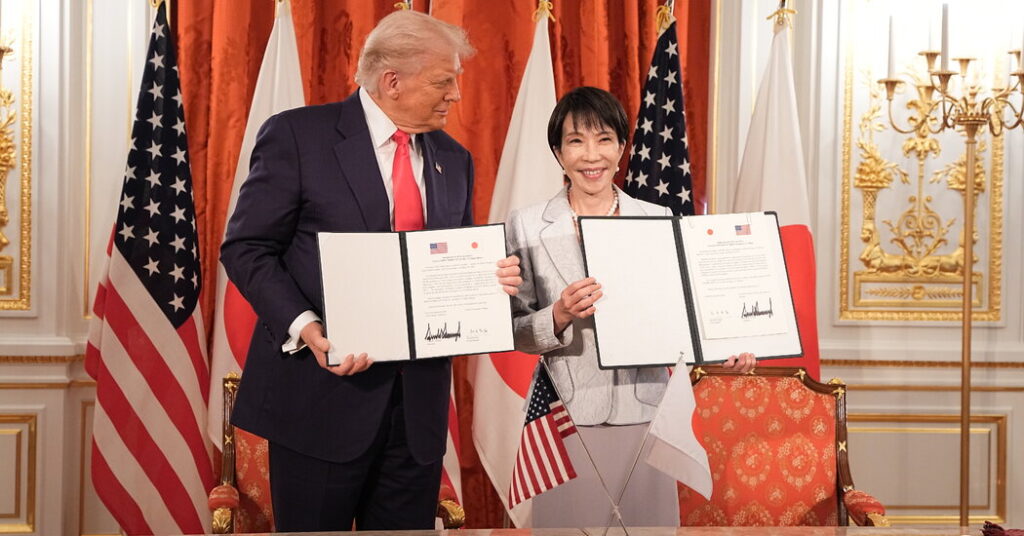
The U.S. government outlined tens of billions of dollars in planned Japanese investments in the United States as part of a trade agreement struck last year, marking the start of a massive pledge that has faced domestic frictions and financing hurdles.
In a statement late Tuesday, U.S. Commerce Secretary Howard Lutnick said Japan would provide capital for three projects: a natural gas plant in Ohio, a crude oil export facility along the U.S. Gulf Coast, and a synthetic diamond manufacturing site. The projects represent a $36 billion commitment and are expected to generate thousands of jobs, Mr. Lutnick said.
The energy and manufacturing projects represent the first phase of funding under a trade framework agreed in July, under which Tokyo pledged $550 billion in funding to U.S.-based projects. In exchange, the Trump administration agreed to impose a 15 percent blanket tariff on Japanese exports — a reprieve from the more aggressive duties it had threatened.
For months, U.S. officials have pressured their Japanese counterparts to move forward with concrete investment plans. For members of the Trump administration, especially Mr. Lutnick, the goal was to maintain momentum following President Trump’s visit to Japan in October.
For their part, Japanese officials were eager to show progress before Prime Minister Sanae Takaichi’s scheduled visit to the United States in March. In an election last week, Ms. Takaichi’s party won in a landslide, and Mr. Trump congratulated the prime minister, wishing her success in her “conservative, peace-through-strength agenda.”
Around the time of Ms. Takaichi’s visit to the United States, Japanese officials are considering making several additional investment announcements, according to two people familiar with the plans.
Japan is aiming to stay out of Mr. Trump’s cross hairs as the country is already feeling the economic ramifications of a prolonged diplomatic dispute with China, Japan’s largest trading partner. Last month, Mr. Trump threatened to raise tariffs on South Korea, saying the country was not moving fast enough to ratify its trade deal with the United States.
Japan “understood there needed to be demonstrable progress,” said William Chou, a Japan expert and senior fellow at the Hudson Institute, a think tank. Without Japan’s investment announcements, “it was uncertain what Trump would have done — whether that was threatening a 25 percent tariff or firing off a few tweets,” Mr. Chou said. “Vibes are good between Trump and Takaichi, so why risk the unknown?”
In a post on social media on Tuesday, Mr. Trump hailed the investments as the formal launch of the U.S.-Japan trade deal. “America is building again,” Mr. Trump wrote. The projects “could not be done without one very special word, tariffs,” he added. Several hours after the president’s posts on Tuesday, Japanese officials had not made their own announcement.
In the months since Mr. Trump’s Tokyo visit, progress on how the $550 billion would be employed had been fitful. Debates have simmered in Japan over how to mobilize such vast sums of capital. Questions have been raised about the plan for the Japan Bank for International Cooperation, a state-owned lender, to serve as the primary financing vehicle for the commitment.
Japan’s economy minister, Ryosei Akazawa, who previously led Japan’s tariff negotiations with the United States, has consistently framed the investments as a “win-win” for both countries. Yet a different sentiment prevails within some business and state-backed finance circles, where the projects are often described as “strategic but less than bankable.”
During Mr. Trump’s visit to Japan in October, officials at a high-profile dinner in Tokyo teased more than a dozen projects that Japanese companies were said to be considering for financing. Mr. Trump hosted a roll call of company officials to shake his hand and pose for photos, holding up signs with details of their projects. Some senior Japanese executives at the companies involved said they learned of the details of their pledges for the first time that evening.
Japan’s investment decisions have also been complicated by an impending Supreme Court decision, expected in the coming months, about whether Mr. Trump exceeded his authority in using a 1970s law known as the International Economic Emergency Powers Act to impose tariffs on dozens of U.S. trade partners.
For Japan and many other nations, the threat of tariffs was a key motivator to pledge investments in the United States. That remains true even as officials, including those in Japan, seek to portray the investment decisions as purely strategic, according to David Boling, a principal at the Asia Group, a strategic advisory firm.
“Would they be doing this normally? Probably not,” Mr. Boling said. But for Japan, keeping the U.S.-Japan trade relationship in a good place is clearly the priority, he added. Strategic or not, he said, “there are other more compelling reasons to be doing this.”
River Akira Davis covers Japan for The Times, including its economy and businesses, and is based in Tokyo.
The post Trump Hails Japan’s First Batch of U.S. Investments appeared first on New York Times.