The Rev. Jesse Jackson’s death comes at a moment when Black voters are hugely influential within the Democratic Party and there are more Black senators than ever before — yet the future of Black representation in the House of Representatives is uncertain.
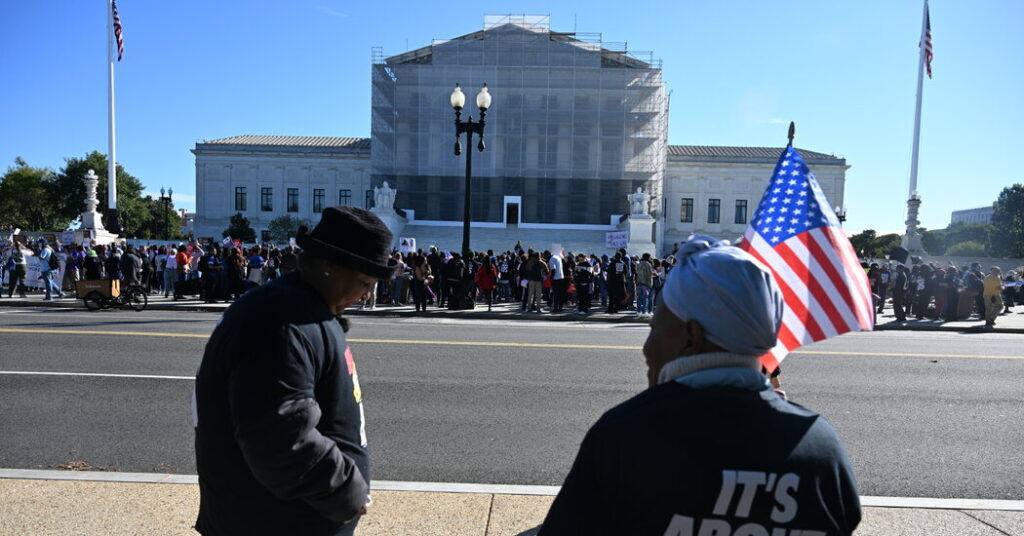
The Supreme Court is set to rule in the coming months on a case that will determine the fate of a key provision of the Voting Rights Act of 1965, the federal law that undergirds Southern Black representation in the House. In arguments last fall, the conservative-leaning court seemed skeptical of a key provision of the law, a signature achievement of the civil rights era.
Black voters overwhelmingly support the Democratic Party, despite President Trump’s notable gains with them in 2024, and some Democrats and Black faith leaders argue that the country is going backward on civil rights.
“We are witnessing right now in real time the kind of attack on voting rights that really does harken back to the darkest days of the civil rights struggle,” Senator Raphael Warnock, a Georgia Democrat and the pastor of the historic Ebenezer Baptist Church in Atlanta, said on Tuesday. “I owe it to Rev. Jackson, and we owe it to the next generation, to pass voting rights and ensure that we level the playing field so that every voice can be heard in our democracy.”
Some conservatives say that decades of rising political power for Black Americans mean that old legal and policy interventions like the Voting Rights Act are no longer necessary.
During oral arguments in the case in October, Justice Brett M. Kavanaugh said that “this court’s cases, in a variety of contexts, have said that race-based remedies are permissible for a period of time — sometimes for a long period of time, decades in some cases — but that they should not be indefinite, and should have an end point.”
Some Black Republicans, however, have voiced support for the civil rights legislation.
“I think the Voting Rights Act is very important — it’s an important part of our history,” Ben Carson, a housing secretary in the first Trump administration, said in an interview. “We should unite around that fact and not let ourselves be divided.”
Mr. Carson, who said that he had met Mr. Jackson while still a surgeon and that the civil rights leader had been an early supporter of his books, added: “What’s necessary is that Americans have their voting rights protected, all Americans.”
For Democrats, defending the voting rights of Black Americans is also about politics.
The influence of Black voters in Democratic presidential primary contests is undeniable: In 2008, 2016 and 2020, Southern states where the primary electorates are dominated by Black voters swung heavily toward the party’s eventual nominees.
In those primary races, Black voters in South Carolina and then across the South helped lift Barack Obama, Hillary Clinton and Joseph R. Biden Jr. to victory, thwarting Mrs. Clinton in her first run, Bernie Sanders and then Mr. Sanders again.
In each case, Black voters were pragmatic, said Jaime Harrison, a former chairman of both the Democratic National Committee and the South Carolina Democratic Party, choosing a candidate they believed had the best chance of winning the general election.
And now, before the order of states has been set for the 2028 primary contest, a parade of would-be White House hopefuls have made their way to South Carolina. Govs. Gavin Newsom of California and Andy Beshear of Kentucky, Senator Cory Booker of New Jersey, Representative Ro Khanna of California and others have visited the state in recent months with an apparent eye on ingratiating themselves with its largely Black primary electorate.
“You’ve seen it election cycle after election cycle,” Mr. Harrison said. “The Black vote has been determinative in the presidential primary. As the first domino falls in South Carolina, it falls the same way across the rest of the South.”
Of the 11 Black people ever elected to the Senate, five are serving now: Mr. Booker, Mr. Warnock and Senators Angela Alsobrooks of Maryland and Lisa Blunt Rochester of Delaware, both Democrats. Senator Tim Scott of South Carolina is the lone Black Republican senator.
Ms. Alsobrooks said in an interview on Tuesday that there was “responsibility and pride” in knowing that she is part of the largest group of Black senators to ever serve together.
She said the impact went beyond policies debated on the Senate floor. She recalled a day last summer when she arrived after having had her hair braided.
“I went to walk onto the Senate floor, when one of the U.S. Capitol Police officers stopped me, and he was thrilled,” she said. “He said, ‘Can I please take a photo with you?’” She added, “He had been in that building for many years and said, ‘Do you know you’re the first person to have ever stepped on the floor of the United States Senate with your hair in braids?’”
The provision before the Supreme Court, Section 2, prohibits election or voting practices that discriminate on the basis of race. That guidance has led to the creation of majority-minority districts that are meant to help voters of color elect candidates of their choice.
If the court fully struck down the provision, Democrats could lose about a dozen majority-minority districts across the South, according to an analysis by The New York Times. Many of those seats are currently held by Black lawmakers.
Even before the Supreme Court ruling arrives, several Republican-led states have already eliminated districts with Black House representatives during the nation’s current gerrymandering battle.
In Texas, Representative Marc Veasey, a Democrat, announced he would not run for re-election after he was drawn out of his seat. Representative Al Green, another Democrat, was drawn out of his longtime district and will now run for a different seat in a March primary race. In North Carolina, Representative Don Davis will have a much more difficult re-election fight after the state redrew its maps in October. And in Missouri, a new map threatens the re-election chances of Representative Emanuel Cleaver, a Democrat who has spent 20 years in Congress and was the first Black mayor of Kansas City.
This century, the Supreme Court has chipped away at the Voting Rights Act.
In 2013, the court struck down another key provision, Section 5, which required states with a history of racial discrimination at the polls to obtain federal approval before changing voting laws. Chief Justice John G. Roberts Jr. wrote in the opinion that “things have changed dramatically” since the law’s adoption decades ago.
During oral arguments on the current Voting Rights Act case, Hashim M. Mooppan, a principal deputy solicitor general in the Trump administration, said that many Black members of Congress now hailed from districts that were not majority-minority. “None of these positions is going to lead to there being no Black representation in Congress or anything remotely approaching that,” he said.
But civil rights leaders contend that the legal erosion of the Voting Rights Act will hurt Black Americans’ political power.
“So here we are, Jesse Jackson dies today, and we have less voting rights protection under the Voting Rights Act than we had on Aug. 6, 1965,” said Bishop William Barber II, a civil-rights leader.
Eric H. Holder Jr., an attorney general in the Obama administration, said that Mr. Jackson’s legacy was under attack at the Supreme Court.
“Leaders like Reverend Jackson were cleareyed about the fact that, without legal protections, we would never have been able to move past the discriminatory voting practices that were perpetrated with impunity and without legal recourse,” Mr. Holder said in a statement.
He added, “Reverend Jackson’s life and legacy are a reminder that hard-fought victories must be protected and that each generation has a role to play in fighting for equality and justice.”
Reid J. Epstein is a Times reporter covering campaigns and elections from Washington.
The post Jackson’s Death Arrives at a Crucial Moment for Black Political Power appeared first on New York Times.